















By Rose Namayanja Nsereko
After taking over power in January 1986, the NRM government
published a political manifesto drawn up in the days when the NRM
was an army of anti-government rebels. The Ten-Point Program
emphasized the importance of economic development, declaring that
an independent, self-sustaining national economy was vital to Uganda’s
interests. The manifesto also set out specific goals for achieving self-
sufficiency by diversifying agricultural exports and developing industries
that would use local raw materials to manufacture products necessary
for development. It also set out to improve basic social services,
including water, health care, and housing; improve literacy skills
nationwide; eliminate corruption, return expropriated land to its
rightful Ugandan owners; raise public-sector salaries; strengthen
international ties in the region; develop markets among East African
nations; and maintain a mixed economy combining private ownership
with an active government sector. The NRM government proposed a
major Rehabilitation and Development Plan (RDP) for fiscal years 1987-
88 through 1990-91 with IMF support.This four-year plan was intended
to stabilize the economy and promote economic growth. Other goals
were to reduce Uganda’s dependence on external assistance, to
diversify agricultural exports, and to encourage the growth of the
private sector through new credit policies.
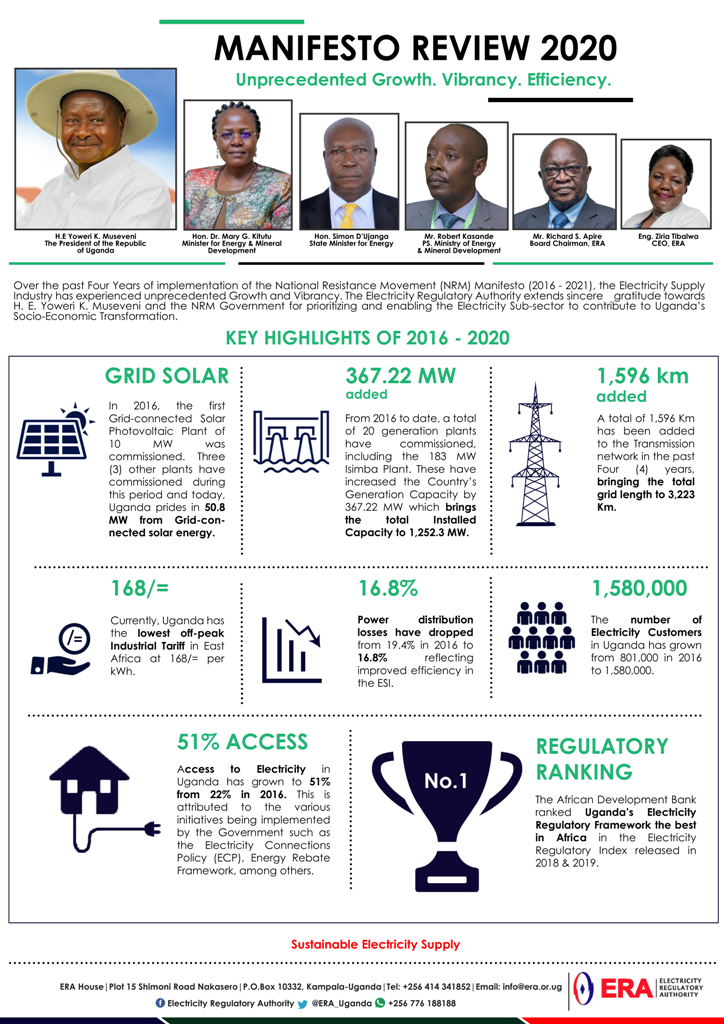
So the different NRM manifestos have been looking at how social
services can be brought near to its people for example the 2016
manifesto focused on taking Uganda to modernity through job creation
and inclusive development, 2011-prosperity for all: better service
delivery and job creation, 2006 prosperity for all, 2001-consolidating
the achievement and 1996-tackling the tasks ahead.
Economic growth has been impressive since 1986 through the priority
guidelines by the NRM manifestos and dedicated leadership of the
NRM GDP was $246m by 1986, $6.046b in 1996 and 25.7billion in 2017,
inflation 240% in 1986 and 5.7% 2017. Agriculture has dominated the
economy, with cottonand coffee(in 1986-160,000 tonnes compared to
4 million bags in 2017 generating $452millioncomprising 76% of
exports, dairy 395 million litres in 1986 to 2.2billion litres in 2017,tea
3,335 litres in 1986 to 58 million bags per year generating $130 million.
Uganda has joined forces with Kenya and Tanzania to form the East
African Community, with the intention of creating a common market
for our Agricultural produce.
Key sectors have greatly witnessed a drastic and tremendous outward
shift. The main sector include health, education, transport, energy and
security
On transport, tarmac roads have increased from 1200km in 1986 to
nearly 5000km today in the whole country. This has eased movement
and doing business. The NRM hopes that in the next few years, 2000km
of new roads will be constructed this will lead to about 6ookm of roads.
Rehabilitation and reconstruction of some sections of the national
roads and turning them into dual carriages is also expected soon.
This above has seen all the county’s borders connected by tarmac
roads. This has led to a boast in trade. The roads from Nimule-Busia-
Katuna and DRC boarders are all in very good conditions.
On health sector, the NRM Government has constructed 3549 health
Centre II in the whole country. By 1986, there were only 89 health
centre IIIs but they are now 1379, 81 district hospitals have increased to
- This has improved the access to medical care and treatment. Out
of the 2547 hospitals, government operates 1708, Non-Government
Organization 559, individuals run 280 health facilities. There are 2
national referral hospitals (Mulago and Butabika) and 10 regional
referral hospitals.
Life expectancy has increased from 48.13 in 1986 to 59.18 today. Infant
mortality rate has dropped from 113.41 per 1000 births in 1986 to
57.4o per 1000 births in 2005. Mortality rate dropped from 438 per
100000 births in 2011 to 336 death per 100000 in 2016.
The Education sector has seen several policy changes including
liberalization of the sector, introduction of USE, UPE, which have
greatly increased enrolment in schools. Teachers have increased from
74000 in 1995 to 200,000 currently, schools have increased from 12500
in 2000 to 25,000, classrooms increased from 68,000 to 170,000,
universities have increased from 1 in 1986 to 11 as of now and 40
private universities are licensed as a result over 400,000 Ugandans
graduate every year.

The East African Community was revived in 2000 and regional
integration has made significant strides since then. A customs union
and common market have been introduced. Among other benefits,
regional trade has been shown to promote regional peace and bring
economic development to border areas. Further integration, such as
greater transport connectivity, has offered important advantages.
Continued growth of the services sector is being promoted. Attention is
given to supporting manufacturing sector growth as it has the potential
to create many low-skilled jobs.Easing the constraints faced by small
and medium sized enterprises is helping to facilitate firm growth,
increase productivity, and raise manufacturing’s contribution to GDP
and exports.
To increase Ugandan firms’ competitiveness, production capacity is
being raised through training programmes and by matchmaking
domestic suppliers with foreign firms.
The NRM Ugandan government under the leadership of H.E President
Museven has played an important role in supporting these efforts and,
with government commitment, considerable economic gains have been
be achieved.
The writer is National Treasurer, NRM