














By Our Reporter
President Yoweri Kaguta Museveni has reiterated that empowering women has been a deliberate focus of his administration since the National Resistance Movement (NRM) came into power.
“I want to thank the Ambassador of Sweden for admitting that Uganda is more democratic than many of the European countries, and this is what we have been telling them because for us, it was an ideology from the beginning. When we were empowering women, it was deliberate. When we defeated Idi Amin in 1979, I recruited women for our FRONASA. But when it came to the integration, our other partners in the system refused to absorb our women, and they had to be dismissed and go home. We brought them back when we were in charge now in 1986, when we were able to admit them in the army,” Museveni saidduring the celebration of the International women’s day in Kyankwanzi District.

The day was held under the theme “Accelerate Action for Gender Equality,” which calls for bold and strategic interventions towards a gender-equal future.
Museveni’s comments were triggered by a speech delivered by the Ambassador of Sweden to Uganda, Maria Håkansson, who recognized Uganda’s significant progress in achieving the Beijing Declaration and Platform for Action and recognized that women’s rights are human rights.
“In Uganda, women’s leadership and economic empowerment have expanded, and legal frameworks have been strengthened to protect women and girls, and Uganda is one of the countries that other nations are learning from. We commend the government of Uganda for its commitment to advancing gender equality, and we see the progress in increasing women’s representation in leadership, Ambassador Håkansson said, adding that Sweden is still way behind Uganda when it comes to women representatives in political positions.
“So, I’m glad the Ambassador of Sweden set the record straight by saying that Uganda has made more progress in some areas than many of the European countries,” Museveni said, while referring to Ambassador Håkansson as one of the few truthful individuals.
The President, however, advocated for the emancipation of the whole society through free education, which was introduced in Uganda in 1997.
“We have moved very well, but we could have moved even more if we had implemented initiatives including free government education. We brought free education to government schools through USE and UPE, but some local people ask learners for money at those schools. If that one had worked, many girls would have gone through education without being interrupted,” he said, while emphasizing empowerment roots such as wealth creation through various government programs and the technical skills offered in the presidential skilling centers across the country.
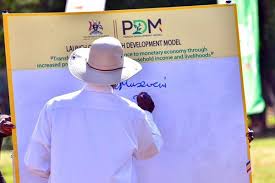
Museveni encouraged the gathering to make good use of the Parish Development Model (PDM) to get out of poverty and the Four-Acre Model as strategies to transition their households from subsistence farming to commercial agriculture.
About the environment, President Museveni blamed the long dry spell on mistakes by some individuals who encroach on the natural resources. He discouraged activities such as deforestation and wetland encroachment, which contribute to environmental degradation.
“Damaging the environment will cause us a massive catastrophe. And you can see how harsh this dry season is. It is not only here; it is in other parts of Africa, but I think it is accentuated by the damaged environment here because, normally, although there is bad weather, normally, here we get our local relief because of the local water bodies,” Museveni stated.
In her remarks, Vice President Jessica Alupo Rose Epel hailed President Museveni as a champion of women’s emancipation.
“Through your strategic and visionary leadership, the women of Uganda are the biggest beneficiaries of the prevailing conducive environment for growth, including peace and security, infrastructure development, energy development, and others. You’re the first president in the whole of Africa to name a woman as a vice president,” Alupo said, adding that right from the villages up to the national level, women have been given a voice, which has enabled them to be heard and participate in strategic decision-making processes.
On the other hand, the minister of Gender, Labour, and Social Development, Betty Amongi, underscored the importance of affirmative action as crucial in motivating young girls to pursue their education.
The Chairperson of the National Women Council Hajjat Faridah Kibowa expressed gratitude for the many government programmes in place, such as the Uganda Women Entrepreneurship Programme, the Parish Development Model that has supported income-generating activities at the household level, and the Presidential Skilling hubs. They are already producing skilled young women and men who are already competitive in the labour market.
“I have witnessed the ability of these young people to participate in the production value chain competitively. We thank you for instilling hope in the young people, especially the girls, most of whom are school dropouts and single mothers. These single mothers are imprisoned by men, who later abandon them because they don’t want to be responsible,” Kibowa noted, adding that during their tenure of office as the National Women’s Council, they have registered a significant increase in the budget for the Women’s Council that has facilitated the popularization of the roles of women leaders and grassroots women, mobilizing them to participate in government programmes and equipping them with life skills.
Kibowa, however, reported the persisting challenges, such as gender-based violence, teenage pregnancy, female genital mutilation, and child marriages, which undermine the gains made in terms of women’s empowerment.
“It is important that these issues are addressed to further advance gender equality in Uganda,” she said.
United Nations Resident Coordinator Leonard Zulu called for collectively redoubling efforts in advancing sustainable development goal five on gender equality with just five and a half years remaining to achieve the sustainable development goals by 2030.
“Let us commit to working together to accelerate old actions to promote gender equality and women’s empowerment in Uganda,” Zulu said, while highlighting how the UN efforts have made a difference in ensuring food security and resilience in areas such as Kaabong in Karamoja, where the Women’s Farmers Association improved agronomic practices and marketing.
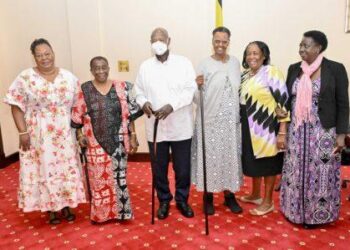
The First Deputy Prime Minister and Minister for East African Community Affairs, Rebecca Alitwala Kadaga, was among the notable Ugandans who were awarded medals for exceptional service.
Rebecca Kadaga has had a distinguished political career, serving as Uganda’s first female Speaker of Parliament from 2011 to 2021. She has been an advocate for women’s rights and has held various ministerial positions.
International Women’s Day has its origins in the struggle by women for social change and to be able to participate on equal terms with men in social, political, and economic processes. In 1975, the United Nations (UN) declared an International Women’s Year and recognized March 8th as a day upon which all member states should recognize and honour women. International Women’s Day was first celebrated in Uganda on 8th March, 1984, at State House Entebbe, and since then this remarkable day has been commemorated and celebrated every year.