
















By James Asingwiire
Energy is one of the essential sectors that underpin the country’s development trajectory under the vision 2040 and the National Development Plan. The sector is among those which gobbled a lion’s share in the 2019/20 budget receiving more than 3trillion.
According to Eng Irene Muloni the minister for energy and mineral development, the major priorities in the Energy Sector are to; increase generation capacity, expand the transmission and distribution networks for local and regional integration, increase access to modern energy services through rural electrification and renewable energy development; promote energy efficiency; guarantee energy security; and promote industrialization through energy affordability.
“We have put in place the necessary reforms with good policies, legal, regulatory and institutional frameworks which have already attracted foreign direct investment and allowed private sector participation. Over 70 per cent of our electricity is generated with private sector involvement,” she told The Public Lens.
Uganda is also endowed with numerous natural resources such as biomass, water, solar geothermal, wind, oil, mineral and gas resources. Of all these, water and biomass are the most significantly utilized; these two resources contribute a great deal to meeting the Energy demands of Uganda’s population.

However, the uneven use of available resources has led to insufficient supply of energy, a situation which is aggravated by consumers’ mostly inefficient use of the little energy that is available. It has further placed the country among the lowest consumers of modern and clean energy, both in sub-Saharan Africa and the world.
“To combat this, and in line with its mandate, the Ministry of Energy and Mineral Development conducts Energy Week, an annual awareness campaign. Energy Week aims to sensitize the public about efficient utilization of energy and alternative modern forms of clean energy,” Muloni said.
To increase access to modern forms of energy, considerable financial and human resources will be needed. These will include resources both from the public and the private sector. The major opportunities for the private sector includes the following; Participation in developing renewable energy projects (hydro, solar, geothermal, biomass, wind) to meet the growing demand of power; Financing of renewable energy projects; Consultancy work on studies and designs; Engineering, Procurement, and Construction (EPC) of the planned generation, transmission and distribution projects among others.
“Uganda has put in place a conducive investment climate and welcomes the business community to invest in the energy sector. The numbers in Uganda’s energy sector speak for themselves: the country is without a doubt the next energy investment destination,” said Muloni.
Uganda aims to grow installed capacity from 868MW to 4100MW, 2002km of transmission lines and 100 per cent of household electrification all by 2030, as part of projects worth USD92 billion. Furthermore, IPPs account for 58 per cent of generation capacity which is set to grow as a number of renewable energy projects develop.
Impressive statistics
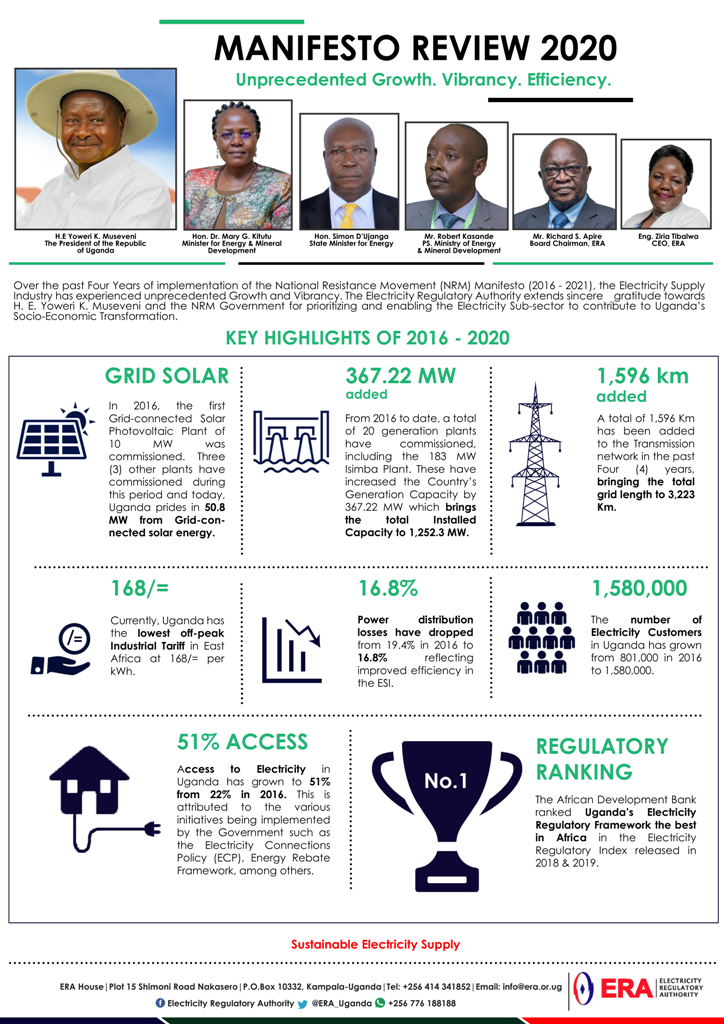
Some current statistics about the Ugandan power sector and development plans include: Grid expansion is set at 1.42 million, new rural connections by 2030 to connect 570, 000 rural households – a USD 6.2 billion project, Uganda has commissioned a 10MW solar power plant, the largest in East Africa. The country has a strong focus on renewable energy going forward with renewable energy share goals of 96% by 2030 and 100% by 2050. From 2011 to 2015, USD 274.96 million was invested in clean energy in Uganda.
The country is also targeting a combination of on-grid and off-grid power generation through 2030 with a projected connected 11,097GWh to 14,080GWh and an off-grid projection of 233GWh to 267GWh. Uganda’s solar PV market is rapidly growing with government incentives such as tax breaks and consumer subsidies aimed at attractive private sector investment and a geothermal resource potential of 450MW.
In a recent World Bank study on the “Financial Viability of Electricity Sectors in Sub-Saharan Africa”, Uganda was reported as one of only two countries (together with Seychelles) who have a financially viable electricity sector. According to the study, “although these results should be looked at in context, these two countries have continued to display good operational performance. Uganda has made substantial progress in reducing transmission and distribution losses.”
In 2016 access to electricity had more than doubled from 7.8% to 20.4% in Uganda since 2002.
A great deal of state investment has been allocated to the Rural Electrification Programme. Hydropower, harnessed from energy generated by the Nile River, is a key part of the country’s power generation programme, with several projects currently in development. Hydro power generation capacity had increased to 830 Mega Watts from 596 Mega Watts in 2010. In addition, the number of distribution connections increased by 143,000 to 790,000, an annual increase of 13 per cent.
The government undertook the construction of the Karuma Hydropower Project, worth about UGX 4.3 trillion (USD 1.7 billion). Eighty-five per cent of the funding is procured by a Chinese firm with a soft loan from the China Exim Bank and the Uganda government will provide the remaining 15%.
The Ayago Power Station is a 600MW hydroelectric power plant that will be constructed on the Victoria Nile, downstream of Karuma Power Station but upstream of Murchison Falls. The project will be developed in two simultaneous phases, known as Ayago North (estimated capacity: 350MW) and Ayago South (estimated capacity: 250MW).In August 2013, a previous award was rescinded and the construction contract was awarded to China Gezhouba Construction Company. Similarly, work towards the construction of power projects on the rivers Ndugutu, Sindila and Nyamagasani has commenced.
The switching on of Bujagali, Karuma and Isimba has brought the total installed capacity to 1,182Mw.