
















Inside a four-day retreat in Kampala, Permanent Secretary Vincent Bagiire Waiswa is rebooting the way Uganda’s diplomatic missions understand their job — and making clear that the era of beautiful reports about busy schedules is over
The Man Behind the Mandate
There is a particular kind of public servant who treats every institution they enter as a system in need of redesign.
Vincent Waiswa Bagiire is that kind of public servant.
His career reads less like a conventional civil service trajectory and more like a serial reformer’s biography — an entrepreneur at 22, a social innovator, a lawmaker, a digital policymaker, and now the man tasked with transforming Uganda’s foreign missions into engines of national economic growth.
He holds a BSc in Computing and Information Technology from the University of Derby, a Bachelor of Laws from Robert Gordon University in Aberdeen, an MBA with Honours from Glasgow Caledonian University, and an MSc in Macroeconomics from the University of Bradford.
He founded the Centre for International ICT Policy for East and Southern Africa, was elected an Ashoka Fellow for life in 2008, and served on a 32-member team appointed by President Museveni to shepherd Uganda’s economic development in the Fourth Industrial Revolution.
He is an Archbishop Desmond Tutu Leadership Fellow, an alumnus of the World Economic Forum’s Young Global Leaders programme, and has studied at Oxford, the Lee Kuan Yew School of Public Policy in Singapore, and Wits University in South Africa.
Before his appointment to the Ministry of Foreign Affairs, Bagiire served as Permanent Secretary in the Ministry of ICT and National Guidance, where he formulated the National ICT Policy 2020, enacted the Data Protection and Privacy Act, and supervised the expansion of the National Backbone Infrastructure that extended internet connectivity to districts across the country.
He was appointed Permanent Secretary at the Ministry of Foreign Affairs in July 2021, carrying his reformer’s instincts with him into the protocol-laden world of diplomacy.
In April 2026, he received the prestigious Responsible Investment Global Award as Uganda Foreign Policy Champion for 2025-2026 — recognition of a tenure defined by the Ministry of Foreign Affairs winning the AIM Investment Award in 2025 and of his work promoting Ugandan exports including vanilla, fresh produce, and the electric buses produced by the Kiira Vehicle Plant, with the UAE emerging as a significant new market.
The Strategy and Its Gaps
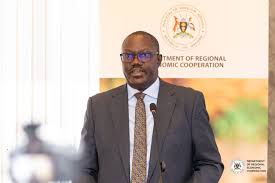
When Bagiire opened a four-day retreat at the Mestil Hotel in Kampala on Monday, under the title “Strengthening Institutional Collaboration for Effective Economic and Commercial Diplomacy Implementation,” the occasion was the most detailed public accounting yet of what Uganda’s embassies have actually delivered — and where the work is falling short.
Uganda’s Economic and Commercial Diplomacy Strategy for FY 2025/26–2029/30, launched in August 2025 in Gulu, repositions diplomatic missions as frontline delivery platforms for exports, foreign direct investment, tourism, science and technology partnerships, and climate finance.
The strategy had been designed to address longstanding weaknesses: weak inter-agency coordination, inadequate market intelligence, limited accountability for results, and overstretched diplomatic coverage — gaps that had caused missed opportunities and wasted public resources.
The retreat brought together the Ministry of Foreign Affairs, heads of Uganda’s missions abroad, several government ministries and agencies, and the Uganda Investment Authority to assess three years of work under the strategy.
It was convened specifically by the Ministry’s Department of Regional Economic Cooperation to work through bottlenecks and agree on coordination mechanisms that would directly support Uganda’s private sector producers and exporters.
Activity Is Not Enough
Opening the meeting, Bagiire told delegates the strategy itself was sound but its execution needed to change fundamentally.
He praised Uganda’s overseas missions for their consultative work, but said the government could no longer measure success by the number of events held or meetings convened.
Missions, he said, needed to move from activity to outcomes, backing their work with solid statistics and proper documentation rather than anecdote.
This was not the first time he had said it.
Speaking during a mid-term review retreat in Frankfurt, Germany, for Uganda’s 13 missions in Europe and the Americas, he had put the same instruction in starker terms.
“Uganda is at a moment where diplomacy must be felt not only in communiqués and meetings, but in factories opened, tourists received, exports increased, and jobs created back home,” he told assembled Heads of Mission.
He recalled that in Financial Year 2025/26, 34 Ugandan missions abroad received funding amounting to Shs113.25 billion, and made clear that future funding would be tied to measurable results — evaluated through a tiered decision matrix covering past performance, delivery capacity, strategic relevance, economic potential, and diaspora engagement.
At Mestil, he announced that the Ministry has set up an ECD Operations Hub, designed to automate coordination between missions abroad, Ministry headquarters in Kampala, and the domestic agencies whose cooperation the strategy depends on — a structural fix for a problem that has undermined the strategy since its inception.
He also pressed missions to sharpen their annual work plans and to publicise Uganda’s opportunities more aggressively in coordination with the Ministry’s public diplomacy department, arguing that visibility abroad was as important as the deals themselves.
He linked the entire effort to Uganda’s wider ambition of a tenfold expansion of the economy and to Vision 2040.
Ambassador Richard Kabonero, who heads the department running the strategy, called the past year the department’s most productive yet and described the retreat as a chance to take stock before the new financial year beginning in 2026/27.
What Uganda’s Embassies Have Been Doing
The retreat produced a series of mission-by-mission presentations that offered a granular and sometimes sobering picture of Uganda’s commercial diplomacy in practice.
Uganda’s mission in South Sudan placed Uganda third by output among EAC’s eight members, behind Kenya’s roughly $147 billion economy and Tanzania’s $95 billion — within a regional bloc that collectively produces about $435 billion annually and covers 355 million people.
The mission identified a persistent coordination gap between what Uganda’s public institutions promise investors and what its private sector can actually deliver, describing it as a primary reason the country has not converted its regional standing into greater trade volumes.
The most detailed account of commercial diplomacy at work came from Uganda’s mission in Geneva.
Deputy Permanent Representative Arthur Kafeero, whose post carries dual accreditation to the Swiss government and to more than 40 international organisations including the World Trade Organization, described a mission built around high-end tourism, agro-industrial trade, sport-linked marketing, and multilateral advocacy.
Geneva counts 16 billionaires and roughly 90,000 millionaires; Zurich has 12 billionaires and about 99,300 millionaires.
Swiss residents spent an estimated 19.3 billion francs — roughly $24 billion — travelling abroad last year.
The mission argued that securing even a modest fraction of that market, at $50,000 to $250,000 per trip for premium safari packages, would transform Uganda’s tourism earnings from Swiss visitors.
Mission staff reported that bookings were already being landed this year, including multi-week itineraries to Uganda and Rwanda, with some travel agents now placing repeat business for 2027.
The mission’s central frustration, however, is the absence of a direct flight: Uganda drew only 107 Swiss visitors in 2024, and airlines require a minimum of 550 one-way passengers a week for at least four months before considering a new route.
On trade, Geneva officials pointed to Switzerland’s position as a global coffee trading hub — home to Sucafina, whose Ugandan subsidiary UGACOF is the country’s largest coffee exporter, and to Nestlé, the world’s largest coffee and chocolate manufacturer — as Uganda’s strongest existing commercial bridge to the Swiss economy.
The Nigeria Challenge
A less optimistic picture came from Uganda’s mission in Abuja.
Nigeria’s economy, at roughly $334 billion, is nearly five times Uganda’s, and its population of 236 million anchors a wider ECOWAS market of 442 million people.
Yet Uganda’s recorded exports to Nigeria totalled only about $34.6 million — led by tobacco at $17.2 million and pharmaceutical products, mainly antimalarials and antiretrovirals from Quality Chemicals, at roughly $11 million.
Dr. Omara Sam attributed the shortfall to long shipping distances, currency restrictions, import quotas, licensing rules, and what he described as the unreliability of Uganda Airlines’ service on the route, alongside supply-side weaknesses at home.
Proposed solutions included fuller use of Uganda’s African Continental Free Trade Area commitments, bilateral negotiations, free trade zones, bonded warehousing, and increased trade missions in both directions.
What Uganda Is Selling
Framing the investment side of the strategy, the Uganda Investment Authority told the retreat that Uganda attracted US$3.5 billion in foreign direct investment in 2025, while tourism generated US$1.5 billion from 1.64 million international visitors.
Its project pipeline runs into billions: $7 billion for mining and mineral processing, $5.1 billion for hydropower, and agro-processing proposals ranging from a $60 million instant coffee plant to a $97 million fruit-processing factory.
The authority’s one-stop centre has helped allocate land to 514 companies across Uganda’s industrial parks, of which 199 are operational, employing more than 100,000 people and drawing close to $3 billion in capital investment.
Diplomacy That People Can Feel
The retreat’s first day closed with a candid session in which mission heads aired their frustrations directly — an unusually honest forum within the typically guarded language of diplomatic reporting.
The instruction that has emerged from Bagiire’s entire year of engagements — at Kampala, Frankfurt, Istanbul, Mombasa, and Gulu — is consistent and uncompromising.
Bagiire stressed that diplomacy should impact everyday Ugandans — from farmers in Kabale to innovators in Kampala — by transforming diplomatic presence into measurable economic value.
For a man who built his career on the conviction that institutions must be held accountable for results that ordinary people can feel, this retreat is less a one-off review and more a declaration of intent.
Stop counting meetings.
Start counting money.
That is the Bagiire doctrine — and Uganda’s ambassadors are now on notice to deliver it.