
















By Ismail Kibedi
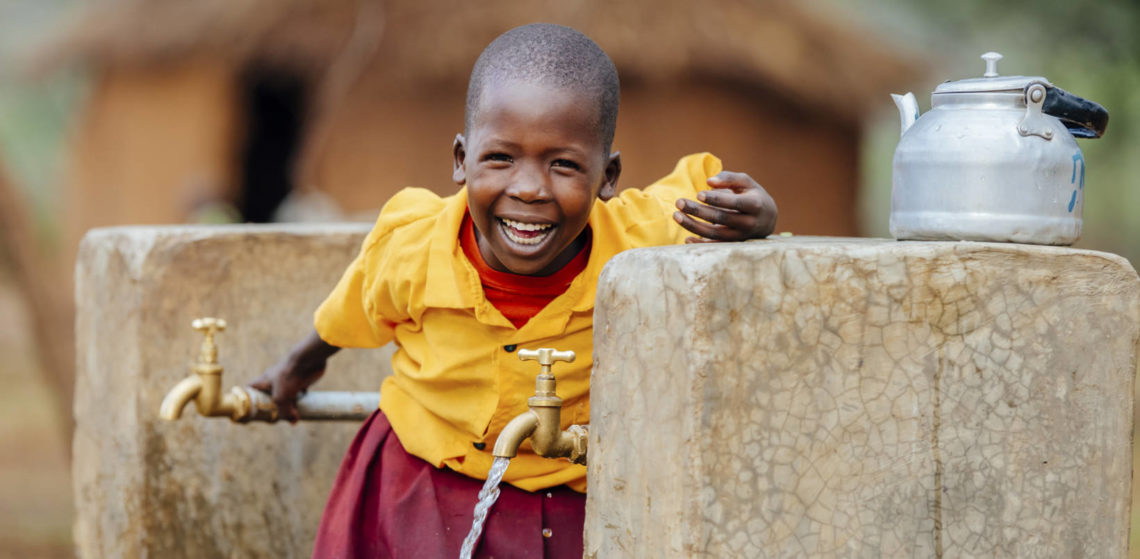
Access to safe and clean water supply in rural and urban areas has increased, at least one source per village is available, a recent report from Ministry of Water and Environment indicates.
The report shows that the target to increase access to clean and safe water from the 65 per cent to 79 per cent in rural areas and from 77 per cent to 100 percent in urban areas by 2021 with the aim of providing a water source in every village has been achieved.

To date, the rural water coverage is estimated at 69 per cent, while the urban water coverage stands at 79 per cent. A total of 38,517 villages representing 66 per cent out of the total 57,974 villages in the country have been served with clean water. So far 35 districts have their water coverage above 80 per cent.
According to the report, 446,686 water sources countrywide serving 27, 797,316 people, 23,910 wards within towns and municipal councils were served by National Water and Sewerage Corporation under the SCAP-100 and Ministry of Water and Environment projects.
The report further details that seven gravity flow schemes namely; Nyarwodho GFS-Phase II in Nebbi,Bududa-Nabweya GFS Phase II in Bududa, Bukwo GFS II in Bukwo, Rwebisengo Kanara GFS in Ntoroko, Lirima-Phase II (Manafwa), Bukedea (Sironko, Kween, Kapchorwa, Bulambuli) and Orom (Kitgum).
More so, 19 water supply systems in selected towns are completed and 36 schemes benefiting 547,670 people in 40 towns.
Better sanitation
The national average sanitation coverage in rural areas increased from 77 per cent to 79 per cent, while in urban areas increased to 87.4 per cent, with five faecal sludge management plants constructed in Pallisa, Apac Kiboga Nakasongola, and Kamuli while 101 public water borne toilets have been constructed across the country and four cesspool emptiers procured.
Sewerage connections increased to 23,796. The total sewer network is 670kms countrywide representing 30 per cent. Improvements are attributed to completion of Nakivubo-Kinawataka sewer lines, Nakivubo Waste water treatment plant, Arua and Gulu projects, and Fortportal and Kisoro package sewage plants.
NWSC is operating in 257 large towns. A total of 12,028 Public Stand Pipes serving 9,909 villages and benefiting an estimated 10.6million people.
The expansion of pipe water main network system aiming at serving all Ugandans with water has since increased from 9,960 km to 19,268Km while the total number of new connections effected in various areas stands at 222,091. The total customer base covering industrial/institutions/commercial customers increased from 472,193 to 711,556 connections.
Water has been supplied to Bweyogerere, Luzira, Kasese and Soroti Industrial and Business Parks.
Water for production
The current cumulative storage for water for production stands at 41.124 Million Cubic Meters (MCM) translating into 71.5 per cent of the target. The irrigation area stands at 19,138ha against the irrigation potential estimated at 3.03m Ha.
Two large multipurpose dams Ongole dam (1,000,000,000 litres) in Katakwi and Mabira dam (1,100,000,000 litres) in Mbarara completed.
Six medium scale irrigation schemes are at various levels of completion with a total of 3,976 hectares. These include, Rwengaaju in Kabarole District standing at 70 per cent, Tochi (500ha) in Oyam District standing at 86 per cent completion level, Mubuku-II (480ha) in Kasese District stands at 63 per cent, Doho-II (1,178ha) in Butaleja District is at 80.5 per cent, Ngenge (880ha) in Kween District is 87.5 per cent and Wadelai (1,000ha) in Pakwach district estimated at 53 per cent completion level.
Government completed construction of 70 small-scale irrigation schemes and constructed 70 additional small-scale irrigation schemes countrywide.
Constructed 153 valley tanks creating a storage capacity of 458,370m3 in Isingiro, Mbarara, Kiruhura, Lyantonde, Tororo, Soroti, Kaberamaido, Bukedea, Gomba, Kabarole, Kamuli, Kiboga, Katakwi, Kitgum, Kyankwanzi, Lwengo, Ntungamo, Sembabule, Kayunga, Nakasongola and Mubende.
In an effort to provide accurate and timely weather information for better planning and delivery, there is increased functionality of weather and climate monitoring stations from 25 per cent to 44 per cent, with great accuracy and reliability of weather forecasts. In addition, the country significant progress in dissemination of monthly weather updates to the public through various media and farmer groups for decision making at the districts.
Government has continued to control the encroachment and degradation of the fragile ecosystems in Lubigi wetlands in Wakiso and Kampala 400 ha has been restored, Kachera wetlands in Rakai and Kiruhura districts, Ntungamo in the West and Serere in the East, 227,489 ha of landscape of shea butter trees in Agago, Abim and Kaabong have been protected.
This is therefore to urge all users to mind the importance of the different water facilities as a common good. We should use them with good care.
Senior Research Officer
Ministry of ICT &National Guidance