
















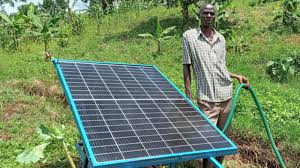
Uganda’s agricultural sector is facing significant challenges due to climate change, with only about 2% of farms utilizing irrigation.
To address this, the government has launched a subsidy program for small-scale solar-powered irrigation systems, supported by the World Bank and managed by the Ministry of Agriculture, Animal Industry, and Fisheries.
The initiative aims to enhance climate resilience and boost agricultural commercialization in Uganda, offering farmers a solution to the growing unpredictability of rainfall and climate extremes.

According to researchers Edward Kato and Claudia Ringler from the International Food Policy Research Institute (IFPRI), while solar-powered irrigation can provide long-term cost savings, concerns remain about its potential to encourage unsustainable groundwater extraction.
The researchers point out that despite the potential benefits, several questions remain, particularly about the impact on smallholder farmers, women farmers, and the overall viability of the program as a business model.
Initial concerns revolve around whether these farmers can equitably access the technology and whether the subsidy program can effectively reach those who most need it.
Claudia Ringler suggests that the subsidy program has garnered significant attention, with over 80,000 applications submitted from across Uganda’s 66 districts.
As of December 2024, around 4,000 solar-powered irrigation systems have been installed, and demand continues to grow.
However, the program’s financial requirements are a significant barrier for many farmers, who are expected to co-finance 25% of the total cost of a solar pump.
Prices range from 4 million Ugandan shillings (about $1,100) to 14 million shillings (approximately $3,800), presenting a serious challenge, especially for poorer farmers.
This financial hurdle is compounded by the reality that many farmers lack access to land with reliable water sources, such as streams, lakes, or boreholes.
With the impacts of climate change worsening, agricultural land that already has water access is increasingly out of reach for average Ugandan farmers.
In addition, the application process, which involves submitting documents through a smartphone app, has proven difficult for smallholders who may not have the necessary technology or skills.
As a result, the early beneficiaries of the program have tended to be wealthier farmers, including local elites, businesspeople, and members of Uganda’s diaspora.
However, as the program expands, it is gradually reaching less affluent farmers.
Initial feedback suggests that the solar-powered pumps are providing more than just irrigation for crops, also enhancing household water security and increasing the return on investment for farmers.
The adoption of solar-powered pumps has led to increased production of high-value crops like fruits, vegetables, and coffee, potentially boosting household income and improving agricultural diversity.
Despite the successes, several bottlenecks remain, including the lack of adequate solar pump repair services in rural areas and delays in the delivery of solar pumps.
Experts suggest that the government should work closely with technical schools to establish training programs for technicians, creating job opportunities for youth and ensuring a skilled workforce to service the growing number of solar-powered pumps.
The government should also consider developing incentives to encourage solar pump suppliers to establish a direct relationship with farmers, addressing the lack of a formal contractual relationship between suppliers and farmers.
As the solar-powered irrigation subsidy program in Uganda scales up, there is a need for a comprehensive review of the program’s structure and its implementation challenges.
A review of sustainable groundwater management practices and enhanced water governance systems could improve equitable access to water resources for all farmers.