












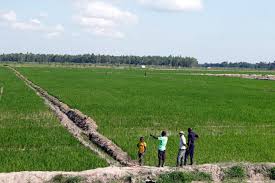
President Yoweri Museveni has called on residents of Kaliro District to voluntarily withdraw from wetlands, emphasizing the importance of dialogue and scientific methods in achieving conservation goals.
The President made this appeal while addressing locals on June 6, highlighting the need to prioritize sustainable agriculture and preserve wetlands as natural water reservoirs.
Museveni explained that wetlands once accounted for 20% of Uganda’s land area, while 80% remained dry and highly suitable for sustainable agriculture.

He noted that much of the dry land remains viable and should be prioritized for crop production, while wetlands should be preserved for their ecological benefits.
“Because of consistent irrigation throughout the year, she harvests 53 tonnes of bananas per hectare, compared to only 5.3 tonnes by neighboring farmers in Bushenyi who rely on seasonal rainfall,” Museveni said, citing the example of Dr. Muranga of the Tooke Initiative.
The President added that dryland farmers using wetland water for irrigation could earn ten times more than those cultivating wetlands directly.
Museveni also referenced his Kawumu farm, where he earns UGX 80 million annually from fish ponds on one acre, compared to UGX 4 million earned by wetland rice farmers on the same area.
He emphasized that his team would adopt scientific methods to sensitize communities on how to profit from waterlogged areas without damaging the environment.
To foster mindset change, Museveni announced plans to take wetland rice farmers on exposure visits to Limoto in Pallisa District, where wetlands have been sustainably repurposed for higher incomes.
“For the wetlands, let us take them to Limoto,” Museveni said. “When they come back, we discuss.”
Bulamogi County MP Sanon Bwiire said that the government has started offering alternative enterprises such as livestock and fish farming to encroachers to encourage voluntary withdrawal from wetlands.
However, he stressed that the success of these initiatives hinges on adequate training in enterprise selection to ensure beneficiaries can sustainably manage their new ventures.
Some beneficiaries shared concerns over the poor outcomes of these alternatives, with Teopista Naisanga lamenting the death of two crossbreed cows she received in exchange for vacating her wetland plot.
“I’ve had to return to rice farming in the wetland just to make ends meet for my family of eight,” Naisanga said.
Arpohia Mbeiza said most residents lack the technical knowledge to manage livestock, while Monica Musekwa highlighted the failure of a beekeeping project due to lack of skills.
Musekwa emphasized the need for grassroots-level training aimed at shifting generational mindsets built on wetland farming.
“Many of the trainings are held at sub-county headquarters and are based on complex documents,” Musekwa said. “Farmers like us need simple economic calculations and practical demonstrations.”
Kaliro LCV Chairperson Elijah Kagoda welcomed President Museveni’s proposal for benchmark visits, saying it could be the turning point for sustainable wetland practices in the district.
“The President’s initiative could be the turning point we’ve been waiting for,” Kagoda said. “His personal involvement gives us hope.”