











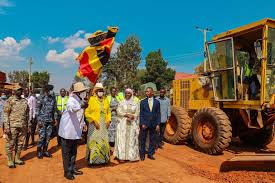
President Yoweri Kaguta Museveni has officially commissioned the construction of the Kayunga–Bbaale–Galiraya Road, a project set to reshape regional connectivity and unlock economic opportunities across Central, Northern and Northeastern Uganda.
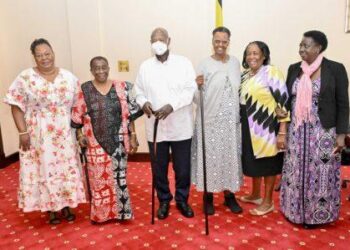
The President was accompanied by the First Lady and Minister of Education and Sports, Maama Janet Kataaha Museveni.
The long-awaited project is expected to bridge communities and stimulate economic transformation.

The road, to be constructed by China Road and Bridge Corporation (CRBC) at a cost of Shs213.9 billion ($57m), will be financed upfront by the contractor, with the government scheduled to begin payments after two years.
Supervision will be handled in-house by the Ministry of Works and Transport.
Stretching 87 kilometers, this road is not just a strip of tarmac, it is a deliberate bridge between communities and a bold leap toward economic transformation.
Once completed within 24 months, the corridor will offer a direct and more efficient route from districts like Amolatar in Lango sub-region to Kampala, cutting travel distances nearly by a half.
The President said: “I am very happy about this road whose ground we have just broken. We’ve been planning it for a long time.”
“It is a strategic route that shortens the journey from Northern Uganda to the Central region,” he added. “From Amolatar, through Kayunga, it’s around 100 miles to Kampala. If you go the long way around Lake Kyoga via Karuma and Soroti you end up doing about 200 miles. That’s why this road is very important.”
The President praised the people of Kayunga for their wisdom and patriotism, noting that many residents have willingly offered their land to fast-track the project.
“You have said give us the road, we won’t charge for the land,” President Museveni said. “That’s clever and patriotic.”
The estimated compensation would have been around Shs 76 billion, nearly a third of the total project cost.
President Museveni commended the contractor’s flexibility in accepting deferred payments.
“Instead of letting your machines sit idle, they will now be at work,” he said. “And you have trusted us to pay you later when our oil revenue starts flowing, which will be very soon.”
Beyond the tarmac, the President delivered a reminder to the residents.
“For a long time, I have been telling you that being on a tarmac road benefits all of us,” he said. “But when you return home at night, you find the poverty you left in the morning still there. You don’t sleep on the road, you sleep in your house. That’s why wealth creation at household level is equally important.”
The Minister of Works and Transport, Gen. Katumba Wamala, described the groundbreaking as a turning point in Uganda’s infrastructure journey.
“This road has been long awaited,” he said. “At 87 kilometers, it connects Kayunga town through Bbaale to Galiraya, and if properly developed, it becomes a powerful artery linking Central Uganda to the North and Northeastern regions.”
Gen. Katumba underscored the strategic objectives of the project: to reduce travel time and vehicle operating costs, improve access to economic and social services, and open up oil and gas exploration zones in the Kyoga Basin.
“Once completed with the ferry connection in place, travel from Lira to Kampala will take less than four hours down from six or more,” he said.
The Chinese Ambassador to Uganda, H.E. Zhang Lizhong, praised the partnership between Uganda and China, noting that infrastructure is the backbone of prosperity.
“In China, we have a saying: ‘To be rich, build a road first,’” he said. “We appreciate that Uganda has embraced this principle.”
H.E. Zhang reaffirmed China’s commitment to Uganda’s development, highlighting that Chinese construction companies are not just building roads, they are also training local talent and contributing to Uganda’s long-term transformation.