
















President Yoweri Kaguta Museveni has called on artisans and entrepreneurs to transition from individual operations to family- or group-owned companies to ensure sustainability, collective wealth, and intergenerational growth.
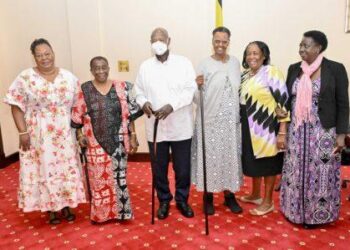
Accompanied by the First Lady and Minister of Education and Sports, Maama Janet Kataaha Museveni, the President made the call today during a visit to the Kigo Carpentry and Skilling Centre located in Kigo Mutungo, Ndejje Parish, Makindye-Sabagabo Municipality, Wakiso District.
The centre is home to 588 members and offers training in carpentry, metal fabrication, tailoring, and weaving.

Before visiting the skilling centre, the President and his entourage inspected ongoing works on the Salaama Road construction project.
While interacting with the artisans, President Museveni advised them to rethink the traditional approach of fragmented individual work, especially when it comes to managing land and shared resources.
“I want to know who the owner is, you people should form a company and work together,” the President said.
“This tendency of working individually is risky,” he added.
“I taught the Banyankore not to divide land when the time for inheritance comes, stay united and work as a family.”
He further explained that land fragmentation causes inefficiencies, chaos, and stunted progress.
He cited his own family’s example, revealing that he and Maama Janet set up a family company where members contribute to shared productivity and benefit from collective profits.
“Europeans developed by forming companies through families,” he emphasized. “That’s how they advanced. Leave backwardness and embrace that model.”
President Museveni also pledged to support the centre’s growth by providing more equipment and financial capital.
He promised to inject Shs500 million into the SACCO to boost production and raw material procurement.
He also noted the importance of proper infrastructure and pledged to work on improving road access to the centre to facilitate easier transportation for buyers.
“All other issues are easy, but the formula for working together is what matters,” the President said.
“If you get it right, everything else will follow.”
He also tasked Hon. Balaam Barugahara, the State Minister for Youth and Children Affairs, to sit with the leadership of the centre and streamline ownership structures, user fees, and training strategies to ensure sustainability.
“Right now, you are training people for free,” he said. “That’s not sustainable. You should have sponsors who pay fees to the centre. You are becoming donors, it’s too early for that. Let’s have a formula that benefits both trainers and trainees.”
Hajjat Minsa Kabanda, Minister for Kampala City and Metropolitan Affairs, also praised the President and the First Lady for their consistency in supporting youth-led skilling projects.
“I remember how bad the situation was for these people in Nsambya,” she said. “Your intervention turned their lives around.”
Ivan Ainebyoona, Chairperson of the Kigo Carpentry Centre, thanked the President for standing with the artisans through difficult times.
“Whenever it rained or the sun was too much, we were worried but you came and rescued us,” Ainebyoona said.
“We now work in dignity. We are happy, and history will remember you.”
He informed the President that their work is non-political and deeply rooted in self-reliance.
Majid Kigundu, the centre’s Secretary-General, emotionally recounted the centre’s journey that began in 2016 when a group of desperate carpenters blocked the President’s convoy in Munyonyo.
“We told you our story,” Kigundu recalled. “We were struggling in Nsambya, being tossed around by KCCA. You listened and gave us carpentry and tailoring machines, Shs100m for our SACCO, and even told us you had sold your cows to buy us this land.”
“We are now paying taxes, training youth, and have now secured orders to make beds for Special Forces Command soldiers.”
He urged the President to enforce the executive order against exporting raw timber, stating that the artisans at Kigo are ready to add value locally.
“We have all the designs,” he appealed. “Let people come and support us here instead of exporting raw timber.”
Maama Janet also pledged to rally schools and government agencies to support the centre’s work by sourcing products locally.