















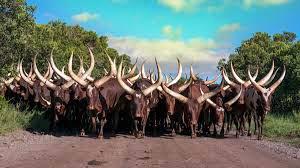
The Special Forces Command (SFC), charged with protecting the President, the First Family, and strategic national assets, has expressed strong support for the National Animal Genetic Resources Center & Data Bank (NAGRC & DB) over its groundbreaking efforts to preserve and multiply Uganda’s indigenous livestock, particularly the famed Ankole long-horned cattle.
In a formal message of appreciation, SFC Political Commissar Major Nelson Gabosya praised the NAGRC’s breeding and livestock programs, calling them a critical driver of profitable and sustainable animal farming across the country.
These interventions are in direct alignment with President Yoweri Museveni’s vision to protect and expand Uganda’s indigenous cattle breeds.

“With allies like NAGRC, there is no doubt that the President’s efforts will yield lasting benefits for Ugandans,” Major Gabosya affirmed.
He commended the agency’s strategic use of indigenous bulls and heifers—many of which were preserved and donated by the First Family—to enhance genetic development and herd quality at public livestock centers such as the Entebbe Data Bank and Nshaara Ranch in Greater Mbarara.
This partnership has significantly strengthened the conservation and continued propagation of Uganda’s high-quality local breeds, contributing meaningfully to the broader socio-economic transformation of the country.
Major Gabosya also highlighted the professionalism and technical competence of NAGRC’s workforce, noting their ability to translate President Museveni’s policy on livestock development into tangible outcomes.
He invoked the guiding principle of the Chief of Defence Forces, Gen. Muhoozi Kainerugaba, who has often stated: “Any step ahead is a step closer to success,” to illustrate the progress made under NAGRC’s leadership.
As a result of the agency’s work, government ranches have recorded increased herd populations, improved infrastructure, and greater access to quality breeding stock by farmers at significantly subsidized prices.
The parliamentary committee on agriculture has consistently called for increased budgetary support to NAGRC.
The committee notes that a top-performing dairy heifer from NAGRC costs around Shs1 million—far more affordable than the Shs3 to 5 million typically charged on the private market.
This price advantage is crucial for smallholder farmers, who continue to grapple with high feed prices and counterfeit veterinary drugs.
NAGRC’s work—conserving, breeding, and distributing livestock at scale—has placed it at the forefront of efforts to reduce poverty, especially in rural areas.
With livestock farming emerging as a more dependable pathway out of poverty than traditional crop agriculture, the center’s interventions are expected to uplift rural livelihoods and drive national development forward.