









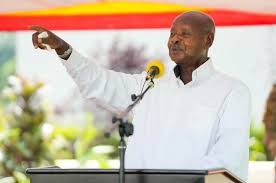
In a bold move to safeguard Uganda’s aquatic resources and uplift local livelihoods, President Yoweri Kaguta Museveni has directed that indigenous fishermen take the lead in managing the country’s lakes.
The Uganda People’s Defence Forces (UPDF)’s Fisheries Protection Unit (FPU) will support them in enforcing sustainable practices and protecting national waters.
The President issued the directive on Tuesday, August 5, 2025, during a consultative meeting with fishing communities and fisheries stakeholders at the State Lodge in Jinja.

Attendees at the meeting included indigenous fishermen and their families, boat owners’ associations, leaders of fishing community groups, district fisheries officers, and representatives of the Bakenye community.
This engagement marked a key turning point in the government’s efforts to reform the fishing sector and empower local communities while ensuring the long-term sustainability of lake ecosystems.
Central to the discussions was the role of the UPDF in curbing illegal fishing practices, preventing cross-border incursions, and preserving breeding areas.
President Museveni stated that indigenous fishermen are integral to the sector’s transformation. He emphasized that they must be at the forefront of conservation efforts, supported by capital-intensive investors and the FPU, particularly in guarding border waters and backing legal fishing practices.
He reaffirmed the importance of military involvement for stability but made it clear that their role should not be permanent.
“Now that we have peace, let’s organize this sector and eventually return the army to the barracks,” the President said.
Reflecting on Uganda’s rich fishing traditions, he highlighted the importance of building modern policy on local knowledge systems.
“This part of Africa is our ancestral home. The heritage of the area is based on ‘Emyooga’—skill-based economic specializations. We must empower those with omwooga (skills) in fishing to lead the transformation of this sector,” he remarked.
He recounted how, early in his presidency, he established Uganda’s first fish processing plant at Masese Landing Site using part of a \$20 million grant from Italy, which spurred growth in the sector.
However, he noted that uncontrolled growth, illegal gear use, and chaos led to the eventual need for military intervention.
“I had to bring in the army because the fishing activity seemed to have no owner. It was being dominated by opportunists. But now we are organized. We have peace and time to plan,” he explained.
While other agricultural sectors had stabilized without military assistance, the lakes presented unique challenges that necessitated continued security involvement.
Museveni encouraged a shift toward fish farming in ponds, referencing successful models in Limoto and Kawumu that earn over UGX 80 million annually.
He showed video footage of efficient pond systems and urged communities to adopt aquaculture as a sustainable alternative to lake fishing.
“We misuse the wetlands and underutilize the drylands. That’s why we must organize domestic fish farming and work with communities to conserve resources,” he said.
Addressing concerns from Buliisa and Kasensero about foreign incursions, he assured stakeholders of enhanced security measures.
“On Lake Albert we already have eyes. We have surface radar where you can see all what is happening on the lake. We are going to do the same on Lake Victoria, so those people who are being attacked in Kasensero, we are going to do something about it,” the President pledged.
Acknowledging the financial demands of the sector, he proposed the establishment of a dedicated fisheries fund, separate from the Parish Development Model (PDM).
He pointed out that while the PDM allocates UGX 100 million per parish, fishing ventures require more capital.
“The indigenous fishing communities must be organized into SACCOs based on proximity and purpose for effective delivery, and the government will allocate UGX 1 billion per SACCO,” he announced.
This, he said, aligns with broader goals to move Ugandans from subsistence living into a modern money economy.
On regulatory enforcement, the President vowed to crack down on illegal fishing gear, including banning the importation of banned nets and the threads used to manufacture them.
“I have received a report from ISO. We must stop this menace. Even the threads used to make illegal gear will be banned,” he declared.
He tasked the Third Deputy Prime Minister, Rukia Nakadama, with ensuring landing sites have public toilets, clean water, schools, and health facilities, particularly in remote and island areas.
“We need to plan for these landing sites because they are far from each other. And then also for the islands. We can say let’s have boarding schools on these islands. We can have a few in Kalangala, Koome, Buvuma and so on. This will be done by the Prime Minister’s Office,” he explained.
Museveni also directed the Ministry of Agriculture, Animal Industry and Fisheries to complete fishing regulations within one month.
“I give you one month to finish that regulation,” he said.
He praised fishermen who had diversified their livelihoods, noting that such initiatives improved household incomes.
“People are waking up and the waking up which I have found here, which apparently the State House has started working on, is that those fishermen have other needs. If he fishes, he still needs to eat, to eat not only fish but other things. Like some women here who are looking after pigs, hotels, shops, if they get support, they can have businesses not only in fishing but other things,” he observed.
He also revealed plans to instruct the Uganda Police to create a special water unit to enhance safety and emergency response on lakes.
“We can discuss it in the cabinet, but I think the police may be the best place,” he said.
On the environment, Museveni emphasized the preservation of breeding areas (byondo), as well as gazetting lake shores and wetlands.
“People should not build near the shores where fish breed. These are like our national parks in the water and must be protected. They must be preserved so that no one goes there. We have heard that the fish business is bigger than coffee in the world,” he said.
Floating islands that deplete oxygen in the lakes, he said, result from swamp destruction and must be addressed through conservation.
The President also proposed establishing skills development centers in fishing communities to promote aquaculture and reduce dependence on natural lakes.
They also explored safe methods of harvesting mukene without affecting other fish species.
Reinforcing his long-held economic principles, Museveni pointed to the NRM’s 10-point program—specifically point five, which focuses on building a self-sustaining national economy.
“They wanted some people to be rich and others to be poor. I resisted that. We must modernize our people,” he stressed.
During the same meeting, Kato David, chairperson of the Bakenye community, emphasized the importance of indigenous knowledge in conserving fish breeding grounds and managing fishing seasons.
Sunday Gerald Kayita, NRM chairperson for Kalangala, advocated for harmonized fishing laws across East Africa to eliminate cross-border illegalities.
The high-level meeting was attended by several government officials, including the First Deputy Prime Minister and Minister of East African Community Affairs, Rt. Hon. Rebecca Kadaga; Third Deputy Prime Minister, Rukia Nakadama; Minister for the Presidency, Hon. Babirye Milly Babalanda; Minister of State for Northern Uganda, Dr. Kenneth Omona; Minister of State for Fisheries, Hon. Hellen Adoa; and Minister of State in the Office of the Vice President, Hon. Diana Mutasingwa.
With these reforms, Uganda aims to position its indigenous fishing communities at the helm of a sustainable, inclusive, and economically vibrant fisheries sector.