






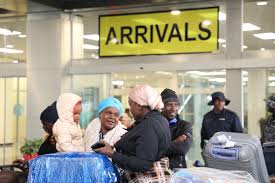
Twelve Ugandans stepped onto the tarmac at Entebbe International Airport on Monday morning, August 11, 2025, their faces a mix of exhaustion, relief, and disbelief.
They had been away for years, some trapped in hopelessness, others worn down by poverty and illness, all longing for a way back home.
Their return marked the first batch in a government-led repatriation mission personally sanctioned by President Yoweri Kaguta Museveni, following an intervention by Senior Presidential Advisor on Political Affairs (SPA) and Office of the National Chairman (ONC) Manager Hajjat Hadijah Namyalo.

Among the group were mothers clutching children who had never set foot on Ugandan soil.
They arrived aboard RwandaAir at around 10 am, accompanied by Moses Badru Kibombo Ssentongo, Chairperson of the Confederation of Ugandans living in Southern Africa (COUSA).
Families waited anxiously in the arrivals lobby, some in tears, others waving in joy as the first embraces unfolded.
Speaking to journalists, Hajjat Namyalo praised the President for “listening to the cries of stranded Ugandans, regardless of their political affiliations” and for authorising their safe return.
“This is purely a government effort to ensure the safety and dignity of our people abroad, not a political mobilisation exercise. But I encourage our bazzukulu to make use of the government’s wealth creation programmes like PDM and Emyooga once they settle back home,” she said.
She promised to push for an empowerment package from the President to help the returnees start income-generating ventures.
For some of those who came home, the rescue was nothing short of a lifeline.
One returnee, who identified as a National Unity Platform (NUP) supporter but preferred to remain anonymous, said they were grateful to be included despite political differences.
“Our party president Bobi Wine visited us once but left us in the same suffering. Hajjat came back with a real solution. We thank her for not segregating against us,” the returnee said.
Teopista Namukwaya, another returnee, had spent five years in South Africa.
She began as a hairdresser but, after meeting a Ugandan man, became a full-time housewife.
Her financial struggles deepened when she lost her job, and the hope of returning home faded.
“When Hajjat came, she was a God-sent angel. We were drowning in hopelessness. Now that we are home, I appeal to President Museveni to help us start afresh,” she said.
Namukwaya Masitula told of how her once-thriving restaurant and grocery business in Pretoria collapsed after what she described as a politically motivated boycott by NUP supporters.
They accused her of being pro-Museveni and even claimed she might “one day poison them.”
After four years of unemployment, she could not afford school fees for her three daughters.
“We have endured enough suffering. Back home, we hope to restore dignity and secure a better future for our children,” she said, appealing for start-up capital.
COUSA chairperson Moses Badru Kibombo Ssentongo called the mission “a grand rescue” and revealed that over 120 Ugandans remain in deportation centres in South Africa.
“Some had overstayed their visas by more than 5, 10, or even 20 years. They stayed illegally, hoping to find work, but the reality has been hardship and poverty,” he said.
He urged that the returnees be reintegrated into their communities and supported through government programmes, noting the rescue was not politically selective.
“This first group included the sickly, the distressed, and those with children who had no access to medical care or decent jobs because they were foreigners,” he explained.
Hajjat Namyalo said the operation was a collaboration between ONC, COUSA, and the Ugandan embassy in Pretoria to secure travel documents, air tickets, and clearance from South African authorities.
“These 12 were among the most vulnerable, starving, sinking in poverty, and desperate to return home. We thank President Museveni for making this possible,” she said.
She warned that neglecting citizens abroad can breed resentment towards the government and insisted such interventions were essential.
“We must show our people that Uganda is their home and that we care. As I always say, Settle for the best,” she declared.
She pledged to extend similar missions to other countries where Ugandans remain stranded.
“As long as the President has my back, I will bring our people home,” she said.