














President Yoweri Kaguta Museveni has proposed a new framework for distributing cattle compensation funds in the Teso subregion.
The Head of State emphasized that the exercise should focus on fairness and rehabilitation, ensuring that every household benefits, rather than allowing a small number of claimants to walk away with large sums.

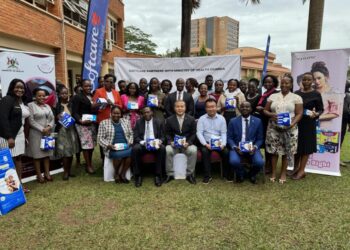
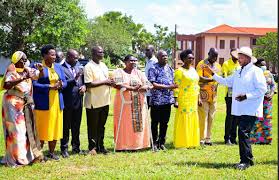
The President made these remarks while addressing cattle claimants, local leaders, and stakeholders at Soroti University.
He explained that the loss of cattle in Teso was the result of wars in the past, and the ongoing exercise should therefore be viewed as rehabilitation rather than mere compensation.
President Museveni noted with concern that in previous processes, lawyers took a significant portion of the funds, leaving beneficiaries with very little support.
He said the government has now restructured the approach to guarantee that funds go directly to households without third-party interference.
The President recommended that the remaining UGX 169 billion be shared equitably among all homesteads in Teso, instead of giving large sums to a few claimants.
He illustrated this proposal by calculating that if each cow were valued at UGX 1 million, the fund would translate into 169,000 cows.
He added that since there are about 69,000 households in Teso, each could receive between two and three cows, while the 28,000 households that have already benefited would not be included in this round.
To ensure fairness and transparency, the President proposed the creation of a committee made up of elders, youth, and women leaders to oversee the harmonization of distribution and budget allocation.
He further suggested that with careful planning and phased disbursement, households could potentially receive up to five cows each.
Vice President Hon. Jessica Alupo thanked the President for visiting Teso and directly engaging with the community on the long-standing cattle issue.
She applauded his efforts in maintaining peace in the region, attributing the stability to his visionary leadership and the role of the Uganda People’s Defence Forces (UPDF).
Deputy Attorney General Hon. Jackson Kafuuzi reported that reforms have been made to improve the payment system.
He explained that the compensation process now bypasses courts and lawyers, with funds being sent directly to verified claimants.
Verification of claimants is carried out at the subregional and district levels by Local Council Committees, Chief Administrative Officers, District Government Officers, and local depots.
He added that this new approach avoids centralized verification in Kampala and brings accountability closer to the people.
The Ministry of Justice and Constitutional Affairs provides data cards for claimants to complete their bio-data, which is verified from the village level up to the district registrar.
This process began in the 2016/17 financial year when the United States Committee verified thousands of claimants across different subregions, including 16,946 in total.
President Museveni officially launched the Cattle Compensation Initiative Series in March 2022 with an initial budget of UGX 200 billion.
Since then, disbursements have reached UGX 506.7 billion, benefiting thousands of households across the country.
In the Lango Subregion alone, 12,389 payments amounting to UGX 48.7 billion were recently released.
Across all subregions, the total disbursed in this phase reached UGX 128.3 billion, covering 28,281 payments.
Despite this progress, a backlog of 24,509 verified claimants remains unpaid, with outstanding claims totaling UGX 506.69 billion.
The pending payments include 5,570 claimants in the Northern Subregion owed UGX 191.5 billion, 8,284 claimants in the Eastern Subregion with UGX 119.26 billion in claims, and 10,708 claimants in the Central Subregion owed UGX 165.9 billion.
According to officials, delays are largely due to technical issues such as duplicate or mismatched claimant details, closed or blocked bank accounts, and invalid account numbers.
Hon. Bosco Okiror, Member of Parliament for Usuk Constituency, appealed to government to enhance transparency and fast-track pending payments.
He revealed that there are still three active court cases related to compensation, including one filed by claimant Elijah Okupa and others, with annual claims estimated at USD 207,000, mostly originating from Teso.
Hon. Okiror suggested that negotiations could resolve some of these disputes faster than court processes.
He proposed that large claims should be paid out in phases or through sequential settlements.
He also reminded the government that compensation should not only cover cattle losses but also address the loss of human life and destruction of property caused by past conflicts.
He stressed that the Teso community expects a holistic settlement that restores dignity and livelihoods for all affected families.