














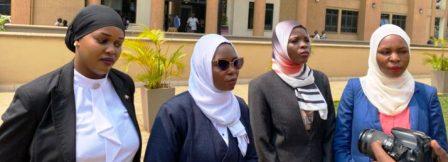
The Constitutional Court of Uganda has received a petition from the Islamic Women’s Initiative for Justice, Law and Peace (IWILAP) and several Muslim women leaders.
The petition challenges Uganda’s strict abortion laws and seeks a constitutional review that could reshape reproductive rights in the country.
The case has been filed against the Attorney General and specifically contests Sections 130, 131, and 207 of the Penal Code Act, which criminalize abortion except in very limited situations.

The petitioners argue that these provisions deny women—particularly Muslim women—the ability to make reproductive health decisions in accordance with their faith, the Constitution, and international human rights standards.
Haulah Nalubega, speaking on behalf of the petitioners, clarified that the move is not an attempt to introduce foreign ideas but a call to align Ugandan law with Islamic principles.
She explained that under Islamic jurisprudence, abortion is permitted in certain cases before ensoulment, which is believed to occur at 120 days of pregnancy.
According to her, these cases include pregnancies from rape, incest, and instances where a mother’s physical or mental health is endangered.
“This petition is about justice for Muslim women and Ugandans at large,” she said. “Islam recognizes exceptions, and we want the Attorney General to enlarge the boundaries of abortion-related matters to reflect these provisions. Our faith gives us a leeway, and it is time for the law to acknowledge it.”
Nalubega added that the petition is not a departure from Islam but a reinforcement of its compassionate principles.
She cited Qur’anic and jurisprudential values of rahma (mercy) and adl (justice), which emphasize fairness in cases where continuing a pregnancy would impose unbearable suffering on a woman.
She further reminded critics that several African countries, including Rwanda, Tunisia, and Zimbabwe, have adopted exceptions to abortion restrictions.
She noted that these countries have managed to balance cultural traditions, religious beliefs, and human rights obligations in their laws.
Kiriswa Bint Yasomini, a legal officer with IWILAP, highlighted the weaknesses in Uganda’s Penal Code.
She explained that the contested provisions broadly criminalize abortion, with Section 207 providing vague exceptions that fail to address realities such as rape, incest, or mental health threats.
“If this petition succeeds, it will not only benefit Muslim women but all women in Uganda,” she said. “Currently, women are carrying out abortions in unsafe, illegal conditions. By clarifying and amending the law to include these exceptions, Uganda would ensure women can access safe, legal medical services.”
The petition draws on Uganda’s Constitution, citing Article 29(1)(c) on freedom of religion, Article 37 on protection of cultural rights, and Articles 33 and 35, which safeguard the rights of women and vulnerable groups.
The petitioners argue that Uganda’s Penal Code undermines these protections by preventing women from acting in line with their faith and cultural values.
They also reference international treaties such as the Convention on the Elimination of All Forms of Discrimination Against Women (CEDAW).
In its 2022 concluding observations, the CEDAW Committee had already urged Uganda to reform its abortion laws to allow exceptions for rape, incest, and risks to the mother’s health.
The petitioners now want the Constitutional Court to declare Sections 130, 131, and 207 unconstitutional to the extent that they criminalize abortion without exceptions.
They also request the court to order Parliament to amend the Penal Code to permit abortion under the conditions recognized in Islamic law and in line with constitutional guarantees.
Additionally, they propose that abortions under these exceptions should only be permitted within 120 days of pregnancy, in line with the Islamic principle of ensoulment.
The petition is expected to ignite fresh debate on reproductive rights in Uganda.
By placing their arguments at the intersection of religion, culture, and law, the petitioners challenge the view that reproductive rights are un-African or un-Islamic.
Instead, they frame the issue around dignity, justice, and compassion—values they say are at the heart of both Ugandan society and Islamic teaching.
The Constitutional Court’s ruling will determine not only the future of abortion laws in Uganda but also how far the country is prepared to go in harmonizing domestic law with religious freedom, cultural values, and international human rights commitments.