
















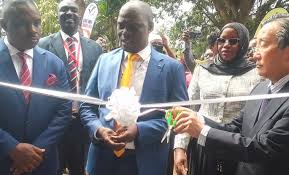
Kampala Capital City Authority (KCCA) has officially commissioned the Kampala Traffic Control Center, a state-of-the-art facility designed to modernize traffic management in the city and ease chronic congestion.
The project, which cost 1.96 billion Japanese Yen (approximately 47 billion Uganda Shillings), was funded by the Government of Uganda with support from the Government of Japan through the Japan International Cooperation Agency (JICA). Construction began in October 2022 and was completed in 30 months.
The newly launched control center links 30 intersections across Kampala, equipped with smart traffic lights that can be monitored and adjusted in real time.

Speaking at the launch, KCCA Executive Director Hajati Sharifah Buzeki described the facility as a milestone in shaping the city Kampala residents aspire to live in.
“This center is a significant step toward building the kind of city that Kampala residents have long desired,” she said.
Buzeki explained that the system, which integrates signalized junctions and a traffic control platform, will transform the flow of people and goods. She emphasized that the facility will not only benefit KCCA but also extend services to sister agencies such as the Uganda Police, Traffic Police, and academic researchers.
“The system is equipped with detectors and data collection tools that allow us to monitor congestion, incidents, and equipment faults instantly, and to deploy corrective measures without delay,” she said.
Buzeki assured that the center will be operated with high professional standards. She also revealed that KCCA intends to expand the system to cover more intersections and adopt emerging technologies.
“KCCA will continue to seek funding to incorporate artificial intelligence for predictive traffic management,” she said.
At present, the system uses sensors that track traffic flow as moving dots but do not identify vehicles. Plans are underway to upgrade the system by installing cameras that will provide real-time images of traffic.
Imoue Yoichi, the Chief Representative of JICA Uganda, noted that traffic congestion not only wastes time but also undermines productivity, worsens air pollution, and heightens the risk of accidents.
“This project provides a solution to these challenges, and JICA reaffirms its commitment to support Uganda,” he said.
The Japanese Ambassador to Uganda, Takuya Sasayama, acknowledged that Kampala still faces several urban challenges, including solid waste management, but praised the progress marked by the new traffic system.
“The traffic system marks progress,” Sasayama said. He highlighted other infrastructure projects supported by Japan, including Lot One of the Kampala Flyover, which was opened earlier this year, and confirmed plans for Karuma Bridge and Kampala Flyover Lot Two.
He further explained that JICA, the World Bank, and other partners are contributing to a Greater Kampala Master Plan designed to link the city center with surrounding regions and improve urban mobility on a wider scale.
Kampala Lord Mayor Erias Lukwago thanked the Government of Japan for its continued partnership, describing the project as an important step toward transforming Kampala into a smart city.
“This project demonstrates the benefits of digitizing the city and moving toward a smart city vision,” Lukwago said.
However, he also expressed concern about bureaucratic bottlenecks that often delay critical urban projects.
“There are projects that are designed, and I’m worried I may not see them in my lifetime. It pains me so much, but at least this one I have been able to witness,” he remarked.
The Lord Mayor recalled that under KCCA’s 2021–2025 strategic plan, the authority set a goal of reducing travel time to three minutes per kilometer, down from 4.1 minutes, though this target has not yet been achieved.
He urged city authorities to use the new traffic control center to accelerate progress on this target and to focus on road safety black spots such as the Northern Bypass. He also called for serious investment in a city-wide mass transit system.
“A mass transit system remains essential for easing congestion and improving the movement of people and goods. The central government must sustain and maintain such investments to ensure long-term benefits,” Lukwago added.
The commissioning ceremony was attended by the State Minister for Kampala, Kabuye Kyofatogabye, Engineer Stephen Kitonsa from the Ministry of Works and Transport, representatives of taxi operators led by Rashid Ssekindi, and leaders of the boda boda industry.
Stakeholders welcomed the center as a much-needed tool to tackle the city’s growing traffic problems, while emphasizing that continued investment, maintenance, and expansion will be key to realizing its full benefits.