





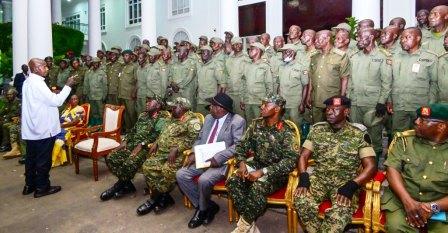
President Yoweri Kaguta Museveni has pledged renewed efforts to improve the welfare of veterans, saying it is unacceptable for men and women who risked their lives in Uganda’s liberation struggle to continue living in poverty.
“It’s not good to have the veterans in poverty. It’s not good at all,” Museveni told a gathering of veterans drawn from Luwero, Wakiso, Nakasongola, Kiboga, Kyankwanzi, and Nakaseke districts.
The President made the remarks on Wednesday, 3rd September 2025, while delivering a lecture of opportunity and officially closing the Transformational Leadership Course Intake 07/2025 for veteran cadres at State House, Entebbe.

His speech combined reflections on Uganda’s liberation history, the ideological foundation of the National Resistance Movement (NRM), and concrete plans to empower ex-servicemen economically.
Museveni reminded the veterans that their sacrifices during the 1981–1986 liberation war should not be betrayed by a life of deprivation.
“The ones who are leaving now are going with better packages, but for those who sacrificed earlier, we must make up for the shortfalls. We shall do this through revolving funds, organized at the zone level,” he added.
He encouraged veterans to form structured associations and Savings and Credit Cooperative Organizations (SACCOs) through which government can channel financial support.
“We are giving money to the Kampala ghetto boys. Why can’t we give money to the SACCOs of veterans?” he asked, stressing that the men and women who fought for Uganda’s freedom deserve priority.
Museveni emphasized that veterans must be absorbed into the four key sectors of Uganda’s modern economy—commercial agriculture, manufacturing, services, and ICT—if they are to achieve sustainable prosperity.
He pointed out that even veterans without land should not be left behind, since they can pursue trades that generate income.
“If you don’t have land, then your option is to have omwoga—an economic activity that is not based on land. You can do maize milling, tailoring, carpentry, or other trades that generate income,” he said.
Reflecting on Operation Wealth Creation (OWC), which was launched in 2013, the President explained that veterans were intended to be its first beneficiaries.
“I told General Saleh to first give seedlings to all the veteran families and those who supported us during the war. Only after that should others benefit. But I later heard some veterans missed out because they lacked land,” he noted.
The President also revisited the three historical missions of the NRM, rooted in four ideological principles: patriotism, pan-Africanism, socio-economic transformation, and democracy.
He explained that lasting prosperity comes when individuals and families produce goods and services for sale, not from handouts.
To illustrate this, Museveni recounted his personal story of how his father, Mzee Kaguta, sold cattle in auction markets in Ntungamo with the help of traders like Walusimbi Mpanga and Bukenya to raise his school fees.
“I like the story of how I went to school. I was able to go to the school system in the 1950s and 1960s when the school system was for paying. How did I manage? How did Mr. Kaguta manage to pay my school fees? Kaguta had traditional cows, but he had no money. The only way he could get money was from the traders. A trader was coming from Kampala, here called Walusimbi Mpanga. He would come all the way to all those areas in Ntungamo and buy our cows. So that’s how Kaguta now converts his cows into money, and he’s able to pay my school fees and do a few other things,” Museveni explained.
From this experience, the President said he learned that the prosperity of the Banyankore and all other tribes depends on wider national and regional markets.
He highlighted Uganda’s current production surplus as an example, citing milk, maize, and sugar. Uganda produces 5.3 billion liters of milk annually but consumes only 800 million.
It produces 5 million tons of maize yet consumes only 1 million, and generates 700,000 tons of sugar against local demand of 300,000 tons.
“Fortunately, there is a regional market that buys our extra milk, beef, and maize. So that’s why we say we need East Africa, we need Africa for our own prosperity. And that’s why we say the second principle is pan-Africanism; Love Africa. Why? Because you need it for your own good,” he said.
On behalf of the veterans, Captain (Rtd) Leonard Settimba presented a memorandum outlining concerns and requests.
These included a revolving fund, affordable government loans channeled through Wazalendo SACCO or similar institutions, and the proposal for an annual national day to reunite Kadogos and bush war fighters in honor of their sacrifices.
Settimba and others also raised concerns about land evictions. Museveni assured them that no one would be removed from their land so long as they paid busuulu (ground rent).
The event also featured Brigadier General Justus Rukundo, Commandant of the Oliver Reginald Tambo Leadership School and Pan-African Centre of Excellence (ORTLS-PACEX), Kaweweta. He thanked the President for supporting the training of veteran cadres and revealed that the school has trained 15 intakes of officers while strengthening ideological clarity and leadership among veterans.
He announced that the school is constructing a 20-room guest house named “ANC” in honor of South Africa’s African National Congress and Oliver Tambo.
Plans for a modern auditorium and senior officers’ dormitory remain in the pipeline, pending funding.
The ceremony drew high-level attendance, including Hon. Alice Kaboyo, Minister of State for the Luwero Triangle and Rwenzori Region; Maj. Gen. David Mugisha, Commander of the Special Forces Command; Maj. Gen. (Rtd) Phinehas Kitirima, NRM District Chairperson for Sembabule; Maj. Gen. James Kiwanuka, UPDF Joint Staff for Human Resource Management; Maj. Gen. Steven Mugerwa, UPDF 1st Division Commander; and Maj. Gen. Felix Kulayigye, Director of Defence Public Information.