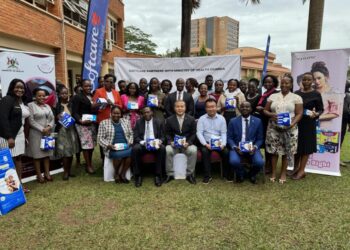
















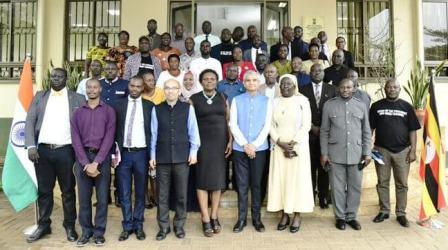
A team of 40 Resident District Commissioners (RDCs), Resident City Commissioners (RCCs), along with their Deputies and Assistants, have been flagged off for specialized training in India.
The group will undergo a two-week Entrepreneurship and Promotion of Livelihood Generation Activities (EPLGA) programme scheduled to take place from 18th September to 1st October 2025.
Their training will be conducted at the National Institute for Entrepreneurship and Small Business Development (NIESBUD) in Noida City.

Speaking at the event, Upender Singh Rawat, the High Commissioner of India to Uganda, explained that the initiative is part of India’s long-standing capacity building programme for the Global South.
He emphasized that the training seeks to boost skills in ICT, agriculture, technology, and entrepreneurship.
He said the effort is grounded in India’s 68-year commitment to empowering developing nations through knowledge exchange.
Rawat also reaffirmed the strength of India–Uganda relations, noting that India remains committed to supporting skills development for socio-economic growth.
Yunus Kakande, Secretary in the Office of the President of Uganda, expressed gratitude to India for what he described as “long-standing support to Uganda since 1901.”
He highlighted the significant role played by Indian investors and bilateral cooperation in accelerating Uganda’s socio-economic development.
“These RDCs are field staff representing the President. Enhancing their skills empowers them to mobilize, oversee security and evaluate government programs in their districts,” Kakande stated.
He revealed that discussions are underway for an additional 40 slots to expand the training opportunities.
Hajji Kakande commended the government of India for what he termed “sincere support” to Uganda, saying such interventions have contributed substantially to the country’s progress.
“These interventions in the various sectors in Uganda have contributed significantly to the development of our country,” he observed.
He further drew parallels between Uganda’s Parish Development Model (PDM) and India’s advanced livelihood programmes.
“India has similar programs like Uganda such as the PDM though theirs are more developed than ours. We are looking forward to taking a leaf from you so that we also develop our programs more in order to achieve the much desired socio-economic transformation,” Kakande remarked.
He assured that Uganda would continue to benefit more from its partnership with India through this training exchange.
Maj. Martha Assimwe, the Head of the RDC Secretariat in the Office of the President, advised participants to approach the training with discipline and professionalism.
“Respect facilitators, follow rules and learn from India’s advanced programs to drive socio-economic transformation back home,” she urged.
The programme is designed to strengthen the RDCs’ capacity in mobilization, security management, and monitoring government initiatives, with a focus on making them agents of socio-economic change in their respective districts.
This marks the second cohort of RDCs sent for training in India, following an earlier batch of 20 participants.
Plans are already in motion to expand the programme further, signaling deeper collaboration between Uganda and India in skills development, entrepreneurship, and livelihood promotion.