








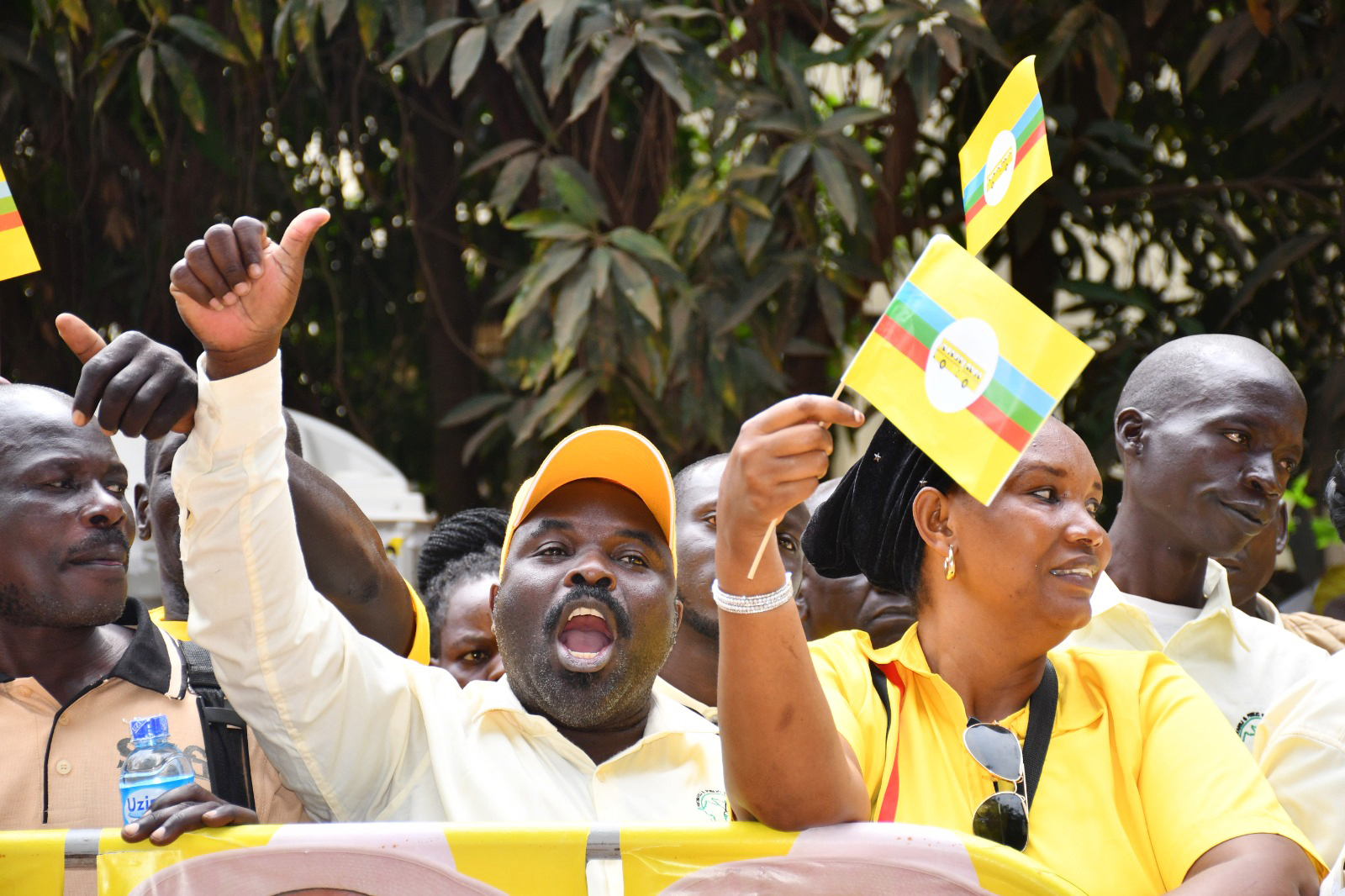
Ugandans happy with NRM, Museveni
The recent Afrobarometer data, released a few months ago, should leave the ruling NRM party and President Yoweri Museveni happy.

The Afrobarometer national partner in Uganda, Hatchile Consult Ltd., interviewed a nationally representative, random, stratified probability sample of 2,400 adult citizens. A sample of this size yields country-level results with a margin of error of +/-2 percentage points at a 95% confidence level.
This is the 12th survey of this type that Afrobarometer is conducting and publishing on Uganda. The interviews were conducted between January 16 and February 01, last year, and Afrobarometer has since October 2024 consistently released batches of data on specific areas of the survey findings.
The data has good news for the NRM party and President Yoweri Museveni.
When asked which particular political party they feel close to, most respondents at 41% said they feel close to the NRM. The National Unity Platform was a distant second at 9%, FDC 3%, UPC 1.5% and others 1% or less. Significantly, up to 36% of respondents said they do not feel close to any party. But when asked which candidate’s party they would vote for if national elections were held tomorrow, up to 56% said NRM, 11% NUP, and 4% FDC. Up to 7% said they would not vote and 14% refused to answer.
In a related question, when asked how much they trusted each party, only 8.6% said they trust NUP a lot, FDC 5.9%, UPC 4.7%, DP 3.2%, JEEMA 2.3%, and PPP 2%. It is not clear, however, what “trusting” a party means.
President Museveni should be equally happy because, among leaders, he enjoys the highest level of trust of Ugandans, according to the survey. Only traditional leaders and religious leaders are more trusted than Museveni.
Museveni is trusted more than his ruling party; NRM, more than opposition parties, MPs, the Electoral Commission of Uganda, district and city councils, courts of law, NGOs, UPDF, police, and the Ministry of Health.
According to the survey, the least trusted institution or leaders are the opposition political parties. Only 11% of respondents said they trust them a lot. Another 27% said they trust them just a little. Up to 36% of respondents said they do not trust them at all.
Compare that with President Museveni who 39% of respondents said they trust a lot and another 44% said they either trust him somewhat or just a little. Only 14% said they do not trust Museveni at all.
When asked whether they approve or disapprove of the way President Museveni has performed his job over the past 12 months, 70% said they either approve or approve strongly. That was a year ago of course. But Members of Parliament got a 46% approval rating and local government councilors 53%.
In a positive for the opposition, when asked to say whether they agree or disagree that Uganda’s opposition offers alternative vision, 64% of respondents agreed or agreed strongly.
Religious leaders are the most trusted. Up to 60% trust them a lot, 21% somewhat trust, and 14% trust just a little. Only 5% do not trust at all. Up to 44% respondents said they trust traditional leaders a lot, 22% somewhat trust and 12% trust just a little bit. Significantly, 37% trust the UPDF a lot compared to 20% for police. Also 31% trust the NRM party a lot compared to 11% for opposition parties.
Electoral reforms wanted
Trust for the Electoral Commission is at a lowly 17% and a high 33% of respondents say they do not trust it at all. Ugandans are very concerned about the lack of independence of the electoral commission. According to the survey, when asked what the most important issue is that should be addressed ahead of the 2026 general elections, most respondents at 30% mentioned it. They said they want a non-partisan electoral commission to be appointed.
Other major concerns around elections include strengthening electoral laws, making laws against vote buying tougher, and addressing issues with voter register. Respondents also wanted declaring polling station results individually for better vote tally confidence, banning candidates convicted of vote-buying from future elections, strengthening campaign finance laws for political accountability, and holding officials accountable for electoral offences.
Ugandans generally express a high feeling of freedom related to the election period. According to the survey, when asked how free they are to say what they think, majority 83% said they are free. But only 50% said they are completely free. Up to 11% said they are not very free.
When asked how free they are to choose who to vote for without feeling pressured, a whopping 79% said they are completely free. Only 3% said they are not at all free.
The sense of freedom Ugandans feel when voting is possibly because it is a secret ballot and, although there has been fear; especially in rural areas that officials know who votes how, there have not been reports of appraisals related to voting.
When asked how likely do they think it is that powerful people can find out how one voted, even though there is supposed to be a secret ballot in this country, a majority 57% said it not likely at all, and 17% not very likely. Only 10% said it very likely.
Political violence
Despite the reports of political violence and intimidation that fill news media during elections, Ugandans surprisingly do not feel threatened. When asked how much they personally feared becoming a victim of political intimidation or violence during the last national election campaign in 2021, the largest number of respondents at 49% said not at all. Another 27% said they feared becoming a victim of political intimidation or violence somewhat or a little bit. Only 21% said they feared it a lot.
Equally, when asked how on the whole they would rate the freeness and fairness of the last national election held in 2021, a whopping 70% said the elections were free and fair. Only 24% said the elections were not free and fair. Up to 30% said the elections were completely free and fair, 26% that they were free and fair with minor problems, and 15% that they were free and fair with major problems.
Democracy and politics
Ugandans are equally positive regarding their politics and democracy. When asked to what extent, in their opinion, is Uganda a democracy today, up to 85% said Uganda is a democracy. Up to 30% of these said Uganda’s democracy has major problems and 40% said it has minor problems. Only 14% said it is a full democracy.
When asked to what extent they are satisfied with the way democracy works in Uganda, majority 53% said they are satisfied. Only 21% said they are not satisfied. The biggest number, 45%, said they are fairly satisfied and 12% very satisfied.
A whopping 88% said Ugandans should choose their leaders through regular, open, and honest elections and rejected the view that since elections sometimes produce bad results, the country should adopt other methods for choosing leaders.
The respondents appeared to agree almost unanimously on the issue of need for change in leadership. A slim majority 51% said in a democracy, it is better if power sometimes changes hands in elections from one political party to another. But an equally large 48% said in a democracy, as long as a government is elected by the people in a free and fair election, it doesn’t matter if one party always wins and continuously governs the country.
But, according to the survey, 72% said the Constitution should limit the president to serving a maximum of two terms in office. They rejected the view that there should be no constitutional limit on how long the president can serve. Only 27% supported this view.
Equally, 60% said the Uganda Peoples’ Defence Forces (UPDF) should never intervene in the country’s political process. Only 38% said it is legitimate for the armed forces to take control of government when elected leaders abuse power for their own ends.
A huge majority of respondents, 66% said once an election is over, opposition parties and politicians should accept defeat and cooperate with government to help it develop the country. But 34% said after losing an election, opposition parties should monitor and criticise the government in order to hold it accountable.
Docile population
The survey revealed that Ugandans rarely participate in actions that people sometimes take as citizens. Up to 64% said they had not joined others in their community to request action from government in the last 12 months.
According to the survey, this community participation was the highest form of citizen participation. Up to 36% of respondents said they had participated in some form of citizen activity to request action from government. Only 5% said they do it always. Most, at 16%, said they do it once or twice.
But up to 91% said they have never contacted the media, like calling a radio programme or writing a letter to a newspaper. Up to 96% had not posted about politics or community affairs on social media. And 97% said they had not participated in a demonstration or protest march.
Up to 82% had not contacted their Member of Parliament about some important problem or to give them their views. Up to 79% had not contacted a political party official.
According to the survey, when Ugandans have an important problem or want to make their views heard on an issue, they most easily contact their traditional leader. But this too is rare at just 28%. Most times they just stay away. Only 18% contact their MPs and just 23% contact their political party official.
Part of the explanation for the lack of participation by Ugandans in matters of governance is that the government and other officials are largely not responsive to citizen concerns. According to the survey, up to 88% of respondents said elected officials should listen to voters’ views and do what they demand.
But only 15% of the respondents said their MPs try their best to listen to what ordinary people have to say. Members of district or city councils appear to do better than MPs according to the survey. But only 22% of respondents think so.
When asked what kind of society they would like to have in their country, 56% said that they should be able to join any organisation, whether or not the government approves of it. They rejected the view that the government should be able to ban any organisation that goes against its policies. Only 43% of respondents sided with this view.
Most of the respondents, 77%, said many political parties are needed to make sure that Ugandans have real choices in who governs them. They rejected the view that political parties create division and confusion and it is therefore unnecessary to have many political parties in Uganda.
They also rejected the view that since the president was elected to lead the country, he should not be bound by laws or court decisions that he thinks are wrong. Instead, 74% said the president must always obey the laws and the courts, even if he thinks they are wrong.
According to the Afrobarometer survey, however, when asked how often, in their opinion, the president ignores the courts and laws of this country, only 14% said he always. Another 19% said he often does. On the flip side 22% said the President never ignores the courts and laws of this country. Most respondents at 31% said he ignores the courts and laws of this country but rarely.
When asked how often, in their opinion, are people treated unequally under the law in Uganda, the majority 85% said people are treated unequally. Up to 34% said it happens all the time, 31% often, and 20% rarely.
When asked how often, in their opinion, officials who commit crimes go unpunished in Uganda, up to 68% said it happens either always or often. Only 14% said it never happens and 21% that it happens rarely.
When asked how often, in their opinion, judges and magistrates decide cases based on the influence of political leaders, government officials, or other powerful people, rather than based on the law, a majority 70% said it happens either always, often, or rarely. Only 13% said it never happens.
When asked which areas the government is handling very well or fairly well
|
1 |
Preventing or resolving conflicts |
18.5% +50.6% |
|
2 |
Providing water and Sanitation |
19.1% + 38.2% |
|
3 |
Reducing crime |
16.7% + 41.9% |
|
4 |
Providing electricity |
14.9% + 39.9% |
|
5 |
Educational needs |
13.1% + 45.1% |
Areas that the government is not handling very well
|
1 |
Keeping prices stable |
3.9% +15.3% |
|
2 |
Reducing gap between rich and poor |
4.7% + 16.4% |
|
3 |
Improving Standards of living |
5.1% + 33.2% |
|
4 |
Fighting corruption |
5.6% + 19.8% |
|
5 |
Creating jobs |
7.7% +28.1% |
Problems govt should address
When asked what are the most important problems facing the country that government should address, most mentioned health, education, and infrastructure (roads) and communication.
But money or poverty is also a major concern. When asked whether, over the past year, they or anyone in their family had gone without a cash income, a whopping 92% said they had gone without a cash income. The biggest number, 51%, said it happened either many times (26%) or several times (25%). Only 8% of respondents said they had never gone without a cash income.
When asked who they turn to for assistance to make ends meet, the majority at 55% said family, 48% said friends, and 18% said they turn to a religious organisation to make ends meet.
When asked if they have a cash-income job, majority (57%) said they have no cash job, another 18% said they have a part-time job. On 27% said they have a cash income job.
When asked whether, over the past year, they or anyone in their family had gone without medicines or medical treatment, the majority at 76% said they had. The biggest number (24%), said they had gone without medicines or medical treatment several times in the last 12 months, 20% said it had happened many times, 19% just once or twice and 13% said they always go without medicines or medical treatment. Only 26% said they had never gone without gone without medicines or medical treatment.
When asked to describe their current living condition, most respondents said they are either fairly bad at 30% or bad 19%. The other respondents (33%) said their living conditions are fairly good or very good 9%.
Equally, when asked to looking back and rate the current economic condition of this country compared to 12 months ago, most said things have become worse at 29% or much worse at 20%. Only 4% said the economy is much better while 26% said it is better.
When asked to rate their current living conditions compared to 12 months ago, 60% said they were either better 30%, much better 5%, or the same at 24%. Fewer respondents at 27% said they were worse and 14% much worse.
Also when asked to look ahead and say if they expect economic conditions in this country to be better or worse in 12 months, the majority 57% said the economic conditions will either remain the same at 15%, get better at 34%, or get much better at 8%.
The Afrobarometer survey shows Ugandans are generally optimistic about their country. When asked whether the country is going in the wrong or the right direction, 57% of respondents said it is going in the right direction. Those who say it is going in the wrong direction were 42%. But that was a year ago.