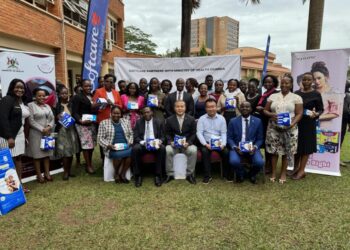














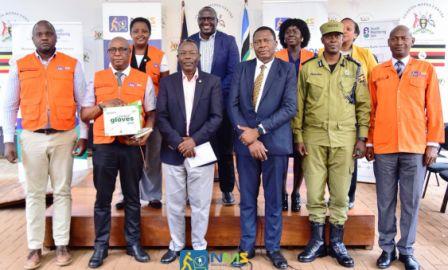
Uganda has launched a coordinated national campaign against the theft of government-procured medicines, bringing together the National Medical Stores (NMS), the Ministry of Health, the Uganda Police Force, and the Health Monitoring Unit (HMU) in a determined effort to safeguard public health.
The one-month media campaign was unveiled with the aim of raising nationwide awareness, enforcing accountability, and pushing for stronger penalties against offenders.
The NMS General Manager, Mr. Moses Kamabare, used the launch to issue a strong call to Parliament to impose tougher fines on those found guilty of drug pilferage.

He argued that the current penalties are inadequate and fail to discourage large-scale theft of medicines.
“Currently, when someone steals medicines worth UGX 200 million, they can walk away with a fine of about UGX 5 million. That is far too lenient. We recommend that whoever is found culpable pays three times the value of the commodities they are caught with. If someone is caught with goods worth UGX 1 billion, they should pay UGX 3 billion. That is how we deter offenders,” Kamabare explained.
The campaign, which will run on radio stations across the country and online platforms, is designed to reach both rural and urban communities.
It emphasizes that medicines supplied by government are purchased entirely with taxpayers’ money and must never be diverted, stolen, or sold under any circumstances.
Mr. Kamabare warned that the crime goes beyond financial loss, stressing the danger to human life when medicines fail to reach patients.
“Medicines are not just government assets that cost money, when stolen, they cost lives. No Ugandan should die because the drugs meant to save them were taken away,” he said.
To assure the public of NMS’s transparency, he explained the systems already in place to track medicine deliveries and empower citizens to monitor them.
“Every truck that leaves NMS is loaded with life-saving supplies and is fitted with GPS trackers. From here, we at NMS are able to monitor when a truck stops. Furthermore, we send dispatch and delivery alerts so stakeholders can monitor and verify deliveries in real time. Each consignment is accompanied with stamped and signed delivery notes..any citizen or official can verify that medicines reached their facility in good order,” he stated.
He further reminded Ugandans that all government-provided medicines are free of charge.
“If anyone asks you to pay, that is theft, report it immediately,” he declared.
The Uganda Police Force joined the campaign with an assurance of protection for whistleblowers who come forward with information.
Police spokesperson, ACP Rusoke Kituuma, underscored the seriousness of the crime and its impact on national security.
“The moment you blow the whistle, we are ready to protect you. Anyone who dares steal our medicines will be treated as a threat to national security and dealt with firmly. We must speak with one voice to defend the lives of Ugandans,” he affirmed.
The Health Monitoring Unit, represented by its head, Dr. Warren Namara, highlighted the widespread scale of the challenge.
He revealed the value of drugs and equipment recovered in recent years and the toll on patients who were denied essential treatment.
“The health of the population is a strategic resource. You destroy it at your own peril. In the past two years alone, we have recovered medicines and equipment worth over UGX 1.5 billion. Many cases are in court, and countless patients have suffered because drugs meant to save them were stolen,” Dr. Namara explained.
He urged the media to take a leading role in exposing culprits and called on the public to use the HMU hotline to report suspicious activities.
“We urge anyone that notices any suspicious to please call our hotline 0800200447,” he added.
The Director General of Health Services, Dr. Charles Olaro, used the platform to point to forthcoming reforms that will further strengthen oversight.
“The forthcoming National Drug and Health Products Authority Bill will be a game-changer, with strict penalties and special provisions for those entrusted with government medicines. But prevention is equally vital—safer road use, reduced alcohol intake, avoiding smoking, good nutrition, and exercise will lessen the demand for medicines and save lives,” Dr. Olaro said.
He also stressed the importance of hospital-level accountability, outlining measures being adopted across facilities.
He explained that hospitals are now reinforcing stock cards, dispensing logs, and Medicines & Therapeutics Committees, while aligning procurement plans with actual patient needs to minimize wastage and prevent medicines from expiring unused.
The multi-agency drive signals a stronger government resolve to crack down on medical theft, protect vital public resources, and ensure that every Ugandan has access to the life-saving medicines they are entitled to.