





President Yoweri Kaguta Museveni has called upon Ugandans to become active players in wealth creation, emphasizing that national economic transformation depends on the collective participation of all citizens.
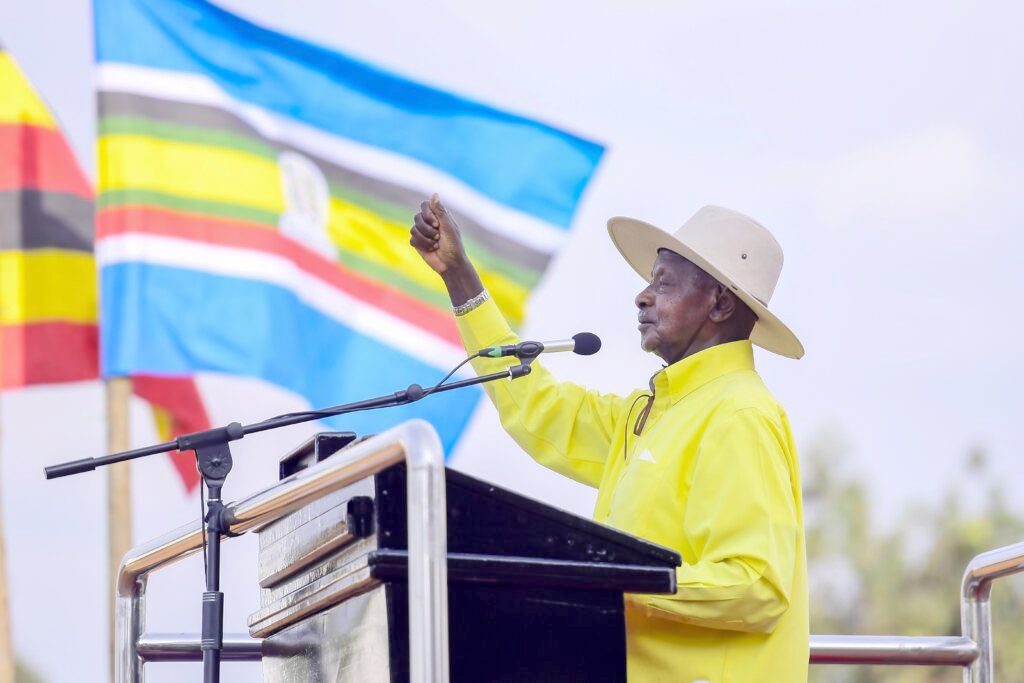
Speaking at a presidential campaign rally held at Boma Grounds in Oyam District on Tuesday, the President said that government programs such as the Parish Development Model (PDM) were designed specifically to ensure that every household directly contributes to Uganda’s journey toward prosperity.
Museveni warned that national development cannot be achieved if citizens remain passive recipients of government support, urging them instead to take full advantage of the initiatives available.
“When it comes to wealth creation, we don’t want spectators,” Museveni stated firmly. “With football or athletics, you can have players and fans, but with wealth creation, everyone must be a player.”
He explained that Uganda’s progress toward middle-income status rests on mass participation in production, value addition, and trade at the grassroots level.
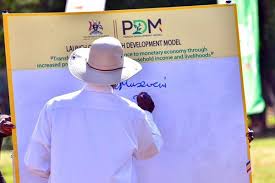
The President highlighted the Parish Development Model as a practical tool for empowering households to engage in commercial agriculture and other productive ventures that generate income.
“The infrastructure is there, roads, schools, health centers, but these are only useful if people use them to create wealth,” he said. “If you don’t work for money, poverty will still be waiting for you.”
Museveni noted that while the government has invested heavily in building roads, electricity networks, and social services, these facilities would only fulfill their purpose if citizens used them as foundations for enterprise and productivity.
Under the Parish Development Model, funds are disbursed directly to parishes through Savings and Credit Cooperative Organizations (SACCOs) to support small-scale and community-based enterprises.
The President announced that the government will raise the financial allocations under the program, increasing funding to Shs 300 million per urban parish and Shs 150 million for rural parishes.
He further revealed that an additional Shs 15 million will be provided to each parish to facilitate effective monitoring and coordination of projects.
Oyam District, where the President was speaking, has distinguished itself as a leading performer in implementing the PDM.
According to a joint evaluation conducted by the Ministry of Local Government and the Ministry of Finance, Oyam ranks first in Northern Uganda and fourth nationwide in the program’s execution.
District NRM Chairperson Bosco Onyik Ogwal reported that UGX 15.26 billion has already been distributed to 15,358 households across the district.
He explained that this financial injection has enabled many families—especially women and youth—to shift from subsistence farming to commercial production.
“Thousands of families who were previously in subsistence farming are now participating in the money economy,” Ogwal said. “Women have formed SACCOs, young people have begun enterprises, and lives are changing.”
The President commended these achievements and announced that the next phase of the PDM would focus on fish farming and livestock restocking to enhance productivity and sustainability in Northern Uganda.
“You will earn more from fishponds than from rice in swamps,” he advised, warning residents against degrading wetlands through improper cultivation practices.
Museveni outlined plans to restock homesteads with five cows each, describing the initiative as both “democratic and transformative.”
He said the strategy was designed to ensure that every household in the region has the means to participate in productive agricultural activities, thereby broadening the base of Uganda’s economic growth.
The President also attributed Uganda’s continued progress to the peace and stability maintained under the National Resistance Movement (NRM) government.
He said this stability has provided a conducive environment for developing strong institutions that support sustained growth and equitable distribution of opportunities.
Museveni reaffirmed that ongoing government investment in infrastructure, industrialization, and local enterprise development would enable every region of the country to share in the fruits of national progress.
“As we move towards middle-income status, no one should stand aside,” he concluded. “The goal is to make sure every Ugandan household contributes to, and benefits from, national prosperity.”
Through this call, the President reinforced his vision of an economically self-reliant Uganda, where every citizen is both a participant and a beneficiary of the nation’s steady march toward shared prosperity.