






President Yoweri Kaguta Museveni has reaffirmed his government’s renewed commitment to upgrading health facilities, improving education infrastructure, and promoting household wealth creation in the West Nile sub-region.
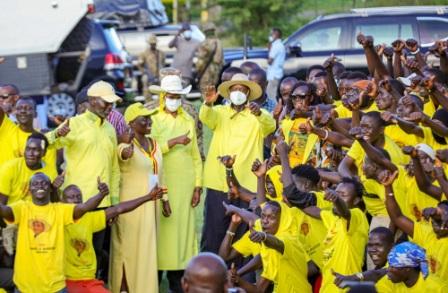
Speaking to thousands of supporters at the Arua Golf Course grounds in Arua City on Monday evening, Museveni outlined the National Resistance Movement (NRM)’s next phase of development priorities, which he said are aimed at consolidating the region’s progress and securing long-term prosperity for Ugandans.
The President praised Arua’s steady growth in the education sector, noting that the region has made remarkable strides over the years.
He reported that Arua District and Arua City now boast a total of 120 government-aided primary schools—50 in Arua District and 70 in Arua City—alongside 16 government secondary schools across both administrative units.
“For someone who has been here for a long time, seeing this progress makes me very happy,” Museveni said, reflecting on the transformation that has taken place since the NRM came to power in 1986.
Turning to healthcare, the President announced that the government plans to upgrade key health facilities to bring essential services closer to the people.
“On health, our plan in the next government is to upgrade Orivu Health Centre III to a Health Centre IV in Ayivu Division East, and to upgrade Lazebu Health Centre II to a Health Centre III in Arivu Sub-county,” he revealed.
Museveni reminded the crowd that one of the greatest legacies of the NRM government remains the restoration of peace and stability—foundations he said were indispensable for any meaningful development.
He recalled that before 1986, Uganda had been torn apart by instability and divisions rooted in ethnic and religious politics.
He emphasized that the NRM’s approach since taking power has been to unite Ugandans under a common vision rather than divide them by sectarian interests.
“The NRM opposed politics of sectarianism and marginalization,” he said. “We built a national party that unites Ugandans regardless of tribe, religion, or gender. That is why we win on the first round.”
The President stressed that political unity and peace must now translate into economic strength at the household level.
He said that while Uganda’s economy has grown, the government’s focus in the coming term will be to deepen wealth creation among families to eliminate poverty completely.
“If you have no income in your home, you create problems not only for your family but also for the country,” Museveni noted.
He explained that sustainable national growth depends on the ability of citizens to earn and participate in the economy through productive activities.
“The government receives taxes from what people buy. When you have no money, you are not contributing to your family or your nation,” he added. “I therefore urge everyone to be active in wealth creation and to support NRM to continue the battle against poverty.”
First Lady Maama Janet Museveni, who accompanied the President, expressed appreciation to the people of Arua for their unwavering support and loyalty to the NRM government.
She encouraged residents to preserve the unity and peace that Uganda currently enjoys, saying that national progress depends on collective effort and continued political stability.
The Arua rally formed part of President Museveni’s ongoing nationwide campaign tour themed ProtectingTheGains, an initiative aimed at reinforcing the achievements made under the NRM’s long rule while laying the groundwork for the next phase of Uganda’s socio-economic transformation.
The campaign also seeks to remind Ugandans of the progress made in peacebuilding, infrastructure, and service delivery since the NRM took office nearly four decades ago, while outlining the government’s agenda for inclusive growth.
Museveni’s message to the people of Arua fits into a broader development strategy for the West Nile sub-region—an area historically known for its resilience but also one that endured the brunt of Uganda’s post-independence instability.
Under the NRM, West Nile has seen an expansion in education, health, and transport infrastructure, along with improved cross-border trade with neighbouring Democratic Republic of Congo and South Sudan.
The President’s focus on wealth creation echoes the government’s Parish Development Model (PDM) and Emyooga programs, both designed to channel resources to the grassroots to stimulate production and self-reliance.
As the President continues his campaign trail in Maracha and Koboko Districts on Tuesday, his message remains consistent: that the NRM’s next term will prioritize practical service delivery, modernization of key sectors, and empowering every Ugandan to participate in building a self-sustaining economy.
By urging West Nile residents to protect the peace and prosperity achieved over the years, Museveni positioned his campaign not just as a bid for reelection, but as a call to preserve Uganda’s hard-won stability and use it as a springboard for lasting economic transformation.