















President Yoweri Kaguta Museveni has once again emerged as a strong advocate for a fair and cooperative global order, urging world leaders to abandon ideological rivalries and focus on partnerships that foster mutual benefit and prosperity.
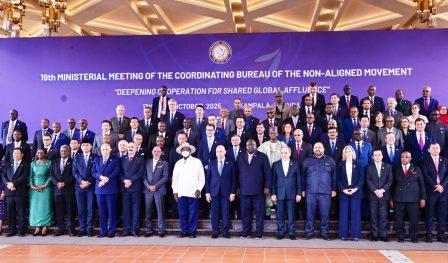
Speaking as Chairperson of the Non-Aligned Movement (NAM) during the 19th Ministerial Meeting of the Coordinating Bureau at Speke Resort Munyonyo, the Ugandan leader called for a renewed global spirit anchored on shared interests, peace, and economic interdependence.
The meeting, held under the theme “Deepening Cooperation for Shared Global Affluence,” runs from October 13 to 16, 2025, and brings together ministers and representatives from NAM’s 121 member states, the United Nations, African Union, and other international organizations.

President Museveni praised the wisdom of NAM’s founders, crediting them for establishing a neutral platform that prioritized peace and fairness during the tense Cold War era.
“I salute the Non-Aligned Movement. Our elders who started it did us a great service because they achieved neutrality,” President Museveni said.
He reminded delegates that neutrality—judging global issues on merit rather than allegiance—remains as relevant today as it was in the 20th century.
“At that time, there was a conflict between the socialist camp and the capitalist camp, and our elders said, ‘No, we want to be neutral. We want to judge issues on merit.’ That helped us then, and it is even more important today.”
The Ugandan leader criticized modern-day hegemonism, noting that attempts by some powers to dominate others are not only outdated but also counterproductive to global progress.
“Anybody who thinks they should control the world is wasting their time,” he said firmly.
Museveni proposed that nations should instead focus on what he termed “minimum mutually beneficial interests” — trade, investment, tourism, and human development — rather than divisive political ideologies.
“My advice to people in the world is that we concentrate on minimum mutually beneficial interests: trade, investments, tourism, and mutual support in any other area. Where we don’t agree, let us act by good example and not coercion,” he said.
Quoting the Bible verse, “Let your light so shine before men that they may see your good deeds and praise your Father who is in heaven,” President Museveni explained that true global influence should arise from setting positive examples, not through force or domination.
In his historical reflection, Museveni drew lessons from Europe’s religious and political conflicts, including the Thirty Years’ War and the collapse of the Austro-Hungarian Empire, to demonstrate the futility of suppressing societal evolution.
“When one of the kings of England wanted to become Protestant, the Pope refused to allow anyone to change from Catholicism, and that caused a lot of chaos,” he noted. “In the end, the Pope failed.”
“When capitalism emerged in France after the Revolution, Metternich of Austria-Hungary tried to stop it but failed. Where is Austria-Hungary today? It disappeared because it wanted to stop the evolution of history, which is impossible,” he added.
Museveni emphasized that each nation must have the freedom to determine its own social and political systems without external interference.
He also drew attention to the benefits of scientific progress and industrial advancement, noting that humanity thrives collectively when nations uplift each other.
“Once there is an advance in the control of nature through science, we should be very happy, and there should be no conflict. I don’t see why anybody would worry that country X, B, or C has come out of poverty and is more prosperous,” he explained. “Why don’t we want all our partners to be prosperous so that you can do better business?”
Using China’s rise as a case study, Museveni said the Asian giant’s technological growth has indirectly benefited Uganda and other developing countries by making industrial materials such as steel more accessible.
He reiterated that Africa’s economic transformation is central to global prosperity, urging fellow leaders to embrace industrialization, innovation, and value addition.
“If Africa’s GDP per capita was $20,000, we would have a total GDP of about $30 trillion. At $25,000, it would reach $45 trillion. That would not only make Africa richer but would benefit our trading partners because we would buy more from them,” Museveni reasoned.
The President thanked NAM member states for entrusting Uganda with the chairmanship, expressing confidence that the movement remains a powerful voice for equity in global affairs.
“We are very happy that you have come to Uganda in such big numbers. I thank you for honoring us with the chairmanship of the Non-Aligned Movement. When I look around and see all of us together, I believe we may be the hope of the world,” he said.
Representatives from the United Nations and African Union lauded Uganda’s leadership of NAM, describing it as pivotal in advancing multilateral cooperation.
The representative of UN Secretary-General António Guterres congratulated Uganda for its dynamic chairmanship and reaffirmed NAM’s relevance in promoting dialogue and South-South partnerships.
H.E. Ambassador Musa Mohamed Omar, representing AU Commission Chairperson Mahamoud Ali Youssouf, echoed similar sentiments, urging NAM to work with the G77 plus China to push for reforms in global governance.
“Those who benefit from the current world order are defending the status quo. But if we put our efforts in common and align our vision with other frameworks such as the G77 plus China, we will be able to influence the construction of a new, fairer world order,” Ambassador Omar said.
He also condemned coercive unilateral measures imposed on some nations, calling them obstacles to peace and sustainable development.
The current NAM Midterm Review builds upon the success of the January 2024 Kampala Summit, which positioned Uganda as a hub for diplomatic dialogue and South-South cooperation. Discussions this week are expected to focus on peacebuilding, industrial transformation, technology transfer, and climate resilience.
Founded in 1961 by visionary leaders including Jawaharlal Nehru, Josip Broz Tito, Gamal Abdel Nasser, Sukarno, and Kwame Nkrumah, the Non-Aligned Movement has grown into the world’s second-largest multilateral bloc after the United Nations—representing over half of humanity and two-thirds of UN member states.
More than six decades later, Museveni’s call for partnership and mutual growth reaffirms NAM’s enduring mission: that peace and prosperity can only thrive where cooperation replaces coercion, and respect replaces rivalry.