












President Yoweri Kaguta Museveni has reaffirmed Uganda’s commitment to deepening its historical relations with the Republic of Cuba through a groundbreaking trade partnership centered on food-for-medicine exchange.
The initiative, discussed during a high-level bilateral meeting at the sidelines of the 19th Ministerial Meeting of the Coordinating Bureau of the Non-Aligned Movement (NAM) at Speke Resort Munyonyo in Kampala, signals a new chapter in Uganda–Cuba cooperation.
The proposed deal will allow Uganda to export food items to Cuba in exchange for essential medicines and medical supplies, an arrangement that aligns with both countries’ long-standing traditions of solidarity and mutual support.

President Museveni, who hosted the Cuban delegation on Wednesday, 15th October 2025, expressed Uganda’s readiness to operationalize the initiative in the next financial year.
“We are ready. We are going to target the next financial year. We are going to start planning, and we shall budget for it,” the President said.
He explained that the trade framework would be designed to benefit both nations — strengthening Uganda’s agricultural export base while ensuring access to affordable medicines for its population.
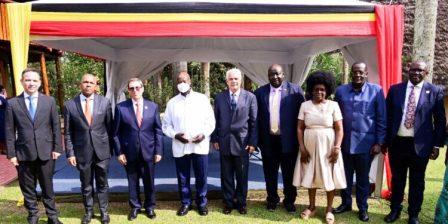
The Cuban delegation was led by Cuba’s Minister of Foreign Affairs, Bruno Rodríguez Parrilla, who delivered warm greetings and best wishes from Army General Raúl Castro and Cuban President Miguel Díaz-Canel Bermúdez.
He also extended an official invitation to President Museveni to visit Havana at his convenience, emphasizing Cuba’s commitment to expanding economic and scientific collaboration with Uganda.
The discussions focused on broadening bilateral cooperation in key areas, including trade, science, technology, and manufacturing, reflecting a shared vision for self-reliance and sustainable development.
President Museveni reiterated Uganda’s readiness to embrace barter trade as a practical solution to economic challenges facing developing nations, particularly in a volatile global financial environment.
He underscored that the arrangement with Cuba would not only enhance trade relations but also promote mutual resilience by leveraging each country’s comparative advantages.
The proposed trade initiative will be implemented through the National Enterprise Corporation (NEC) — the commercial arm of the Uganda People’s Defence Forces (UPDF).
Under this framework, NEC will manage the procurement and export of key food commodities such as maize and beans to Cuba, while coordinating the import of essential medicines and medical equipment in return.
Lt. Gen. James Mugira, the Managing Director of NEC, briefed the President on the progress of preliminary consultations held with Cuban officials.
He explained that both sides had already assessed Cuba’s food requirements and identified the categories of medical supplies to be exchanged with Uganda.
“These supplies will be directed to the Ministry of Health to enhance healthcare delivery and improve the quality of life of Ugandans,” Gen. Mugira said.
The food-for-medicine exchange is expected to serve as a model for other African and Latin American nations exploring non-cash trade systems to strengthen economic resilience amid global inflation and supply chain disruptions.
The meeting was attended by several senior government officials and diplomats, including Hon. Dr. Monica Musenero, Minister for Science, Technology, and Innovation; Hon. Vincent Bagiire, Permanent Secretary of the Ministry of Foreign Affairs; H.E. Juan Humberto Macias Pino, Cuban Ambassador-Designate to Uganda; and Alberto Amoros Nunez, Head of the Cuban Sub-Saharan Africa Division.
The discussions reflect a revival of historical Uganda–Cuba ties that date back to the 1960s, when both nations aligned under the Non-Aligned Movement (NAM), championing independence, anti-imperialism, and South-South cooperation.
Over the decades, Cuba has contributed significantly to Africa’s healthcare and education sectors — sending doctors, training students, and offering scholarships to Ugandan and other African medical professionals.
President Museveni has repeatedly praised Cuba for its solidarity with Africa, especially during the liberation struggles and its continued support for developing nations through technical and scientific exchange.
Analysts believe that the new barter arrangement underscores Uganda’s strategy of diversifying trade partnerships and reducing dependency on foreign currency transactions.
The model also fits into President Museveni’s broader “Buy and Build Africa” vision, aimed at promoting intra-global south trade and creating self-sustaining economies that can thrive through mutual exchange rather than debt-based trade.
The anticipated deal, once finalized, is expected to bolster Uganda’s agricultural sector — one of the country’s largest employers — while strengthening the health system through reliable access to quality medicines.
As both nations prepare to translate their shared vision into action, the Uganda–Cuba food-for-medicine frame work could become a landmark example of innovative South-South trade cooperation.
It not only reaffirms President Museveni’s long-standing advocacy for practical economic independence but also revives Uganda’s historical role as a bridge between Africa and Latin America within the Non-Aligned Movement.