
















The Uganda National Examinations Board (UNEB) has launched an emergency plan to avert disruptions to this year’s Primary Leaving Examinations (PLE), following renewed industrial action by arts teachers across the country.
In a circular dated October 14, 2025, UNEB Executive Director **Dan N. Odongo** warned that the ongoing strike by primary school teachers could significantly affect the turnout of invigilators during the national examinations.
“The industrial action by primary school teachers is still on and might affect the turnout of teachers for PLE invigilation,” the letter reads in part.

The circular, addressed to District, Municipal, and City Inspectors of Schools, urged education officials to use all available means to persuade teachers to participate in the examination exercise.
Odongo emphasized that those who take up the task should be paid promptly to encourage participation and maintain morale.
To prevent a shortage of personnel, UNEB instructed districts to widen their recruitment pool.
The Board advised that potential invigilators could include teachers from private schools, those not yet on the government payroll, secondary school teachers who are available, and retired but physically capable educators willing to serve.
This measure reflects UNEB’s contingency approach to maintaining the integrity and continuity of national assessments, despite ongoing labour unrest within the education sector.
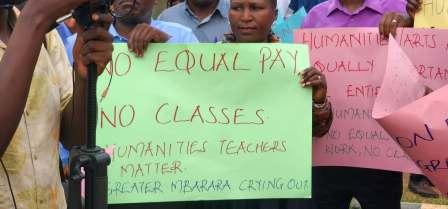
The development comes amid a nationwide strike by arts teachers organized under the Uganda National Teachers’ Union (UNATU), who are protesting the government’s continued failure to harmonize their salaries with those of science teachers.
The current standoff traces its roots to*2022, when the government implemented a salary enhancement policy that favoured science teachers, nearly doubling their pay while leaving their arts and humanities counterparts behind.
That decision, although justified by government officials as part of a drive to promote Science, Technology, Engineering and Mathematics (STEM), has since deepened divisions among teachers and triggered a cycle of strikes in public schools.
UNATU argues that the pay disparity undermines teacher morale, devalues arts subjects, and violates the principle of equal work for equal pay.
The timing of this latest strike has raised serious concerns about the administration of the 2025 PLE, which is scheduled to commence later this month and will involve thousands of candidates across Uganda.
In his letter, Odongo expressed UNEB’s awareness of the potential logistical challenges posed by the strike, warning that any large-scale absenteeism of teachers could jeopardize the credibility and security of the examinations.
The circular, issued under the theme “Embracing Security and Holistic Assessment of Learners in a Dynamic Environment,” reflects UNEB’s broader focus on ensuring that all national exams are conducted fairly, securely, and without interruption.
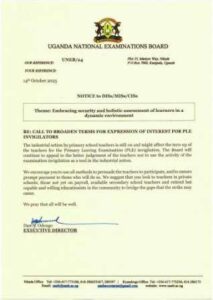
“We pray that all will be well,” Odongo said in conclusion, underscoring the Board’s hope that dialogue between government and teachers will resolve the impasse in time.
Education analysts note that UNEB’s directive to include private and retired teachers marks one of the most extensive emergency mobilization efforts in recent years.
The approach mirrors strategies adopted during previous industrial disruptions, including the COVID-19 period, when examination bodies relied on volunteers and temporary invigilators to ensure continuity.
However, education experts warn that the heavy dependence on non-government teachers and retirees could present new challenges, including limited experience with UNEB protocols and increased financial strain on districts tasked with facilitating the recruitment process.
Despite these concerns, UNEB maintains that all necessary steps are being taken to preserve the credibility of the PLE, which remains the cornerstone of Uganda’s education system.
The PLE serves as the gateway to secondary education and is regarded as one of the most high-stakes examinations in the country, with over 800,000 candidates registered annually.
For many Ugandan families, it represents not only the culmination of seven years of primary education but also the first major test in a child’s academic journey.
As the examination season approaches, UNEB’s quick response and contingency planning underscore the government’s broader challenge — balancing teacher welfare with the need to maintain stability in the education sector.
The Board’s decision to tap into private and retired teachers demonstrates its determination to ensure that no candidate’s future is jeopardized by labour disputes.
Still, the outcome will largely depend on whether ongoing negotiations between the Ministry of Education and UNATU yield a resolution before the PLE begins.
For now, all eyes remain on Uganda’s classrooms — and on the thousands of teachers, parents, and pupils anxiously waiting for stability to return before the examinations start later this month.