













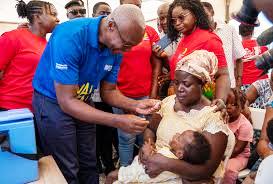
The World Health Organization (WHO) has sounded an alarm over a looming financial crisis that could severely undermine decades of progress toward eradicating polio worldwide.
According to the WHO, the Global Polio Eradication Initiative (GPEI) — a coalition that includes the WHO, UNICEF, the U.S. Centers for Disease Control and Prevention (CDC), Rotary International, and the Bill & Melinda Gates Foundation — is facing a $1.7 billion funding shortfall through 2029.
The deficit, which will result in a 30 percent budget reduction beginning in 2026, threatens to stall vaccination drives, surveillance operations, and emergency response efforts that have been instrumental in reducing polio cases to historic lows.

“The significant reductions in funding … mean that certain activities will simply not happen,” warned Jamal Ahmed, WHO’s Director of Polio Eradication, during a press conference on Tuesday.
Ahmed stressed that the cutbacks could jeopardize the final push to eliminate the virus globally, even though eradication remains within reach.
“Eradication remains feasible and is doable,” he stated. “We need everybody to remain committed and ensure that no child is left behind.”
The funding shortfall comes at a critical time for the global campaign, which has been ongoing since 1988, when the GPEI was first launched. At that time, polio paralyzed an estimated 350,000 children annually across more than 125 countries.
Today, transmission of the wild poliovirus remains endemic in just two nations — Afghanistan and Pakistan — but experts warn that complacency could lead to resurgence.
Officials attribute the current financial crisis largely to a decline in foreign aid, particularly from some of the initiative’s traditional major donors.
The United States, which had been one of GPEI’s most consistent supporters, has significantly scaled back its contributions following the return of President Donald Trump to office and his administration’s renewed skepticism toward multilateral health organizations such as the WHO.
Similarly, Germany and the United Kingdom, both of which have faced economic pressures and domestic political realignments, have also reduced their international health funding.
The combined effect of these cuts has left the GPEI scrambling to reassess its operational priorities.
To adapt to the constrained funding, the initiative plans to focus its resources on surveillance and vaccination campaigns in the highest-risk regions, particularly Afghanistan and Pakistan, where 36 cases of wild poliovirus have been recorded in 2025 alone.
The GPEI also intends to integrate its operations with other global health programs, such as measles immunization campaigns, to maximize efficiency and outreach.
In addition, the organization will expand the use of fractional dosing, a scientifically validated method that delivers only a fifth of a standard vaccine dose but still provides effective immunity. This approach allows limited vaccine supplies to protect a larger number of children.
Lower-risk areas, meanwhile, will see scaled-back operations, with interventions only reactivated in response to confirmed outbreaks.
Polio eradication has long been considered one of the most ambitious public health undertakings in history. While the disease has been eliminated in most of the world, recent years have seen a troubling rise in vaccine-derived poliovirus cases.
In 2025 alone, 149 cases of vaccine-derived polio have been detected in several countries, including Nigeria.
This form of polio emerges when children vaccinated with an oral vaccine — which contains a weakened form of the virus — shed the virus in their stool, allowing it to mutate and spread in under-immunized communities.
Despite this challenge, health experts maintain that the benefits of vaccination far outweigh the risks, emphasizing that continued immunization and strong surveillance systems remain the only path to full eradication.
“Without sustained vaccination efforts, we risk losing decades of progress,” one WHO official noted.
Global health data indicates that both wild and vaccine-derived polio cases have continued to decline since 2024, reflecting the effectiveness of the GPEI’s ongoing efforts. However, experts warn that the current funding gap could reverse these gains, potentially allowing the virus to regain ground in vulnerable regions.
As the world edges closer to what could be the end of polio, WHO officials are urging donor nations and private partners to renew their financial commitments to ensure that the dream of a polio-free world does not slip away after nearly four decades of struggle.