















The Uganda Bureau of Statistics (UBOS) has entered a new collaboration with the Umukuuka wa Bugisu aimed at improving the collection, analysis, and dissemination of statistics within the Bugisu sub-region.
As part of the partnership, UBOS has committed to providing the cultural institution with office furniture, three desktop computers, and an undisclosed number of computer tablets to facilitate data management and statistical work.
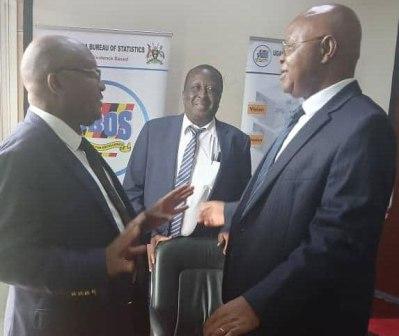
The partnership agreement was formalized through a Memorandum of Understanding (MoU) signed between UBOS Executive Director, Dr. Chris Ndatira Mukiza, and Umukuuka wa Bugisu, in the presence of the institution’s Information, Media, and Communications Minister, Mr. Alfred Geresom Musamali.

UBOS’s latest engagement with Bugisu follows similar partnerships established earlier this year with other cultural institutions across the country, which also received tablet computers used during the National Population and Housing Census (NPHC) 2024 — Uganda’s first-ever fully digital census.
The NPHC 2024 marked a milestone in Uganda’s data collection history, as UBOS deployed thousands of tablet computers across the country. Some of these devices were produced locally by a Chinese technology firm operating in the Mbale Industrial Park, underlining the region’s growing role in Uganda’s digital transformation.
Speaking after the signing ceremony, Dr. Mukiza emphasized that the partnership with the Umukuuka wa Bugisu represents an important step toward community-level data empowerment and localized decision-making.
He revealed that UBOS is establishing a permanent regional office in Mbale City, which will serve as a hub for training, coordination, and statistical development in the Bugisu region.
“Capacity building means training their statisticians and also attaching UBOS statisticians to work with them so as to avoid duplicating effort,” said Dr. Mukiza, noting that the new office would replace the existing Consumer Price Index (CPI) centre, which has historically been limited in function.
According to Mr. Musamali, the Umukuuka wa Bugisu has embarked on setting up a dedicated statistics unit to generate accurate and timely data for evidence-based policy formulation and planning.
He explained that one of the institution’s priority areas will be collecting detailed statistics on circumcision, the Bagisu’s most important cultural ritual, which is carried out every even year among adolescent males.
“Among the information we wish to collect is the number of males that undergo circumcision from each clan each season,” said Musamali, adding that the data would help in planning logistics for the cultural rite.
He elaborated that the number of initiates each year determines how many traditional surgeons are needed for the operation — a demand that sometimes compels families to bring in surgeons from neighboring Kenya, where culturally related communities also perform the ritual.
Beyond cultural rites, the Umukuuka wa Bugisu is also looking to apply data-driven insights to environmental and resource management.
Musamali revealed that the institution intends to monitor the rate of harvesting and consumption of kamalea (bamboo shoots) — a traditional delicacy harvested from the forests of Mt. Elgon.
“Umukuuka wa Bugisu is interested in establishing the rate of harvesting and consumption of kamalea so as to work out if their practice is culturally sustainable,” he explained, noting that overharvesting could threaten both biodiversity and the continuity of cultural culinary traditions.
During the same event, UBOS also signed collaboration agreements with the Bunyoro Kingdom and the Inter-Religious Council of Uganda (IRCU), reinforcing its strategy of building broad-based partnerships for data development.
Dr. Mukiza noted that UBOS’s mandate extends to working with cultural and faith-based institutions, as they play a vital role in community mobilization and information dissemination.
“UBOS is mandated to establish collaborations, including with cultural institutions,” he stated. “But we encourage the use of environmentally sustainable methods of collaboration, and that is why we are providing computers to reduce the amount of paper consumed. Paper is known to be environmentally unsustainable.”
He further urged all cultural institutions that have signed MoUs with UBOS to develop strategic plans for statistics, which will guide their data collection and management efforts in alignment with national frameworks.
The new partnership marks a major stride in Uganda’s efforts to decentralize data systems and integrate cultural institutions into the national statistical ecosystem. Analysts say it could transform how traditional institutions participate in development planning, policy evaluation, and environmental conservation — making data not just a government tool, but a community asset.