
















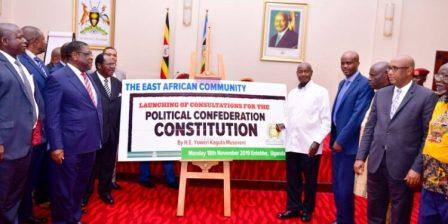
Museveni Positions Uganda at the Heart of East Africa’s Political and Economic Unification Drive
President Yoweri Kaguta Museveni has reaffirmed his bold ambition to transform the East African Community (EAC) into a politically federated bloc with a shared constitution and single currency by 2031.
The agenda, central to his 2026–2031 re-election manifesto, goes beyond mere political aspiration. It represents a deeply ideological and strategic recalibration of Africa’s place in the global order—anchored in pan-Africanism, economic transformation, and regional security.

President Museveni’s proposal envisions an East Africa that functions as a single political federation, governed under one constitution, trading under one currency, and speaking with one voice on global platforms.
Pan-African Roots of Museveni’s Vision
At the core of this agenda lies President Museveni’s long-standing belief in pan-Africanism, a philosophy that has shaped his political ideology for decades.
The President argues that Africa’s challenges stem from the artificial divisions imposed by colonial borders that fragmented the continent into weak and economically unviable states.
“Africa’s 1.4 billion people are broken into small units. Small populations mean small markets. Small markets mean low prosperity,” he remarked during a recent engagement at the East African Community Secretariat in Arusha.
Uganda, with a population of 46 million, may appear large by regional standards, but even its domestic market is too small to drive high prosperity levels on its own.
President Museveni has often drawn comparisons with historic unifications such as Germany in 1871, Italy in 1860, and the modernization paths of China and India—arguing that integration is the only route to sustained growth and independence.
“Our economic problems—surpluses of sugar, maize, cassava, milk, and bananas—are not because we overproduce but because we are disorganized and have limited markets,” Museveni explained. “The solution is a unified African free market.”
Integration as an Economic Imperative
The African Continental Free Trade Area (AfCFTA), established in 2017, is central to this strategy.
By reducing intra-African trade barriers, AfCFTA opens wider markets for Ugandan goods and reduces dependence on traditional Western markets.
“If we mobilize the whole of Africa to remove trade barriers, we shall no longer worry about being shut out of markets in Europe or the USA,” Museveni said.
The President has backed his words with tangible actions. Uganda and the Democratic Republic of Congo (DRC) are already collaborating on cross-border infrastructure such as the Mpondwe–Beni highway, designed to strengthen regional connectivity and trade.
A Shared Vision Among East African Leaders
Museveni’s integration agenda has found resonance among other EAC leaders, each emphasizing a different dimension of unity.
Kenya’s President William Ruto, speaking at the EAC Heads of State Summit in Arusha, underscored the urgency of economic convergence. “We must move beyond rhetoric. A single currency will eliminate transaction costs and boost intra-regional trade. Political federation is the next logical step,” Ruto said.
Tanzania’s President Samia Suluhu Hassan highlighted the importance of cultural unity in achieving political cohesion. “Kiswahili is more than a language—it is our shared heritage. Promoting Kiswahili across East Africa will strengthen our identity and ease communication,” she noted during a regional youth forum.
Rwanda’s President Paul Kagame also lent his support to the federation project, emphasizing its strategic benefits. “A united East Africa can negotiate with global powers from a position of strength. Fragmentation weakens us,” Kagame said at the African Union Summit.
Political Federation as a Shield for Regional Sovereignty
For President Museveni, political integration is not only an economic issue—it is a question of survival and strategic autonomy.
He argues that while market integration provides economic resilience, only political unity can safeguard the sovereignty of African nations in an increasingly competitive and polarized global landscape.
“Market integration alone cannot solve strategic inferiority. Political integration is the shield that protects our sovereignty,” Museveni asserted.
Under the proposed East African Federation, Uganda, Kenya, Tanzania, Rwanda, Burundi, South Sudan, and the DRC would form a powerful bloc of more than 340 million people, commanding a combined GDP (PPP) exceeding USD 1 trillion.
The Five Pillars of Museveni’s Integration Blueprint
President Museveni’s 2026–2031 NRM manifesto outlines five central commitments to fast-track the federation agenda.
First, Uganda will champion the EAC Political Federation process, including the drafting and ratification of a shared constitution.
Second, it seeks to establish a single EAC currency to facilitate trade and minimize exchange rate volatility.
Third, it will work to eliminate non-tariff barriers to enable seamless movement of goods, people, and services across borders.
Fourth, Uganda will promote Kiswahili as a unifying regional language to foster cohesion and shared identity.
Finally, the country will leverage AfCFTA frameworks to expand trade beyond East Africa, deepening ties across the continent.
These commitments align closely with the EAC’s Sixth Development Strategy (2021–2026), which prioritizes customs harmonization, fiscal convergence, and implementation of the Single Customs Territory.
Regional Trade Growth and the Path to Federation
Uganda’s trade statistics already reflect the benefits of regional integration.
Exports to the East African Community reached USD 2.84 billion in FY2024/25, underscoring the growing interdependence among partner states.
The inclusion of South Sudan and the DRC into the EAC has also expanded the bloc’s economic footprint, making it one of the most dynamic regional groupings in Africa.
The EAC’s integration journey began in 2000 and has since passed through three milestones: the Customs Union (2005), the Common Market (2010), and the Monetary Union (2013).
The Political Federation remains the final and most transformative stage—one that Museveni insists is both achievable and essential.
Fighting Sectarianism to Build Unity
Museveni has cautioned that tribalism, sectarianism, and religious divisions remain major obstacles to achieving meaningful integration.
“Our enemies are those who push for sectarianism. They do not understand the value of integration,” he said.
He emphasized that unity must be built on ideology, not ethnicity, and that East Africans must transcend parochial interests for the sake of continental prosperity.
Challenges Ahead, but the Vision Persists
Experts note that while the goal of federation is laudable, it faces practical challenges—ranging from political will and economic disparities to bureaucratic delays and public skepticism.
However, the strategic and economic opportunities it presents far outweigh the risks.
A united East Africa could become one of the world’s most powerful emerging blocs, with the ability to negotiate better trade terms, pool security resources, and coordinate macroeconomic policy.
Museveni’s integration agenda is therefore not just a campaign promise—it is a legacy project designed to define East Africa’s future trajectory.
As he often reminds his audiences, the vision of “One People, One Destiny” must move from rhetoric to reality.
Vision for the Next Generation
The idea of a united East Africa is not a utopian dream but a strategic necessity.
With visionary leadership, regional solidarity, and active citizen engagement, Museveni believes the goal can be realized within this generation.
His vision calls upon all East Africans to imagine a future where borders are bridges, currencies are unified, and a common constitution enshrines shared values and prosperity.
“The question is no longer whether we can achieve federation,” Museveni declared recently. “The question is how fast we can make it happen.”
Background: The Evolution of the East African Community
The East African Community, re-established in 2000, builds upon earlier integration attempts dating back to 1917 under the colonial administration of Kenya and Uganda.
Its revival brought renewed hope for shared growth, beginning with the Customs Union in 2005, the Common Market in 2010, and the signing of the Monetary Union Protocol in 2013.
With a combined population exceeding 340 million and a GDP of over USD 1 trillion, the EAC is now Africa’s fastest-integrating regional bloc.
As Uganda positions itself as a central driver of the next phase—political federation—the region stands at a historic crossroads between aspiration and action.
For President Museveni, the mission remains clear: to unite East Africa under a single constitution, one currency, and one destiny.