









President Yoweri Kaguta Museveni has hailed Russia as a “historic ally and ideological partner” in Africa’s liberation and development journey, reaffirming Uganda’s long-standing ties with Moscow as rooted in shared revolutionary ideals rather than mere defense cooperation.
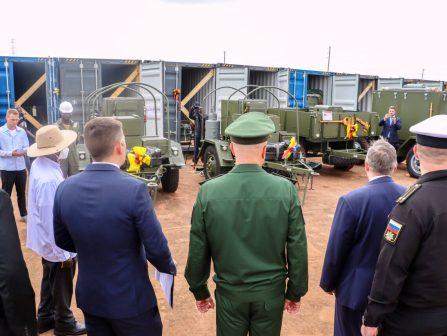
The President made the remarks on Sunday, October 26, 2025, while presiding over a high-profile ceremony at Gaddafi Military Barracks in Magamaga, where the Russian Federation officially handed over defense equipment worth $53 million to the Uganda People’s Defense Forces (UPDF).
At the same event, President Museveni launched the Military Mechanised Major Repair Facility at Magamaga and a new engineering workshop under construction in Entebbe, both designed to strengthen Uganda’s capacity for local maintenance and self-sustained defense logistics.

The donated military hardware, which includes obstacle clearers, trench diggers, boats, mobile workshops, and a coastal station, was described by the President as “very important and practical contributions” to Uganda’s defense modernization.
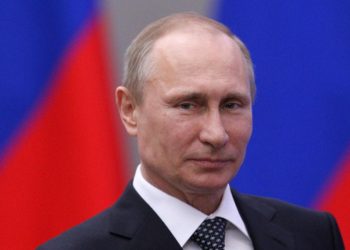
“I want to thank His Excellency Vladimir Putin for this donation of various equipment valued at $53 million. All of them are good, and they make work so easy,” President Museveni said.
He noted that Russia’s gesture goes beyond material support, symbolizing renewed commitment to mutual cooperation and ideological solidarity between the two nations.
Tracing the historical roots of Uganda–Russia relations, President Museveni situated the partnership within a broader global context of anti-imperialist struggle, noting that the foundation of Africa’s liberation movements drew strength from the ideals of the 1917 Russian Revolution.
“By 1900, the whole of Africa, except for Ethiopia, had been colonized. The first Africans to organize for liberation were the South Africans, who formed the ANC in 1912. But globally, we were isolated. The only friends of African freedom fighters were African-Americans,” he said.
He added that the Soviet Revolution became a turning point for the global oppressed, inspiring anti-colonial movements and providing moral and ideological backing to freedom fighters across the developing world.
President Museveni also credited the 1949 Communist Revolution in China for further transforming global geopolitics by giving rise to new allies for Africa’s decolonization agenda.
“Therefore, our relationship with Russia is not just defense and security—it is ideological and strategic,” he emphasized.
The President underscored that Uganda’s foreign policy remains anchored in the principles of sovereignty, non-alignment, and mutual respect, noting that the country continues to work with all international partners who value equality and independence.
The Minister of Defense and Veteran Affairs, Hon. Jacob Oboth Oboth, praised the President for his consistent leadership in prioritizing security as a cornerstone of national development.
“We want to thank you for the strategic guidance and leadership that you give to our ministry and the Uganda People’s Defense Forces,” Hon. Oboth said.
“Your wise decisions in prioritizing security and defense matters as a precondition for development continue to shape our success,” he added.
The minister extended appreciation to the Russian government for its sustained partnership and pledged that Uganda would continue to deepen its defense and technical cooperation with Moscow.
Representing the Chief of Defense Forces, Lt. Gen. Kayanja Muhanga, the Commander of Land Forces, described Russia’s donation as a “symbol of genuine partnership and historical continuity.”
“This assistance is not just equipment and resources. It represents a powerful commitment to security, peace, and stability for all,” Gen. Kayanja said.
He observed that the new facilities would enhance the UPDF’s operational capacity and reduce dependence on external maintenance support, making the force more efficient and self-reliant.
The Ambassador of the Russian Federation to Uganda, H.E. Vladlen Semivolos, reaffirmed Moscow’s long-standing friendship with Kampala, founded on principles of mutual trust, non-interference, and respect for national sovereignty.
He noted that Russia was among the first countries to recognize Uganda’s independence and has remained a steadfast partner in defense, education, and industrial development.
“We are pleased to see that under His Excellency Yoweri Kaguta Museveni, Uganda continues to develop as a strong, independent, democratic, and prosperous country,” Ambassador Vladlen said.
He recalled that the meeting between Presidents Museveni and Vladimir Putin at the Second Russia–Africa Summit in 2023 laid the foundation for expanded cooperation in defense technology, infrastructure, energy, and education.
In recognition of the enduring partnership between the two countries, ten Russian dignitaries were decorated with the National Independence Diamond Jubilee Medal for their outstanding service in strengthening Uganda’s sovereignty and defense capacity.
The medal, awarded under Section 3 of the National Honors and Awards Act (2001, Cap 173), is among Uganda’s highest civilian honors, given to individuals who have rendered exceptional contributions to the protection and promotion of national independence.
The high-profile event attracted Uganda’s top military and government officials, including Ms. Rosette Byengoma, Permanent Secretary of the Ministry of Defense and Veteran Affairs; Lt. Gen. Jack Agonza Bakasumba, UPDF Chief of Joint Staff; and Maj. Gen. D.K. Sande, Commander of the UPDF Armored Division.
Others present were Maj. Gen. Moses Rwakitarate, Commander of the 3rd Headquarters Vital Assets Infantry Brigade; Maj. Gen. Don Nabasa, Joint Staff (Policy and Strategy); Brig. Gen. Richard Wakainja, Head of the Combat Engineers Brigade; Brig. Gen. Goodwin Karugaba, Joint Staff (Logistics); Brig. Gen. Robert Mugabe, Joint Staff (Finance); Brig. Gen. Akankunda, Joint Staff (Operations); and Senior Superintendent of Police Kyeyune Edirisa, Regional Police Commander for Busoga Eastern Region.
Defense analysts have noted that the latest cooperation signals a new phase in Uganda–Russia relations, characterized by technical collaboration, mutual capacity-building, and renewed geopolitical alignment amid shifting global power dynamics.
As global attention pivots toward Africa’s strategic importance, President Museveni’s message at Magamaga was clear: Uganda’s partnerships will continue to be guided by historical friendship, mutual respect, and the pursuit of self-reliant defense and development.