
















Kampala is on the brink of a major transformation as government unveils an ambitious plan to eliminate all fuel-powered boda bodas from the capital by 2026 and replace them with electric motorcycles.
The initiative marks a historic step in Uganda’s commitment to clean energy, sustainable urban mobility, and climate action, positioning Kampala as a model for green transport in Africa.
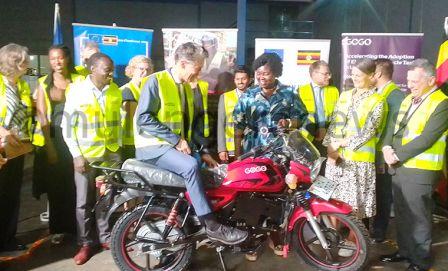
The plan was officially announced by the Minister of Energy and Mineral Development, Hon. Ruth Nankabirwa, during a visit to Gogo Electric, a Kampala-based electric motorcycle assembly company, as part of the Green Diplomacy Week 2025 events hosted by the European Union (EU) Delegation in Uganda.

“All the boda bodas in Kampala must be electric by next year, 2026. There is no reason why we should not. Kampala, the capital city, must serve as a model in reducing smoke and CO₂ emissions,” Hon. Nankabirwa said.
Her statement set the tone for Uganda’s new era of e-mobility, aligning with global efforts to reduce urban air pollution and transition to clean energy transport systems.
The visit, attended by EU Ambassador Jan Sadek, EDFI representatives, and Gogo Electric executives, showcased Uganda’s growing collaboration with the EU under the Global Gateway and ElectriFI initiatives, both of which promote sustainable energy investment and green industrial innovation.
In 2024, the EU invested USD 1.5 million in Gogo Electric through its ElectriFI impact facility, supporting the company’s efforts to locally assemble electric motorcycles and batteries.
Building on that success, a follow-on investment of USD 1 million was announced to expand Gogo’s battery-swapping infrastructure and increase production capacity to 27,000 electric motorcycles and 43,000 batteries.
Ambassador Sadek commended Uganda’s progress in clean transport adoption, describing the project as a benchmark for sustainable development in Africa.
“The EU’s investment in Gogo Electric demonstrates our shared vision for a climate-neutral, job-creating, and sustainable economy. Thousands of electric motorcycles, supported by battery-swapping stations, will clean the air and provide new livelihoods for Ugandans,” he said.
Gogo Electric currently employs about 250 Ugandans, with expansion plans expected to create hundreds more jobs across manufacturing, battery maintenance, and distribution.
The company assembles most motorcycle and battery components locally, reinforcing Uganda’s drive toward industrialization, while importing specialized parts that are not yet produced domestically.
Its innovative battery-as-a-service model allows riders to swap used batteries for charged ones at multiple stations across the city, ensuring uninterrupted rides and eliminating the downtime associated with recharging.
Minister Nankabirwa said the government is committed to supporting the transition with targeted incentives to encourage the use and manufacture of electric motorcycles within Uganda.
These incentives include tax waivers, facilitation of “use-and-pay” financing models for riders, and accelerated efforts to expand electricity access in key urban areas to power battery-swapping networks.
She revealed that the Ministry of Energy is working closely with the Electricity Regulatory Authority (ERA) to introduce special e-mobility tariffs, ensuring electricity costs remain affordable for commercial motorcycle operators.
To complement these efforts, Uganda has achieved over 240,000 new electricity connections, while a government amnesty program has regularized power access for former illegal users, thereby expanding the potential network for charging and swapping infrastructure.
The pilot phase will focus on Kampala, before extending the model to other major urban centers such as Jinja, Gulu, Masaka, Mbarara, and Lira by 2040.
Officials say concentrating on Kampala first will allow planners to assess operational challenges, optimize infrastructure, and measure environmental impact before scaling up nationally.
Minister Nankabirwa urged both riders and passengers to embrace the transition responsibly, emphasizing safety compliance alongside environmental awareness.
She highlighted the importance of helmets, proper riding gear, and public education campaigns to ensure that Uganda’s e-mobility revolution also enhances road safety and public health.
“The transition to e-mobility is not just about clean energy — it is about modern cities, safer roads, and healthier citizens,” she said.
Studies by the Ministry of Energy project that replacing Kampala’s estimated 200,000 fuel boda bodas with electric ones could reduce carbon dioxide emissions by over 148,000 tonnes annually, significantly improving air quality and reducing respiratory health risks.
Beyond environmental gains, the shift is expected to reduce dependence on imported fuel, cut operational costs for riders, and create new employment opportunities in assembly, battery logistics, and maintenance services.
The EU reaffirmed its long-term support for Uganda’s green transition, noting that the ElectriFI program forms part of the EU’s broader €300 billion Global Gateway strategy, which mobilizes sustainable investments worldwide in renewable energy, infrastructure, and climate-smart innovation.
Ambassador Sadek said the Kampala initiative is a clear example of how public-private partnerships can drive inclusive and environmentally conscious development.
For Uganda, the transition signals a turning point in urban transport modernization — one that combines economic opportunity, environmental stewardship, and industrial innovation.
As Minister Nankabirwa summed up, “This initiative is more than a green policy. It’s about jobs, cleaner streets, and prosperity for all Ugandans. Kampala will lead the way, and the rest of the country will follow.”
With the 2026 deadline fast approaching, Kampala is set to become a living laboratory for Africa’s clean mobility future — one powered by local innovation, international cooperation, and a collective commitment to sustainable growth.