







President Yoweri Kaguta Museveni, the National Resistance Movement (NRM) presidential candidate, has cast doubt on the authenticity of the National Unity Platform (NUP)’s membership register, describing the opposition outfit as “shallow and incapable of authenticating its membership.”
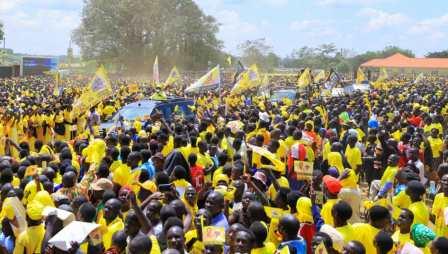
Museveni made the remarks while addressing a campaign rally at Bukedea District Headquarters, where he lauded the NRM’s internal unity and organizational discipline as pillars of its sustained political dominance.
His comments followed NUP’s failed attempt to nominate Florence Asio, a relative of the Speaker of Parliament Anita Among, as a challenger for the Bukedea District Woman Member of Parliament seat.

The opposition’s nomination attempt was later withdrawn, a development Museveni cited as evidence of NUP’s “weak internal structures and disorganized leadership.”
President Museveni commended the people of Bukedea and NRM leaders in the Teso Sub-region for maintaining party harmony and avoiding unnecessary political competition.
He particularly applauded the district’s decision to allow Speaker Anita Among to run unopposed for the Bukedea Woman MP seat, saying the move saved the party valuable time and resources that could now be directed toward development initiatives.
“I want to thank you for your unity,” Museveni said. “The decision to have unopposed candidates shows maturity and focus on service delivery rather than divisive politics.”
The NRM candidate added that party cohesion was a major factor behind Uganda’s long-term political stability and economic progress.
He argued that infighting and fragmentation within opposition parties often undermined their credibility and capacity to offer constructive alternatives.
Museveni assured the residents of Bukedea and the wider Teso Sub-region that his government would continue to guarantee peace and stability, which he described as the foundation of all development.
He noted that ongoing efforts by security forces had successfully subdued rebel elements and restored calm in previously volatile areas of northeastern Uganda.
“In Karamoja, we have neutralized the armed rustlers who had destabilized the region,” Museveni said. “Our next focus is on consolidating peace through wealth creation and infrastructure development.”
The President highlighted several upcoming infrastructure projects aimed at transforming the Teso Sub-region. He revealed that government had prioritized the tarmacking of the Kumi–Ngora–Kagwara Road, Soroti–Amuria–Obaranga–Abim Road, and Katakwi–Toroma Road, which are critical links for trade and mobility across eastern Uganda.
He also announced plans to extend electricity coverage to the few remaining parts of Bukedea and emphasized the government’s commitment to completing the Lake Kyoga Gravity Water Flow Scheme—a flagship project designed to supply clean water to households and boost irrigation in dry areas.
Museveni further pointed out that the newly commissioned Acomai Irrigation Scheme would help increase agricultural productivity, enhance food security, and reduce the risk of flooding in the region.
Turning to social services, Museveni reiterated his government’s dedication to strengthening universal education programs.
He reaffirmed that the NRM administration would continue expanding access to free universal primary and secondary education, with a target of ensuring that each parish and sub-county in Bukedea has a government school.
On health, the President pledged to improve the quality and reach of healthcare infrastructure, ensuring that residents no longer have to travel long distances for essential medical services.
“Our government remains committed to providing education and healthcare for all, because these are not privileges but rights,” he said.
Museveni once again emphasized the importance of wealth creation as a key driver of household income growth.
He urged residents to embrace government-backed initiatives such as the Parish Development Model (PDM) and the Emyooga program, noting that these projects were designed to uplift rural families through organized production and savings.
“The NRM’s ideology is based on truth and knowledge,” Museveni said. “We believe in empowering people to create wealth and jobs through enterprise, not dependency.”
He advised farmers in Bukedea to diversify agricultural production and adopt modern methods, saying such transformation would ensure long-term economic resilience for the region.
During the rally, Speaker of Parliament Anita Among, who also serves as the NRM’s National Vice Chairperson for Female Affairs, introduced several independent candidates who had stepped down to support official NRM flag bearers.
Among them was Florence Asio, who had earlier sought to contest under the NUP ticket but later pledged allegiance to the ruling party, a move Museveni said demonstrated the growing recognition of NRM’s political strength and developmental record.
Among praised the President for his steady leadership and credited the NRM government for transforming Bukedea through improved roads, schools, health centers, and electricity coverage.
Vice President Jessica Alupo commended the NRM government for restoring stability in the Teso Sub-region through disarmament campaigns and community development programs.
She noted that the peace achieved in Karamoja and neighboring districts had opened new opportunities for trade, investment, and social services.
“Because of the NRM’s efforts, our region is now stable, connected, and ready for transformation,” Alupo said.
NRM Vice Chairperson for Eastern Region Calvin Echodu also reaffirmed the Teso region’s unwavering support for President Museveni, describing him as “a tested leader whose policies continue to uplift ordinary citizens.”
Analysts say Museveni’s statements reflect a broader political narrative ahead of the 2026 elections—one that positions the NRM as a party of order and consistency against an opposition struggling with internal divisions.
As Uganda’s longest-serving leader, Museveni continues to emphasize peace, wealth creation, and unity as the cornerstones of the NRM’s legacy.
By contrast, his latest criticism of NUP’s membership structure signals an election season likely to be defined by competing claims of credibility and organizational capacity.
For now, Bukedea stands as a showcase of NRM cohesion—a message Museveni appears eager to replicate across the country as the 2026 campaign momentum builds.