






President underscores NRM’s peace legacy and unveils fresh development pledges for Bugisu Sub-region
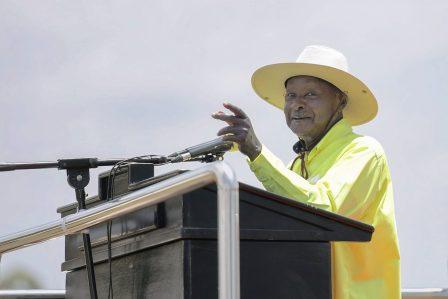
President Yoweri Kaguta Museveni on Thursday made a powerful appeal for continuity and self-reliance as he addressed thousands of supporters at Bugobero High School grounds in Manafwa District.

The rally, his second stop in the Bugisu Sub-region this week, drew local leaders, farmers, and youth groups eager to hear the President’s message on wealth creation, jobs, and service delivery.
President Museveni said his mission in Bugisu was to highlight the National Resistance Movement’s (NRM) enduring achievements and the party’s ongoing commitments under its current manifesto.
“I am here with the NRM leaders to present to you the NRM manifesto. This manifesto highlights seven major contributions the NRM has made to Uganda since 1986,” he said.
The President outlined these as peace and stability, national unity, economic and social infrastructure, free education, improved healthcare, water access, and household wealth creation.
A Legacy of Peace and Unity
President Museveni said peace remains the cornerstone of Uganda’s progress, describing it as the NRM’s greatest achievement.
“That peace you hear people talking about was not easy to bring,” he emphasized.
“We were able to achieve it because we rejected sectarian politics of tribes and religion. When we recruit people into the army, we don’t mind about tribe or religion. That is why we have been able to build strong national institutions like the army, police, and others,” he explained.
The President recalled the turbulent years before 1986, when Uganda was divided along ethnic and religious lines, noting that national unity has since become a defining feature of his administration.
He said the country’s stability has enabled development across all regions, including the once-marginalized eastern districts.
Development: The Dual Engine of Progress
President Museveni said the second pillar of NRM’s legacy is development, which he divided into two complementary parts — economic and social infrastructure.
He said economic infrastructure includes electricity, roads, and telecommunication, while social infrastructure covers schools, hospitals, and clean water systems.
On education, the President noted that Manafwa District currently has 61 government primary schools and 10 government secondary schools.
“There are parishes without government primary schools and sub-counties without government secondary schools,” he said.
“The plan is to make sure all these areas are covered so that every child can easily access education,” he added.
He revealed that the government is constructing six new Seed Secondary Schools in Manafwa District, which will reduce the number of sub-counties without government secondary schools from 23 to 17 once completed.
Education Reform and Skills for the Future
President Museveni reaffirmed his long-standing commitment to free education in government schools, a policy first introduced in 1996.
“We started free education in 1996, but head teachers have been sabotaging it,” he said.
“That is why I introduced the skilling hubs to show that free education is possible. You have seen the testimonies — children who had dropped out of school now have skills in tailoring, bakery, and other trades and are doing well,” he noted.
The President said skilling programmes are being scaled up to equip youth with employable skills, reducing dependence on white-collar jobs.
Expanding Health Facilities Across Manafwa
On the health sector, President Museveni acknowledged gaps in service coverage, saying Manafwa District currently has two Health Centre IVs and four Health Centre IIIs.
He said 26 sub-counties remain without a government health facility, but this will soon change under a new expansion plan.
“To address this, Government plans to upgrade Ikaali Health Centre II to Health Centre III and construct new Health Centre IIIs in several sub-counties and town councils including Masaka, Buwangani, Buyinza, Buwaya, Butta, Khabutoola, Bukoma, Sibanga, Nalondo, Bugobero, Nangalwe, Kimaluli, Buwagogo, Weswa, Butoto, Bukusu, Bunabutsale, Sisuni, Bunabwana, Makenya, Maefe, Butiru, Mayanza, Busukuya, and Bukhadala,” he said.
He added that ongoing projects include completion of staff houses at Bukewa HCIII and renovation of the Outpatient Department (OPD) at Ikaali HCII.
He said the Government will continue with immunization programs, equip all Government health units, and construct more staff houses for health workers to improve retention.
Safe Water Coverage Nears 100 Percent
On water and sanitation, the President praised Manafwa’s progress toward universal access.
“Manafwa District now has 1,262 out of 1,309 villages with access to safe water, representing 96% coverage — one of the highest in the country,” he said.
“Only 47 villages remain without access to safe water. We have constructed new piped water systems in Bubwaya, Majali, Lwakhakha, Buyinza, Butiru, Bubutu, and Bumbo, providing safe water to tens of thousands of people,” the President said.
He noted that additional boreholes have been drilled and rehabilitated, and several piped water projects are ongoing, including the Manafwa Town Council Water Supply System, which is already 76% complete.
From Roads to Wealth Creation
President Museveni said that while physical development such as roads and electricity is essential, it must be matched by household wealth.
“You people here in Bugobero have a good tarmac road, but you do not sleep on tarmac,” he said.
“When you go home, the poverty you left in the morning is still there. This is why we say that talking about development alone without talking about wealth creation is not good.”
He said true transformation begins with individual productivity through the four-acre model of commercial agriculture.
“Wealth creation is through commercial agriculture using the four-acre model — even two acres can work if you do at least one of the seven activities in the model,” he said.
Jobs from Wealth, Not from Government
The President clarified what he called a widespread misunderstanding about employment.
“There is another confusion people have — that jobs come from the government. Jobs come from commercial agriculture and industrialization,” he emphasized.
He said that by encouraging value addition and supporting agro-industrialization, the NRM government aims to create sustainable private-sector jobs for the youth.
He revealed that Manafwa will soon benefit from the establishment of the Manafwa Industrial Park, citing the availability of minerals such as vermiculite and iron ore that will support industrial growth and create employment opportunities.
Five-Point Message for Transformation
Concluding his speech, President Museveni summarized his day’s message in five key words — peace, development, wealth, jobs, and free education.
He urged residents to consolidate the gains achieved under NRM and to focus on turning peace into prosperity.
Leaders Applaud the President’s Vision
The NRM Second National Vice Chairperson (female) and Speaker of Parliament, Rt. Hon. Annet Anita Among, hailed the President for transforming Manafwa District through infrastructure projects and social services.
She thanked him for the tarmac roads, water systems, and education programs that have uplifted living standards in the region.
The NRM District Chairperson for Manafwa, Wolimbwa Charles Peke, also praised the President for his visionary leadership and unwavering support for the Parish Development Model (PDM).
“Manafwa has fully embraced the PDM. Out of Shs.47.8 billion allocated, over 99% has already been disbursed to nearly 48,000 beneficiary households,” he reported.
He assured the President of overwhelming political support from the district, saying the PDM had begun to transform household incomes and reduce poverty.
Background: Bugisu’s Development Strides
The Bugisu Sub-region, which comprises Manafwa, Mbale, Bududa, Sironko, Bulambuli, and Namisindwa, has in recent years benefited from government investment in road tarmacking, rural electrification, and agricultural financing.
The Mbale–Lwakhakha road and the ongoing expansion of Mbale Industrial Park have opened new markets for farmers and small industries.
The NRM’s renewed focus on skilling youth and establishing industrial parks is seen as part of President Museveni’s long-term plan to transition the region from subsistence to a commercial economy ahead of Vision 2040.
A Call for Unity and Self-Reliance
As the rally ended, the President urged the people of Manafwa to stay united, avoid divisive politics, and focus on building wealth within their households.
He reminded them that the NRM’s philosophy of patriotism, Pan-Africanism, and socio-economic transformation remains the surest path to prosperity.
“The peace we brought must now translate into wealth in every home,” he said.
The crowd responded with loud cheers as Museveni waved to supporters and boarded his vehicle, closing another chapter of his 2026 re-election campaign tour of the Bugisu Sub-region.