
















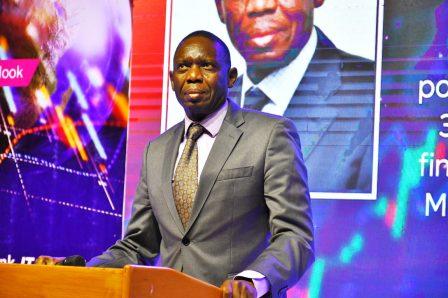
Governor of Bank of Uganda, Dr. Michael Atingi-Ego, has said the country must embrace artificial intelligence (AI) and data analytics as the new engines of economic transformation if it is to remain competitive in the evolving global economy.
Delivering the keynote address at the 2025 Data Analytics, Artificial Intelligence and Data Governance Symposium held at the Sheraton Kampala Hotel, Dr. Atingi-Ego urged policymakers, businesses, and institutions to move beyond being consumers of digital technologies to becoming innovators who use data and AI to shape Uganda’s economic future.
The Governor emphasized that artificial intelligence offers enormous potential to improve productivity, financial inclusion, and public service delivery across all sectors of the economy.

He pointed out that the world is producing vast quantities of data, yet most of it remains untapped.
“In 2010, the world generated around two zettabytes of data. By 2024, it had reached 149 zettabytes. This is a massive opportunity waiting to be tapped,” he said.
Dr. Atingi-Ego explained that if managed well, AI could contribute up to 20 trillion dollars to the global economy by 2030 and boost productivity by 40 percent by 2035, according to international research projections.
He said that in the financial sector, Uganda can harness AI to expand access to credit, improve risk management, and enhance financial inclusion for underserved populations.
AI-powered tools, he noted, can analyse alternative data sources such as mobile phone usage patterns, satellite imagery, and transaction histories to assess creditworthiness for individuals who lack formal financial records.
“This can help reach populations previously excluded from the financial system,” he said, citing examples of successful initiatives such as Kenya’s FarmDrive and Uganda’s Ensibuuko, which use data analytics to empower smallholder farmers and rural entrepreneurs.
The Governor revealed that the Bank of Uganda is already exploring AI applications in digital payments and is studying the feasibility of a Central Bank Digital Currency (CBDC) to strengthen financial innovation and transparency.
He, however, cautioned that AI adoption must be guided by robust ethical and governance frameworks to prevent risks such as algorithmic bias, data misuse, and loss of public trust.
“At the Bank of Uganda, we are developing an AI Governance Framework to ensure that all AI applications meet high standards of fairness, transparency, and accountability,” he said.
Dr. Atingi-Ego added that building a strong digital economy requires heavy investment in infrastructure such as data centres, reliable electricity, and fast internet connectivity.
He noted that global AI investment reached 110 billion dollars in 2024, concentrated mainly in the United States and China, and urged Uganda to strengthen its digital systems, regulatory environment, and data governance to attract similar investments.
Beyond finance, he said AI can play a transformative role in agriculture, healthcare, and education.
In agriculture, AI can support weather forecasting, crop monitoring, and post-harvest management, helping farmers adapt to climate change and reduce losses.
In health, AI can assist in diagnostics where medical specialists are scarce, while in education, it can help personalise learning and track student progress.
The Governor underscored the importance of investing in human capital to build a digitally competent workforce.
“Uganda must reorient its education system for a digital-first future, promote national upskilling programs, and support young innovators,” he said.
He revealed that the central bank has already begun training its staff in data analytics, programming, and digital policy design to keep pace with global financial innovation.
Dr. Atingi-Ego also reminded participants that while AI offers predictive power and efficiency, human judgment remains indispensable in decision-making.
“We need to combine the best of both,” he said.
Speaking at the same symposium, Victoria University Vice Chancellor, Prof. Lawrence Muganga, echoed the Governor’s sentiments, saying that embracing AI was no longer optional for Uganda’s progress.
“AI isn’t the enemy; it’s the upgrade,” Prof. Muganga stated.
He argued that integrating AI into education, media, and other sectors can open new opportunities, boost productivity, and improve competitiveness, calling on learning institutions to prioritise digital literacy and innovation.
The symposium, attended by government officials, academics, private sector players, and technology experts, highlighted a shared national consensus that artificial intelligence and data-driven governance are crucial to driving Uganda’s next phase of socioeconomic transformation.
Dr. Atingi-Ego’s call reflects a growing recognition within Uganda’s financial and policy circles that the country’s economic resilience in the coming decade will depend on how effectively it adopts and governs emerging digital technologies.