












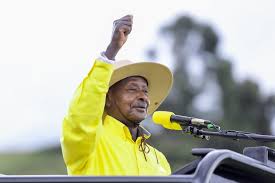
As the 2026 election season gains momentum, the National Resistance Movement (NRM) presidential flag bearer, General Yoweri Kaguta Museveni, has officially opened his Kigezi Sub-region campaign trail in Kisoro District, using the platform to outline a detailed development roadmap grounded in historical progress, current achievements, and future priorities for both Kigezi and Uganda.
The launch in Kisoro comes at a time when the region has undergone significant transformation over the past three decades—progress largely attributed to government-led interventions in infrastructure, security, education, and wealth creation.
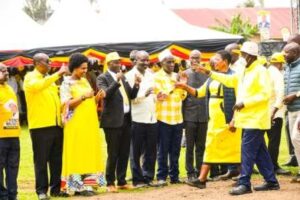

The President framed his message by reminding the public that when the NRM took power in 1986, Kigezi and much of southwestern Uganda were grappling with shortages of essential goods, poor road networks, limited electricity access, and pockets of insecurity that hindered development.
He said those early challenges shaped the NRM’s long-term policy approach of rebuilding Uganda’s institutional, economic, and security foundations.
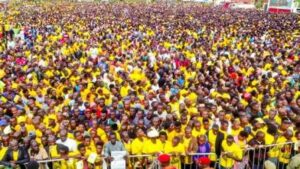
Speaking at the Saza Grounds in Kisoro Town, the NRM candidate emphasized that the party’s reforms have revived Uganda “across key sectors including peace and security, infrastructure development, wealth creation, and job creation.”
He said the restoration of peace had been central to Kigezi’s ability to recover from its historical isolation and limited market access.
He recalled that government interventions helped Kisoro overcome repeated shortages of essential commodities—especially during the 1980s and 1990s—strengthening the district’s resilience and restoring development enablers that continue to support the region today.
He told voters that sustaining these gains required continuity of leadership and political stability.
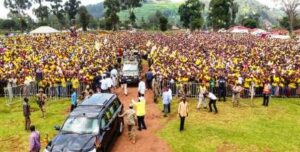
He used the moment to criticize opposition candidates, arguing that they lack the demonstrated capacity to meaningfully contribute to Uganda’s development agenda.
He stressed that the NRM’s track record, particularly in Kigezi, should guide voters as they weigh Uganda’s future.
The President outlined a comprehensive infrastructure plan for Kisoro District, saying that roads were central to unlocking tourism, agriculture, and cross-border trade.
He announced plans for additional major tarmac roads, including the Kabale–Bunyonyi–Mugahinga Road, Kisoro–Muko Road, Katuna–Muko–Kamuhangura Road, and Kerere–Kanungu Road.
He said these roads will strengthen connectivity between Kisoro, the wider Kigezi region, and neighboring economies such as Rwanda and the Democratic Republic of Congo.
He noted that the NRM government has already constructed major roads that link Kisoro to the rest of Uganda, supporting trade, tourism, and overall socio-economic modernization.
He assured the electorate that infrastructure improvements will continue under his leadership.
Museveni urged residents to safeguard the peace and stability that the region now enjoys.
He warned against insecurity experienced in some neighboring areas across the border, saying Kisoro’s stability is a vital national asset.
Transitioning to his message on household prosperity, Museveni emphasized the need for families to distinguish between national development and personal wealth creation.
He said while the government provides infrastructure and peace, families must engage in deliberate efforts to grow their incomes.
He highlighted the success of Uganda’s four-acre model, encouraging residents to adopt enterprises such as poultry, coffee, dairy farming, piggery, and fish farming.
He said households embracing commercial agriculture and small-scale value addition stand to benefit most from government funding.
He promised intensified support to wealth creation programs and called for the community’s active participation to stimulate jobs in manufacturing, services, and commercial agriculture.
Museveni further assured residents that government will extend electricity to Nyarubuye Sub-county, the only sub-county in Kisoro still awaiting power connection.
He highlighted ongoing progress in water distribution, telecommunications improvement, and rural electrification, and pledged to fast-track the remaining gaps.
He also addressed education planning in Kisoro District, noting that the area has 140 government primary schools unevenly distributed across 71 parishes.
He said this imbalance must be corrected in line with the national policy of one primary school per parish and one secondary school per sub-county.
He promised to establish additional schools in his next term to improve access to education and reduce congestion.
The rally drew several influential NRM leaders who mobilized support for Museveni and reinforced his message.
NRM 2nd National Vice Chairperson (Female), Anita Among, urged residents to evaluate Museveni’s achievements in infrastructure development and reward him with another term.
Deputy Speaker of Parliament Thomas Tayebwa highlighted Museveni’s strengths compared to his opponents and encouraged voters to retain the NRM.
NRM Vice Chairperson for Western Region, Jornad Asiimwe, called on residents to secure an NRM victory in the 2026 elections.
Former Inspector General of Police, Gen. Kale Kayihura, pointed to the progress achieved under NRM leadership in Kisoro and across Uganda, saying these gains must be protected through Museveni’s re-election.
The event concluded with a presentation of the Kisoro District status report by the District NRM Chairperson, Alex Ndayambaje, who outlined key achievements and remaining development priorities.
The opening of Museveni’s Kigezi campaign trail sets the tone for what analysts predict will be one of the most consequential election cycles for southwestern Uganda, especially as the region positions itself for expanded tourism, commercial agriculture, and cross-border economic integration.