

















Uganda’s central bank has opted for continuity in its monetary policy, underscoring confidence in the country’s inflation outlook and economic momentum despite ongoing global volatility.
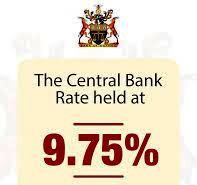
The Bank of Uganda (BoU) has retained the Central Bank Rate (CBR) at 9.75 percent, a decision aimed at sustaining economic growth while ensuring inflation remains firmly anchored within the medium-term target.
The decision was announced in the Monetary Policy Statement for February 2026, released following a meeting of the BoU Monetary Policy Committee (MPC).

According to the MPC, the current monetary policy stance remains appropriate to balance support for economic activity with the need to maintain price stability around the 5 percent inflation target.
The central bank reported that inflationary pressures in the economy remain subdued and broadly consistent with earlier expectations.
Over the 12 months to January 2026, headline inflation averaged 3.5 percent, while core inflation, which excludes volatile food crops and energy prices, averaged 3.8 percent.
In January 2026, headline inflation edged up slightly to 3.2 percent from 3.1 percent recorded in December 2025.
The marginal increase in headline inflation was mainly attributed to higher prices in selected services, particularly passenger air transport.
Food crop inflation declined significantly to 3.0 percent from 4.4 percent, reflecting improved supply conditions supported by favourable weather across key agricultural regions.
Energy, Fuel and Utilities (EFU) inflation rose modestly to 1.7 percent, largely driven by higher firewood prices.
BoU noted that the overall inflation environment continues to benefit from stable macroeconomic conditions and improved supply-side factors.
Looking ahead, the central bank revised its inflation outlook slightly downward compared to the November 2025 forecast.
The revision reflects a modest appreciation of the Uganda shilling, alongside lower global oil and food prices.
BoU now projects inflation to remain within the 3.8 to 4.3 percent range throughout 2026.
Over the medium to long term, inflation is expected to gradually stabilise around the central bank’s 5 percent target.
Despite the benign outlook, BoU cautioned that risks to inflation remain elevated and tilted in both directions.
On the upside, stronger domestic demand, expansionary fiscal policy, potential exchange rate pressures, geopolitical tensions and adverse weather conditions could drive prices higher.
On the downside, slower domestic economic activity, weaker global growth and declining international commodity prices could ease inflationary pressures further.
The Monetary Policy Committee also highlighted encouraging developments in economic activity.
Uganda’s economy recorded robust performance during the first three quarters of 2025, with average growth of 6.3 percent.
The expansion was largely driven by final consumption expenditure across both public and private sectors.
Government consumption grew sharply by 22.8 percent, reflecting increased public spending.
Household consumption also expanded strongly by 14.2 percent, supported by improving incomes and economic confidence.
BoU reported that high-frequency indicators point to even stronger economic activity in the quarter ending December 2025.
The positive momentum is expected to carry through the second half of the 2025/26 financial year.
Economic growth for FY2025/26 is projected to fall within the range of 6.5 to 7.0 percent.
Over the medium term, growth is expected to strengthen further to about 8 percent.
The anticipated acceleration will be supported by sustained public investment, oil and gas developments, large-scale infrastructure projects and rising private sector activity.
Against this backdrop of steady growth and contained inflation, the MPC resolved to keep the CBR unchanged at 9.75 percent.
BoU said the decision reflects a careful assessment of heightened global uncertainty and the balance of risks to both inflation and economic growth.
The central bank emphasized that maintaining the current policy rate is consistent with its strategy of guiding inflation toward the target over the medium term while safeguarding macroeconomic stability.
Under the existing monetary policy framework, the rediscount rate remains at 12.75 percent.
The bank rate also remains unchanged at 13.75 percent.
BoU reiterated that future monetary policy decisions will continue to be data-driven.
The central bank said it will remain guided by ongoing assessments of domestic economic conditions, global developments and emerging risks to the inflation and growth outlook.