











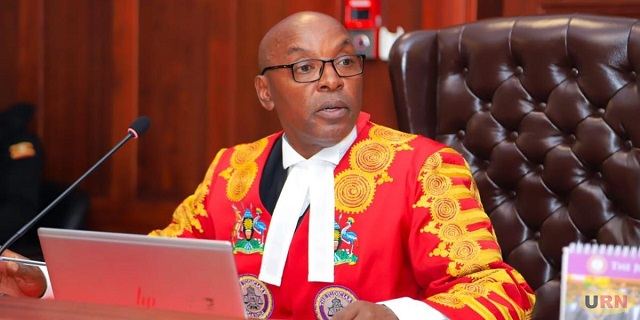
His Lordship the Chief Justice of Uganda Dr Flavian Zeija
The Supreme Court of Uganda has formally confirmed President Yoweri Kaguta Museveni as the duly elected President of the Republic of Uganda following the withdrawal of a petition challenging the outcome of the January 15, 2026 presidential election.
The decision, delivered in Kampala on Thursday, brings to a close the final legal challenge arising from the highly contested national polls.

The nine-member panel of the apex court, led by Chief Justice Flavian Zeija, reached a unanimous decision allowing former presidential candidate Robert Kasibante to withdraw his Petition No. 01 of 2026, which had sought to overturn Museveni’s victory.
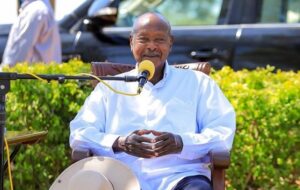
Ugandan President Yoweri Museveni speaks to the press after voting at a polling station in Kiruhura district, Uganda, on Jan. 15, 2026.
Delivering introductory remarks, Chief Justice Zeija stated that the Court had reached one unanimous decision on the withdrawal of the petition.
He, however, noted that there was a dissenting judgment limited specifically to the issue of costs.
He then invited Justice Muzamir Mutangula Kibeedi to read the lead judgment on behalf of the majority.
Justice Kibeedi proceeded to read the names of the eight justices who supported the unanimous decision allowing the withdrawal.
The justices were Chief Justice Zeija, and Justices Percy Night Tuhaise, Mike Chibita, Elizabeth Musoke, Step
A separate opinion was signed by Justice Christopher Izama Madrama, who dissented solely on the matter of costs.
In its majority reasoning, the Court underscored that the institution of a presidential election petition is not an ordinary civil dispute but a matter of the highest constitutional importance.
The justices observed that a petitioner cannot casually invoke the Court’s jurisdiction to challenge a presidential election and later exit proceedings without due consideration of the implications.
They described the consequences of filing such a petition as preloaded and likened them to congenital twins inseparable from the decision to challenge the results.
The Court emphasized that a presidential election petition concerns the highest office in the land and carries immense logistical and financial implications.
The justices noted that by challenging results from more than 50,000 polling stations within strict constitutional timelines, a petitioner should be fully aware of the foreseeable legal and financial consequences.
They stressed that such consequences are foreseeable and should be carefully weighed by both the petitioner and his legal advisers before commencing proceedings.
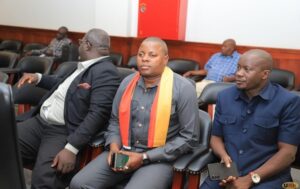
Presidential Petitioner Robert Kasibante in the Middle at the Supreme Court together with his supporters.
Kasibante had, on February 5, 2026, applied to withdraw both the substantive petition and a related application seeking access to backend electoral data held by the Electoral Commission.
He explained that he lacked the financial capacity to sustain a nationwide forensic audit of electoral materials, including biometric voter verification systems, scanners, and servers.
He conceded that without the evidence he hoped to secure through the discovery application, the petition could not meet the required standard of proof.
The respondents in the matter — President Museveni, the Electoral Commission, and the Attorney General — did not oppose the withdrawal.
They, however, requested that the petition be dismissed with costs.
They argued that they had expended substantial public and private resources defending what they described as a petition without merit and incapable of proof.
They further clarified that there had been no negotiated settlement or agreement with Kasibante regarding the withdrawal.
After examining the record, the majority found that the available evidence was insufficient to sustain the petition.
They held that denying the withdrawal would serve no useful purpose in the administration of justice.
“As such, Presidential Election Petition No. 01 of 2026 is hereby withdrawn,” the Court ruled.
The justices observed that Kasibante’s petition was not the first presidential election petition to be withdrawn since the promulgation of the 1995 Constitution.
They noted that previous Supreme Court decisions on presidential elections should have provided guidance to prospective petitioners about the gravity and consequences of challenging election outcomes.
They cautioned that such actions should never be taken casually or without full appreciation of the attendant legal and financial implications.
In line with established precedent, the Court reaffirmed that once a presidential election petition is withdrawn, the candidate earlier declared winner by the Electoral Commission is conclusively deemed to have been duly elected.
The Court cited its earlier ruling in the 2021 presidential petition filed by Robert Kyagulanyi Ssentamu, in which the majority affirmed that the principle remains good law that the person declared by the Electoral Commission should be duly confirmed as the elected President.
The justices therefore declared that the petition against Museveni stands conclusively withdrawn and that he remains the duly elected President of Uganda.
The most contested issue before the nine-member panel concerned the award of costs.
The respondents relied on statutory provisions governing withdrawal of presidential petitions, which state that where a petition is withdrawn, the petitioner “shall be liable” to pay costs.
The majority examined comparative jurisprudence, including a 1982 decision of the Court of Appeal of Jamaica interpreting similar statutory language.
They also considered how neighboring jurisdictions such as Kenya handle presidential election disputes.
While acknowledging the mandatory phrasing of the statute, the justices held that the Court retains discretion in determining whether or not to award costs.
They reasoned that the Court must balance the need to deter meritless petitions with the constitutional obligation to guarantee access to justice.
The majority concluded that ordering Kasibante to pay costs would not serve the broader public interest.
They reasoned that condemning him to costs would not allow the national healing process to move forward.
They accordingly ordered that each party bears its own costs.
Justice Izama Madrama dissented on that specific issue.
He agreed with the decision permitting withdrawal but disagreed with the majority’s refusal to award costs.
He reasoned that allowing Kasibante to walk away without paying costs to President Museveni, the Electoral Commission, and the Attorney General would undermine the statutory authority granted to Parliament.
He referred to Section 61 of the Presidential Election Rules, which indicates that a petitioner who withdraws should pay costs to the respondents.
The withdrawal effectively concludes all presidential election proceedings arising from the January 15, 2026 poll.
The Electoral Commission had declared Museveni the winner with 7,946,772 votes.
Robert Kyagulanyi Ssentamu finished second with 2,741,238 votes.
Other candidates included Nathan Nandala Mafabi with 209,039 votes, Gen Gregory Mugisha Muntu with 59,276 votes, Frank Bulira with 45,959 votes, Mubarak Munyagwa with 31,666 votes, while Kasibante himself obtained 33,440 votes.
Kasibante had accused the Electoral Commission of failing to conduct a free and fair election.
He alleged widespread irregularities, including violence, voter bribery, misuse of state resources, failure to gazette polling stations, lack of transparency in vote counting and result transmission, and biased conduct by state security agencies.
He had asked the Supreme Court to nullify Museveni’s election, cancel the declared results, and order fresh elections in accordance with the law.
After the ruling, Counsel Enoch Barata, Director for Legal Services in the National Resistance Movement party, welcomed the decision.
He stated that President Museveni is now awaiting his swearing-in ceremony in May to commence the 2026–2031 term of office.