













Government of Uganda has renewed its commendation of Resident District Commissioners (RDCs) for what it describes as steadfast service in safeguarding peace, stability, and effective governance across the country.
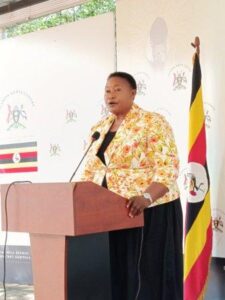
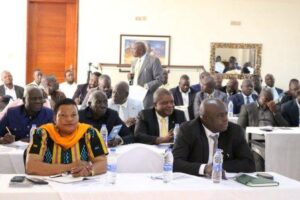
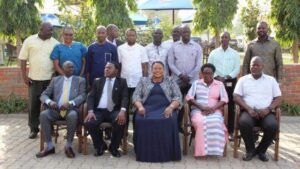
The appreciation was delivered on behalf of President Yoweri Kaguta Museveni by the Minister for the Presidency, Milly Babirye Babalanda, during the opening of a three-day capacity-building workshop in Arua City.

The engagement was held at Hotel Le Confidentiel in Arua City, reflecting the government’s continued emphasis on strengthening grassroots leadership structures in strategically significant regions.
Hon. Babalanda conveyed the President’s gratitude in unequivocal terms.
“He recognizes the central role you play as his representatives at the grassroots in ensuring that government programmes are implemented efficiently, public resources are protected, and ‘wanainchi’ remain secure and actively engaged in national development,” she said.
She emphasized that RDCs remain the direct link between the Presidency and citizens at district and community levels.
She noted that their vigilance ensures that public investments reach intended beneficiaries while safeguarding state resources from misuse.
The Minister also applauded the officials for the role they played during the recent general elections.
“Your vigilance, coordination and leadership ensured peace, order and lawful conduct throughout the electoral period thereby contributing to the victory of His Excellency President Museveni and the continued leadership of the National Resistance Movement,” she said.
She further observed that their mobilization efforts significantly contributed to the electoral success of the National Resistance Movement across multiple positions.
Hon. Babalanda stressed that the party’s victories from parliamentary seats to local council positions were not accidental.
“This is no mini achievement and your hard work is greatly appreciated.”
However, she cautioned that with the elections concluded, the focus must now shift firmly to service delivery and constitutional mandates.
“Politics must give way to performance. Our task is to consolidate the gains of the NRM government and translate the Manifesto commitments into tangible improvements in the lives of our people. That is how we protect the gains of the revolution,” she said.
She urged the commissioners to treat the new political term as a period of reflection and renewed discipline.
“As we begin this New Year and embark on the tenure of the new Presidential Team, His Excellency calls upon all of us to renew our commitment to discipline, patriotism and results-oriented service. This is a time to reflect critically on our past performance, identify areas where we have fallen short and recommit ourselves to excellence, integrity and accountability in all our duties.”
Hon. Babalanda reminded the RDCs that their constitutional mandate places them at the heart of service delivery oversight.
She underscored that they are the “eyes and ears” of the Presidency in their respective jurisdictions.
“Monitoring service delivery is not optional, it is a constitutional obligation that underpins transparency, efficiency, and tangible results for the wanainchi. Your vigilance and proactive oversight will determine the success of government interventions at the grassroots,” she stated.
She also highlighted the indispensable role of citizens in driving socio-economic transformation.
“Delivery of Government services alone without citizenry playing their roles of production and income generation at household level won’t bring the social economic transformation desired.”
The Minister clarified that monitoring should not be misconstrued as persecution.
On the contrary, she explained that it is a mechanism for ensuring value for money and measurable impact.
“Ladies and Gentlemen, Many government programs are well designed but underutilized because our people lack adequate information. You must intensify sensitization and popularization of key government initiatives, including, the Parish Development Model (PDM), Emyooga, Universal Primary and Secondary Education, among others,” she said.
She tasked the commissioners with closing information gaps that often prevent communities from benefiting fully from government interventions.
“Your role is to ensure that no citizen in West Nile remains ignorant of these opportunities. You must work closely with local leaders, religious institutions and community structures to spread accurate information and counter misinformation.”
Hon. Babalanda also reflected on the transformation witnessed in West Nile under the NRM administration.
“Indeed, Under the leadership of President Yoweri Kaguta Museveni and the NRM, West Nile has witnessed remarkable transformation. These gains must be protected and expanded. You are custodians of this progress. West Nile stands today not as a forgotten frontier, but as a region firmly integrated into the national development agenda.”
She warned against internal disputes that could erode public confidence in government institutions.
Hon. Babalanda urged the RDCs to maintain decorum and professionalism in all engagements.
“Maintain discipline, professionalism, and adherence to established procedures in the execution of your duties. Let integrity, impartiality, and accountability guide your decisions at all times. It is through hard work, teamwork and transparency that we strengthen public trust and reinforce confidence in the Presidency and in government as a whole,” she noted.
She further anchored her remarks on the broader policy direction outlined in the ruling party’s manifesto.
“Ladies and Gentlemen, the new NRM manifesto represents our social contract with the people of Uganda. It sets out the government’s strategic priorities for the next term, including wealth creation, industrialization, value addition, job creation, and human capital development. As leaders and representatives of the Presidency, each of you has a critical role to play in translating these commitments into tangible results.”
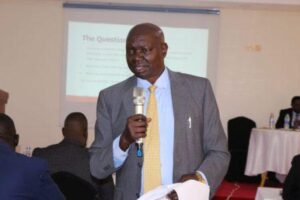
The Senior Presidential Advisor in charge of Mobilization at the RDC Secretariat, Kibrai Ambako, called on the participants to adopt what he described as revolutionary methods of work.
“Revolutionary methods of work are ways and channels with skills that are used and followed in line with acceptable norms and beliefs that can enable knowledge and understanding of opportunities and risks to be able to achieve change,” he said.
He explained that such methods demand resilience and ideological grounding.
He added that these approaches involve rigorous cadre training and capacity development to nurture discipline and commitment to the common good.
“They are used to dispel and counter diversionary and subversive tendencies towards achieving set goals,” Lt. Col. Ambako added.
He stressed that the methods require courage and determination.
“The methods are used with courage, without fear and may include violence, to push crazy ideas that no one can willingly go for, against the status-quo, to achieve radical change.”
The Commissioner in charge of the West Nile sub-region, Obed Collins Gertrude, echoed appreciation for the RDCs’ performance during the elections.
“You have really helped the National Resistance Movement (NRM) to pacify the West Nile,” she said.
She called for strengthened teamwork between RDCs and District Internal Security Officers (DISOs).
“DISOs are the right hand of RDCs, let’s always help and guide our friends, the RDCs. Don’t allow them to go astray,” she noted.
She concluded by appealing for unity and coordinated service delivery across districts in the region.
“Let’s work as a team and make sure that everyone in the West Nile enjoys their stay in their respective districts.”
The workshop in Arua ultimately underscored a central government message that as Uganda enters a new political term, the measure of leadership will not lie in campaign victories alone.
The measure will instead be defined by discipline, accountability, and the tangible improvement of livelihoods at the grassroots.