












As Uganda prepares to enter a new phase of its ambitious poverty eradication strategy, government officials have confirmed that repayment of Parish Development Model (PDM) loans will officially begin in March 2026.
The announcement marks the end of a two-year grace period for beneficiaries and signals a critical test for one of President Yoweri Museveni’s flagship anti-poverty initiatives.
The transition from disbursement to repayment is not merely administrative — it reflects a broader effort to sustain a revolving fund designed to lift millions of Ugandans from subsistence living into the money economy.

Understanding the Parish Development Model: Museveni’s Long War Against Poverty
Uganda’s fight against poverty has been a decades-long journey under the leadership of President Museveni.
Since the late 1980s, his administration has rolled out successive programs aimed at empowering citizens economically — from the Poverty Eradication Action Plan (PEAP) to NAADS, Operation Wealth Creation, Emyooga, and now the Parish Development Model.
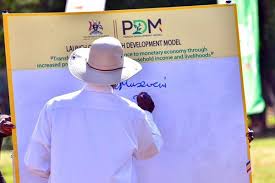
The PDM, launched in 2022, represents a shift in strategy: taking government services and financial support directly to the parish — the lowest administrative and planning unit in Uganda.
With more than 10,000 parishes nationwide, the model is designed to ensure that development resources reach grassroots communities more efficiently.
The core objective of PDM is to transition 39% of Ugandan households that are still outside the money economy into productive economic participation.
Instead of one-off handouts, the model uses Parish Revolving Funds (PRF), channelled through Parish SACCOs (Savings and Credit Cooperative Organisations), to provide soft loans to organized community members engaged in agriculture, trade, and small enterprises.
The philosophy is simple but transformative: lend, invest, grow, repay — and allow another household to benefit.
Repayment Countdown: Grace Period Ends March 2026
Appearing before Parliament’s Public Accounts Committee (Central Government) on Tuesday, 03 March 2026, the State Minister for Luwero Triangle and National Coordinator for the PDM, Dennis Galabuzi, confirmed that the grace period is coming to an end.
“The first batch of money was disbursed in the financial year 2022/2023 because in 2021/2022, there were issues with the money so we more or less discounted it. We are currently reminding parish chiefs and everyone involved in supervision of PDM to sensitise the public on this,” Galabuzi said.
This means beneficiaries who received funds in 2022/2023 are expected to begin repayment within the next year, starting March 2026.
Government officials emphasize that repayment is not punitive — it is foundational to the program’s sustainability.
“PDM is a game changer if well implemented. The issue of repayment should be a concerted effort from our side as government and from Members of Parliament who do oversight. If beneficiaries pay back, then others will also benefit,” Galabuzi noted.
The Revolving Fund Concept: Why Repayment Matters
At the heart of PDM lies the Parish Revolving Fund — a system where repaid loans are redistributed to new beneficiaries within the same parish.
The government’s plan is clear:
* Each parish receives seed capital.
* Organized community members borrow for income-generating activities.
* After the grace period, borrowers repay with minimal interest.
* The money is lent to new beneficiaries.
* The cycle continues, expanding economic opportunity.
Without repayment, the model risks stagnation. With repayment, it becomes self-sustaining.
Officials argue that this system reduces dependency and encourages financial discipline while broadening access to capital at the grassroots level.
Communication Gaps and Public Misunderstanding
However, as Parliament heard this week, the greatest challenge may not be financial — but informational.
Patrick Nsamba (NUP, Kassanda County North) warned that many recipients misunderstood the funds.
“Do you have a communication strategy that will ensure the realignment of the public perception about the loans they took under PDM? Otherwise, they will be so disappointed that they have to pay back,” Nsamba said.
Some beneficiaries reportedly interpreted the money as a political goodwill gesture rather than a recoverable loan.
Kalungu West County MP, Joseph Ssewungu, echoed similar concerns, pointing to operational weaknesses.
“During campaigns, the electorate would condemn PDM coordinators that they misused the money because there is no communication and committees are not giving reports. If you correct that, then public perception of the programme can improve,” Ssewungu said.
He also referenced concerns from the Auditor General regarding coordination challenges, delayed decision-making, and monitoring gaps within the program’s technical structures.
Structural Hurdles: Parishes Without Leadership
Implementation challenges have also emerged in certain areas. Fredrick Angura (NRM, Tororo South County) raised concerns about 127 parishes that have not yet received PDM funding.
Responding to this, the Permanent Secretary in the Ministry of Local Government, Ben Kumumanya, clarified:
“When you do not have elected leaders, you are not a fully operational parish and have no chairperson for the parish development committees. But the elections for local councils are in the pipeline and we are waiting for funding to execute them,” Kumumanya said.
This underscores the program’s dependence on functional local governance structures — without elected parish leadership, the PDM framework cannot operate fully.
Auditor General’s Warning: Strengthen Oversight Now
According to the Auditor General’s report, communication guidelines for the Parish Revolving Fund remain at draft stage and have yet to be disseminated nationally — a delay that could affect repayment compliance.
The Auditor General advised decisive action:
“I advised the accounting officer to prioritise the roles and responsibilities of the high-level policy committee and the inter-institutional PDM technical committee and ensure proper documentation of resolutions and action points,” reads the Auditor General’s recommendation.
The message is clear: better coordination and documentation are urgently needed to safeguard the program’s credibility.
Government’s Broader Vision: From Subsistence to Wealth Creation
Beyond the immediate issue of repayment, the PDM represents a broader economic shift envisioned by President Museveni — transforming Uganda from a subsistence-based society into a commercially vibrant economy.
Government plans for PDM beneficiaries include:
* Strengthened financial literacy and enterprise training.
* Enhanced supervision by parish chiefs and technical committees.
* Improved digital monitoring systems.
* Local council elections to operationalize dormant parishes.
* Stronger public sensitization campaigns about loan obligations.
Officials maintain that if implemented effectively, PDM could become Uganda’s most far-reaching grassroots development intervention.
A Critical Moment for Uganda’s Anti-Poverty Agenda
As March 2026 approaches, the focus now turns to awareness, accountability, and compliance. The success of the repayment phase will determine whether the Parish Development Model evolves into a sustainable poverty-eradication engine — or struggles under miscommunication and weak oversight.
For government, Members of Parliament, and local leaders alike, the coming period represents a defining moment.
If beneficiaries repay, others will benefit. If systems are strengthened, confidence will grow. And if coordination improves, the Parish Development Model may yet fulfill its promise as the “game changer” officials envision.
The next chapter in Uganda’s grassroots economic transformation is about to begin.