
















A fresh wave of accountability is sweeping through Uganda’s public service as the Inspectorate of Government launches a nationwide wealth declaration exercise aimed at restoring public trust and confronting corruption head-on.
Public servants across the country have been given a strict one-month deadline to declare their income, assets, and liabilities.
This move marks one of the most assertive enforcement drives under the Leadership Code Act in recent years.

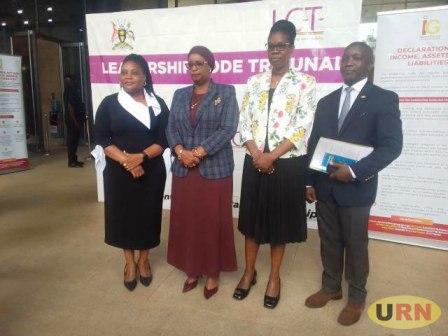
The exercise, officially unveiled at the Prime Minister’s Office in Kampala, requires all qualifying officers to submit their declarations by April 30 or face prosecution.
Leading the charge, Inspector General of Government Naluzze Aisha Batala framed the initiative as more than a legal obligation.
“When public officers are aware that their financial status is subject to scrutiny, they are more likely to act with integrity and make decisions in the public interest,” she said.
She explained that the declaration process has been strengthened through a newly upgraded online system designed to improve efficiency, accessibility, and monitoring.
She warned that failure to comply will attract sanctions before the Leadership Code Tribunal, reinforcing the seriousness of the exercise.
At the same event, authorities unveiled a comprehensive user guide to help public officials better understand their obligations regarding asset declaration, conflict of interest, and ethical conduct.
Chairperson of the tribunal, Rosely Karugonjo Segawa, emphasized the importance of ethical clarity in leadership.
“A leader may have private interests, but those interests must never interfere with their public responsibilities,” she said.
“Where a conflict arises, the officer is required to declare it and refrain from participating in related decisions,” she added.
She further cautioned that failure to fully disclose assets, including property and financial interests, constitutes an offense that could trigger investigations.
Minister of Public Service Wilson Muruli Mukasa described corruption as a persistent global challenge but acknowledged its deep local impact.
He noted that public trust in Uganda’s institutions currently stands at 47 percent, according to the Uganda National Bureau of Statistics, calling the figure a worrying signal.
He urged broader reforms, including extending wealth declaration requirements to all public servants and integrating compliance records into future government appointments.
The minister also revealed that while the March 2024 declaration exercise achieved 90 percent compliance, more than 3,000 leaders failed to declare their assets, exposing gaps in enforcement.
According to the Inspectorate, Uganda loses an estimated 10 billion shillings annually to corruption, underlining the urgency of stronger accountability measures.
Uganda’s corruption short History
Uganda’s renewed push against corruption is shaped by a long and complex history of governance challenges that have periodically shaken public confidence.
From the late 1990s through the 2000s, the country faced a series of high-profile corruption scandals involving misuse of public funds, procurement irregularities, and mismanagement of donor resources.
Notable controversies included the Global Fund scandal, the Commonwealth Heads of Government Meeting expenditures, and repeated allegations of ghost workers and inflated contracts within government agencies.
These episodes not only led to financial losses but also strained Uganda’s relationships with international donors, some of whom temporarily withheld aid pending reforms.
Over time, corruption became one of the most persistent governance concerns, affecting service delivery in critical sectors such as health, education, and infrastructure.
President Museveni’s fight against corruption
President Yoweri Museveni has repeatedly acknowledged corruption as a major obstacle to national development, often describing it as a betrayal of the country’s progress.
Since coming to power in 1986, Museveni has introduced multiple measures aimed at curbing corruption, combining political messaging with institutional reforms.
His government established key oversight bodies, including the Inspectorate of Government and the Office of the Auditor General, to strengthen accountability mechanisms.
He has also supported legal frameworks such as the Anti-Corruption Act and reinforced the enforcement of the Leadership Code Act to regulate the conduct of public officials.
In recent years, Museveni has intensified the anti-corruption campaign by promoting technology-driven transparency systems, including electronic procurement platforms and integrated financial management systems.
He has also backed the creation and strengthening of specialized courts to handle corruption-related cases more efficiently.
Public messaging has remained central to his approach, with frequent calls for citizens to report corrupt officials and for leaders to uphold integrity as a patriotic duty.
At the same time, enforcement has included arrests, prosecutions, and dismissals of officials implicated in corruption, signaling a zero-tolerance stance at least at policy level.
Currently, Uganda’s anti-corruption framework relies on a combination of institutions, laws, and digital systems working together to detect and prevent abuse of office.
The Inspectorate of Government continues to lead investigations and enforce asset declarations, while the Auditor General audits public expenditure and reports irregularities to Parliament.
The Leadership Code Tribunal plays a critical role in adjudicating cases involving breaches of ethical conduct among leaders.
Meanwhile, digital tools such as online declaration systems and e-governance platforms are increasingly being used to reduce human discretion and close loopholes for corruption.
Despite these efforts, challenges remain, including enforcement gaps, limited resources, and resistance within parts of the system.
The newly launched wealth declaration exercise therefore represents not just a routine administrative process but a renewed test of Uganda’s commitment to transparency.
For many citizens, its success will depend not only on compliance rates but on whether it leads to real consequences for those who fail to account for their wealth.
As the deadline approaches, the country watches closely, hopeful that this latest push could mark a turning point in the long struggle against corruption.