













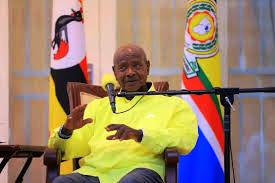
President Yoweri Kaguta Museveni has reaffirmed the National Resistance Movement (NRM) government’s unwavering commitment to accelerating Uganda’s socioeconomic transformation.
Speaking during a media engagement at Mbale State Lodge on Saturday night, President Museveni outlined seven foundational pillars that he said continue to drive the country’s progress, while pledging sustained momentum toward industrialization, peace, and prosperity.
“The NRM manifesto encapsulates all of Uganda’s national aspirations and maintains a clear edge over competing political platforms,” the President asserted.

President Museveni listed the NRM’s seven core contributions to Uganda’s development as Peace and Security, Development, Wealth Creation, Job Creation, Market Expansion (Regional and Beyond), Political Integration of East Africa, and Strategic Security.
He said each of these pillars represents a cornerstone of Uganda’s stability and long-term growth.
“Without peace, there can be no meaningful development,” Museveni emphasized, noting that the calm achieved under NRM leadership has been the bedrock of economic expansion, investment, and improved livelihoods.
The President reaffirmed industrialization as a key catalyst for job creation and wealth distribution.
He cited several ongoing and planned industrial parks as practical examples of this agenda, including Namanve Industrial Park, Mbale Industrial Park, and the Busobo Industrial Park in Manafwa District.
These projects, he said, reflect Uganda’s transition from a raw-material exporter to a manufacturing and value-addition economy.
“Our industrialization drive is the major engine for job creation and transformation,” Museveni noted.
President Museveni stressed that every Ugandan must transition from subsistence farming to commercial, income-generating activities.
He said the NRM government’s focus is on empowering citizens to join the “money economy” through targeted support programs under the Parish Development Model (PDM), Emyooga, and other community-based initiatives.
“We must move away from hand-to-mouth living. Every Ugandan should be engaged in producing for the market,” he said.
Turning to the Elgon subregion, the President warned residents in landslide-prone areas to reconsider their settlement and land-use patterns.
He explained that unregulated cultivation and poor land management have worsened environmental vulnerability in hilly regions.
“Poor land management practices have exposed many communities to recurring environmental disasters such as landslides,” he observed.
Museveni said government experts have made specific recommendations to guide safer settlement in mountainous districts such as Bududa, Manafwa, and Sironko.
In a firm tone, the President revealed that he had dispatched teams to investigate the use of road maintenance funds across districts.
He noted that while each district receives UGX 1.3 billion annually, some local governments had delivered substandard works, which he attributed to corruption and negligence.
“We are following up. The government cannot tolerate shoddy work when funds are provided,” he warned.
President Museveni also accused sections of the opposition of colluding with foreign actors to destabilize Uganda.
He disclosed that two Kenyan nationals were recently arrested for allegedly entering the country to train rioters in collaboration with local political figures.
“Our intelligence agencies acted swiftly,” the President said, adding that similar incidents had been observed in Tanzania.
“I caution citizens to remain vigilant against such foreign-sponsored schemes.”
To counter external manipulation, Museveni directed NRM Secretary General Richard Todwong to intensify patriotism training programs, particularly among the youth.
In a major policy announcement, the President unveiled plans to launch a Graduate Support Fund, to be implemented zone by zone across the country.
This fund, he said, will complement ongoing economic empowerment initiatives under the Parish Development Model, as well as programs supporting religious, cultural, and parish leaders.
“We are going to support our graduates so that they become job creators, not job seekers,” Museveni explained.
President Museveni reaffirmed his administration’s commitment to promoting coffee value addition in the Elgon subregion, one of Uganda’s leading Arabica coffee zones.
He said this will help increase farmers’ incomes and strengthen Uganda’s position in the global coffee market.
“Strategic investments in the coffee sector will further enhance Uganda’s export earnings,” he noted, urging farmers to adopt modern farming and processing methods.
As the nation prepares for the next phase of its development, Museveni reassured Ugandans of a robust and capable security system.
“Our security forces are ready to neutralize any threats that may emerge in the post-election period,” he declared.
He concluded with a promise that Uganda would continue along a steady path of peace, stability, and progress, anchored on the NRM’s seven pillars of transformation.
The President’s latest address echoes the NRM’s 2026–2031 Manifesto theme, “Protecting the Gains and Securing a Qualitative Leap into High Middle-Income Status.”
It aligns with Uganda’s broader development agenda, focusing on industrial expansion, social empowerment, and regional market integration.
Experts note that the President’s renewed emphasis on environmental management and anti-corruption measures signals a growing recognition of governance challenges that threaten infrastructure and livelihoods in rural Uganda.
Meanwhile, the introduction of the Graduate Support Fund is being viewed as a crucial step toward addressing youth unemployment, currently one of Uganda’s most pressing economic challenges.