




President Yoweri Kaguta Museveni has delivered a forceful message to parish and sub-county leaders in Uganda’s Bukedi region, making clear that any local official who excludes young people, women or persons with disabilities from benefiting under the Parish Development Model (PDM) will be removed from office.
Speaking at a campaign rally held in Pallisa District on Wednesday, 12 November 2025, the President — also the presidential flag-bearer of the National Resistance Movement (NRM) for the 2026 general election — reiterated that his government would not tolerate misuse or misallocation of PDM funds which are specifically earmarked for vulnerable and marginalised groups.
He spelled out the required allocation ratios for each parish’s PDM funding: “Within the 100 million shillings per parish, 30% belongs to the youth, 30% to the women, and 10% to the disabled. So, I don’t want to hear that story again,” Museveni declared.
He further warned local leaders: “If I hear that the youth, the women, or the disabled are not getting their share, I will go for the parish chief first, and I will dismiss them, plus the sub-county chiefs.”
The President’s admonishment comes amid growing public scrutiny of the PDM’s roll-out — a government flagship initiative launched in 2022 — after reports emerged of mismanagement, favouritism and delays in disbursing funds in some parishes. The PDM is designed to serve as a poverty-reduction and wealth-creation vehicle by channeling seed capital to parishes and households.
Museveni emphasised that local leaders hold primary responsibility for the transparent and fair disbursement of public resources. He said the success of the PDM rests largely on honest administration at the parish level.
“Let everybody get their share. But also, you, the youth, should join the SACCOs. Go to the Muluka chief and ask them to join the parish SACCOs. Nobody will stop you as long as you’re over 18 years old,” he told the cheering crowd.
Each parish under the PDM is allocated 100 million Ugandan shillings in seed capital to support savings cooperatives (SACCOs), household enterprises and commercial agricultural productivity.
Museveni reiterated that these resources were structured to help transition rural communities from subsistence activity into commercial production.
According to figures presented during his address, Pallisa District — which has 90 parishes — has so far received Shs 27.7 billion under the scheme, of which approximately 98.2 % has been disbursed to 27,343 beneficiary households. That represents around 45 % of the district’s total 60,882 households, leaving 55 % of households yet to benefit.
Wealth Creation at the Heart of NRM Policy
In his broader campaign message, the President revisited the evolution of Uganda’s poverty-alleviation strategy since the NRM came to power in 1986, and made clear that he distinguishes between “development” and “wealth creation”.
“Development is for all of us, but wealth is for individuals. What is mine is better than ours. The wealth that you personally create is what sustains your household,” Museveni explained, citing earlier government initiatives such as Entandikwa, NAADS, Operation Wealth Creation (OWC), Emyooga, and now the PDM as part of a consistent effort to economically empower citizens.
“From the beginning, we have said that if you want to be well, you must add wealth,” he said.
“We have been pleading with Ugandans to get out of poverty since 1986. Some ignored the message, but others listened, and they are now prosperous.”
To illustrate his point, the President screened video clips of farmers he said have benefitted from government support. He described one such beneficiary, Joseph Ijala of Serere District, as earning over Shs 6 million daily from poultry and dairy farming.
“When I visited him, I found him earning 6 million shillings per day from eggs alone, plus Shs 800,000 from milk. That’s Shs 6.8 million per day,” he narrated.
He added: “Serere may not have tarmac roads, but there is wealth there. That’s what we mean when we talk about transforming livelihoods.”
He also referenced a farm model belonging to Fred Byamukama (MP and State Minister for Transport) in Bugangaizi West, where a four-acre enterprise combining coffee, fruit crops, food crops, dairy cattle and poultry reportedly generates about Shs 700 million annually and employs 26 people.
“This is how wealth creates jobs. Government jobs are only about 480,000, yet we have millions of Ugandans. If every household focuses on productive enterprises, we can create jobs through wealth,” Museveni asserted.
The NRM flag-bearer additionally announced plans to broaden the PDM’s reach to new beneficiary categories.
“We are going to add 15 million shillings for local leaders and create special funds for church and mosque leaders, as well as cultural institutions,” he said.
“We shall also start a fund for fishermen, zone by zone, because they need more than one million to buy boats and nets. For university graduates without jobs for two years, we shall also create a fund.”
Industrialisation and Resource-Use Push in Bukedi
Turning his attention specifically to Bukedi, Museveni addressed industrial development, telling the audience that the 100 acres offered by Pallisa District for an industrial park was inadequate. “You have given me very little land. I want a square mile or more. When you get more land, come back to me,” he said. He referenced the Sino‑Uganda Industrial Park in Mbale — which hosts some 75 factories — as an example of how industrialisation can generate mass employment.
Addressing the region’s swampy terrain and natural resources, he encouraged residents to pivot from rice cultivation to fish farming.
“You, the Bukedi people, are blessed with swamps. Fish farming is very lucrative. In my Lira farm, the fish ponds yield 100 million shillings per year. In Limoto here, farmers are getting 56 million per acre — more than what they earned from rice,” he said.
The President pledged government support for pond construction, saying fish farming is a major income source.
On peace and infrastructure he observed that Bukedi, once ravaged by cattle rustling and the insurgency of the Julius Wagayaga Lakwena era in the 1980s, now benefits from peace and growth.
“For 40 years, we have ensured peace. Pallisa was once attacked by cattle rustlers and was a battleground for Lakwena. But now there is stability because of the institutions we built — the army, police, and a united party,” he said.
He listed peace as the first of NRM’s “seven key contributions” to Uganda, followed by development in transport, electricity, telecommunications and water access.
“When NRM came to power, the only tarmac road in eastern Uganda passed through Tororo. We made the Iganga–Nakalama–Tirinyi–Mbale road, and later the Tirinyi–Pallisa–Kumi road,” he said.
He also criticised local authorities for neglecting rural roads and warned: “They just graded this road because they knew I was coming. I have warned Minister Katumba. We gave each district one billion for roads, so the RDC and LC5 must ensure accountability.”
Water, Education and Health Service Upgrades
According to data shared at the rally, 477 of Pallisa’s 498 rural villages (96 %) now have access to safe water sources.
Completed projects include the Pallisa Town Council Piped Water Supply and Sanitation Project serving 54,000 people, and the Limoto Irrigation Scheme in Bolliso Sub-County benefiting 100 farmers.
Ongoing work includes the Nakitende Solar-Powered Irrigation Scheme in Najeneti Sub-County, while future plans cover new piped water systems for Kibale and Kamuge Town Councils.
On education, Museveni said that while Pallisa District has made progress — with 76 government and 160 private primary schools, and nine government and 23 private secondary schools — some parishes and sub-counties still lack institutions.
“Our policy is one government primary school per parish and one secondary school per sub-county. Those that lack will be prioritised,” he said.
He recalled Uganda’s situation in 1961: “In 1961, when I was at Ntare School, we had many boys from Bukedi, like Dr Steven Malinga and others who were coming to Ntare because there were only 3 A-level schools for boys in the whole of Uganda.”
“When I come here today and find that Pallisa has nine government secondary schools, I say Eyalama Edeke (thank you God),” President Museveni remarked.
He also raised concerns over continuing school charges in government schools that keep children out of education.
To address this, he cited the establishment of 19 skilling hubs across Uganda. In Bukedi, the hub is in Kibuku District and has trained 927 youth in welding, carpentry, tailoring, hairdressing, baking and leather design. Currently, 234 are undergoing training.
“These children had no hope, but in just six months, they are producing goods we used to import,” he added.
On health services, he pointed out that in Pallisa’s 21 sub-counties, only one has a hospital and 14 have Health Centre IIIs. Six sub-counties have no health facility at all.
“Our plan is to have a health centre II in every parish, a health centre III in every sub-county, and a district hospital,” Museveni said.
Planned upgrades include turning Obutete, Kaukura and Limoto Health Centre IIs into Health Centre IIIs, and constructing new facilities in Kamuge Rural, Agule Rural and Oboliso Sub-counties.
Local Leaders’ Response and Rally Atmosphere
The rally was addressed by the Speaker of Parliament and NRM Second National Vice-Chairperson, Rt. Hon. Anita Among, who welcomed the President to Bukedi and praised the government’s infrastructure work.
“Especially the road from Tirinyi to Pallisa up to Kumi — now we have the best road in eastern Uganda,” she said. She also commended President Museveni for “defending Uganda’s traditional values” and for “bringing money to the people.”
NRM Vice-Chairperson for the Eastern Region, Mr Calvin Echodu, said the massive turnout in Pallisa reflected public confidence in the President’s leadership.
“It’s a testament to how the people of Bukedi believe in what you and the NRM have done,” he declared.
Hon. Derrick Orone, MP for Gogonya County and NRM District Chairperson for Pallisa, presented seven key requests from the people of Pallisa including elevating Pallisa General Hospital to referral status, establishing more technical schools and making local political appointments for NRM cadres.
“We shall give you above 90 % in the upcoming election,” Hon. Orone said to cheers from the crowd.
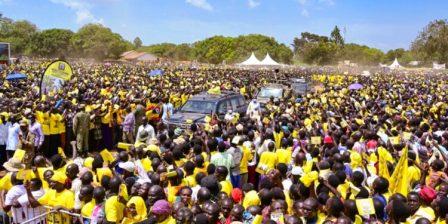
The rally drew thousands of residents, government officials and party supporters, including NRM Secretary-General, Rt Hon Richard Todwong, and several MPs from Bukedi and neighbouring regions.
The President’s clear directive sets a strict accountability standard for local leaders under the PDM, tying political survival to inclusive implementation of the programme.
With the PDM central to the NRM’s 2026 campaign message of wealth creation and transformation, the warning sends a strong signal that exclusion or misallocation of development funds will not be tolerated.