














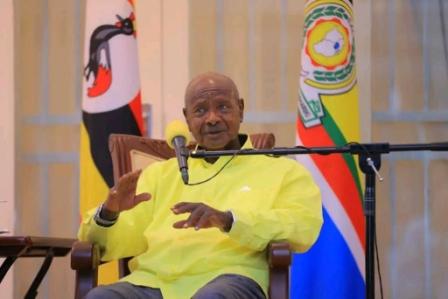
President Yoweri Kaguta Museveni has intensified his call for agricultural transformation in Eastern Uganda, directing the Ministry of Agriculture to produce coffee and other cash-crop seedlings for free distribution to farmers nationwide in a move aimed at countering the high costs imposed by private nursery operators.
The directive was issued during his engagement with leaders and residents of the Bukedi Sub-region, where he urged communities to fully embrace government-backed intensive agriculture as a reliable path to wealth creation.
He emphasized that structured enterprise selection remains critical for households seeking to transition from subsistence to commercial production.

He pointed to success stories from other parts of the country where carefully selected enterprises have turned smallholder farmers into commercial producers.
President Museveni also stressed the strategic importance of proper land management, cautioning residents against misusing wetlands.
He explained that wetlands should be preserved for irrigation to support year-round production, especially as climate variability continues to affect rain-fed agriculture.
He disclosed that government has finalized plans to establish fish-feed factories in Jinja and Bukalasa.
He said these factories will support the rapidly expanding aquaculture sector, which has become a major income source for farming households.
While addressing participants, President Museveni issued a strong warning about the dangers of political disintegration in Africa.
He said fragmentation has slowed technological progress and undermined the continent’s capacity to respond to emerging global security challenges.
He urged African youth to rise to the responsibility of safeguarding the future of the African race.
During an interaction with journalists from Bukedi at Mbale State Lodge, President Museveni questioned the role of intellectuals and young people in shaping Africa’s long-term socioeconomic trajectory.
He challenged African countries to accelerate efforts to consolidate regional markets, arguing that larger economic blocs are essential for resilience and competitiveness.
President Museveni highlighted what he described as one of the NRM government’s most significant historical achievements: the decision to directly finance wealth-creation interventions.
He emphasized that no previous administration had attempted such widespread financing of household-level economic empowerment.
He cited landmark socioeconomic programs—including Emyooga, the Parish Development Model (PDM), the Youth Livelihood Programme, and Women Empowerment Schemes—as “revolutionary tools” that are transforming individuals and communities across Uganda.
He reported that these interventions have driven job creation across the Bukedi Sub-region, especially in commercial agriculture and industrialization.
He explained that the NRM government has deliberately removed structural bottlenecks in multiple sectors to accelerate national development.
Addressing leaders and residents, President Museveni emphasized the need for prioritization in public service delivery.
He called for improved convergence in planning and budgeting processes to ensure that government resources are used effectively.
He noted that uncoordinated budgeting has delayed key infrastructure such as roads, electricity grids, schools, hospitals, and water supply systems.
Highlighting achievements in Bukedi, President Museveni listed several completed and ongoing tarmac road projects.
He assured the public that more infrastructure developments are planned for the region.
He concluded his engagement by calling for unity, saying it remains the strongest foundation for sustained peace and prosperity.