











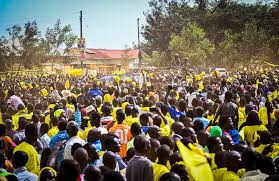
President Yoweri Kaguta Museveni, the National Resistance Movement (NRM) Presidential flag bearer, has officially begun his campaign tour of the Busoga sub-region, using his first rally in Bugiri District to outline a renewed vision for regional transformation and inclusive national development.
The President, who was accompanied by the NRM First National Vice Chairman Alhaji Moses Kigongo and other senior party leaders, arrived to a massive crowd of supporters eager to engage him on the future of Busoga and Uganda at large.
Opening his address, President Museveni urged the people of Bugiri to reaffirm their support for the NRM, arguing that the party’s decades-long commitment to unity, national stability and socio-economic progress distinguishes it from other political entities.

“I am here, together with other leaders, to ask you to support the NRM. We are a national party with a proven record. From the beginning, we rejected the sectarian politics that divided Uganda in the 1960s. We believe everyone is valuable and that is why Uganda is stable today,” he said.
The President emphasized that Busoga has been a major beneficiary of the NRM’s infrastructure revolution, noting that the region’s development footprint is clearly visible.
“If you audit Busoga, you will see the development,” he said.
He cited the reconstruction of key national highways including the Jinja–Kampala and Jinja–Tororo routes, alongside the establishment of new tarmac roads such as Iganga–Kaliro and Busita–Namayingo.
He further confirmed that more road projects are planned, including the Jinja–Kamuli–Mbulamuti and Iganga–Kiyunga–Kamuli roads, as well as additional road upgrades within Bugiri District such as Bugiri–Namayingo.
Turning to water supply challenges, President Museveni explained that the Lake Victoria belt has a unique geological composition that makes borehole drilling unsuitable.
“Our plan is to pump water directly from Lake Victoria to the higher areas, just like we did in Lira where we pumped from Kachung, 21 miles away,” he noted.
“We are already supplying Kampala from Katosi. We shall do the same here so that the people of Bugiri get a reliable water supply.”
The President expressed concern over the imbalance in school distribution across Bugiri District and Bugiri Municipality, despite the existence of 149 government primary schools.
He highlighted that out of 102 parishes in the district, 44 still have no government primary school.
“This must stop, we need to look into this issue of distribution seriously. I appeal to the NRM district chairperson, the RDC, DEOs to take it up. Let us ensure that every parish has a government primary school but not finding one parish with more schools yet there are those without any,” he said.
At secondary level, Bugiri’s 20 sub-counties are served by only nine government schools, a gap the President promised to close.
He announced that three new seed secondary schools will be constructed under the Uganda Intergovernmental Fiscal Transfers (UgIFT) program and the Uganda Secondary Education Expansion Project (USEEP).
“Our target is simple: every sub-county must have a secondary school, and every parish must have a government primary school,” he said.
President Museveni refocused his message on wealth creation, insisting that prosperity comes from productive participation in commercial sectors.
“Some people confuse development with wealth. Kampala has development, but some people in the ghettos are still poor. Wealth is created in four sectors: commercial agriculture, manufacturing, services and ICT,” he said.
He reminded residents that the four-acre model introduced in the 1996 NRM manifesto remains a reliable blueprint for household transformation, with success stories emerging even from traditionally hard-to-farm regions like Karamoja.
He added that government will continue boosting household incomes through targeted financing mechanisms such as the Parish Development Model (PDM), Emyooga, youth funds, ghetto youth programs, boda boda support initiatives, and schemes for religious and cultural institutions.
The President dispelled misconceptions about employment dynamics, noting that public service cannot absorb the population.
“Government jobs are 480,000, yet we have 50 million Ugandans. Real jobs come from wealth from factories, commercial agriculture, services and ICT. The factories alone now employ 1.3 million Ugandans, three times more than the government.”
He criticized persistent attempts by some school administrators to resist free universal education.
“We introduced free education in 1996 because we knew school fees would block many children but some head teachers and PTAs refused to implement it. That’s why I started the Presidential Skilling Hubs,” he said.
He added that the hubs have already transformed thousands of youth who would otherwise be excluded from mainstream education opportunities.
During the Bugiri event, the President officially handed NRM flags to parliamentary aspirants, LC V leaders, councillors and other party candidates, signifying his endorsement ahead of the upcoming elections.
Alhaji Moses Kigongo thanked residents for continually supporting the NRM.
“We request your votes for the President. Once we are united, we can settle all issues. On voting day, go out and support our chairman,” he appealed.
Hon. Calvin Echodu, the NRM Vice Chairperson for Eastern Uganda, praised the massive turnout.
“Your Excellency, you are no stranger to Busoga. The numbers here justify the strong support for you. We congratulate you on completing the Bukedi sub-region. Thank you, Busoga.”
Rt. Hon. Rebecca Kadaga, First Deputy Prime Minister and Minister for East African Community Affairs, welcomed President Museveni and urged attention to industrial growth, water access and tourism expansion.
“Your Excellency, we need safe water in Busoga, an issue that has been affecting our people. We also want to look forward to boosting tourism and creating more opportunities for our people.”
Bugiri District NRM Chairperson Hon. Solomon Silwany thanked the President for steering major development initiatives that have improved livelihoods across the region.
The rally also showcased the government’s development footprint in Bugiri, covering education, healthcare, water services and environmental restoration.
Bugiri District and Bugiri Municipality have 149 primary schools serving over 105,000 learners. Out of 102 parishes, 58 have at least one government primary school, while 44 remain without one.
The district currently has nine government secondary schools enrolling 10,699 students, while Bugiri Municipality has one such school with 1,876 learners.
With the forthcoming construction of three additional secondary schools under UgIFT and USEEP, the number of sub-counties lacking a government secondary school will drop from 11 to 8.
In skilling, the Busoga Presidential Industrial Hub in Jinja has already trained 961 youth in welding, carpentry, building, tailoring, bakery, hairdressing and leatherwork, with 240 new trainees currently enrolled.
The health sector comprises one hospital, one HCIV and 11 HCIIIs. Government plans to upgrade several HCII facilities to HCIII level and construct new HCIIIs in Buwumi Town Council, Muwayo Town Council and Muterere Sub-county.
On water access, 335 out of 498 villages (67%) have safe water coverage, while urban water systems have been expanded in Bugiri Town Council, Buwuni TC and Nankoma.
Upcoming projects include the Namayemba piped water and sanitation system and expanded water-for-production investments.
Bugiri’s wetlands, covering 22,760 hectares, remain heavily degraded—with only 29.6% still intact—raising concerns about long-term environmental resilience.
The event was attended by NRM Central Executive Committee members, Members of Parliament, cultural and religious leaders, and thousands of enthusiastic supporters.