














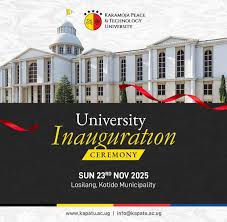
A wave of renewed optimism swept across Karamoja on November 23rd, 2025, as leaders, cultural institution representatives, religious figures, and thousands of residents gathered in Losilang, Kotido Municipality, to witness the official unveiling of the Karamoja Peace and Technology University (KAPATU) project.
The event—colorful, emotional, and historically symbolic—signalled what many described as the beginning of a new era for a region long associated with conflict, marginalization, and chronic underdevelopment.


The ceremony opened with a Holy Mass led by Archbishop Emeritus of Gulu, Rt. Rev. John Baptist Odama, whose call for healing and unity set a reflective tone for a project built on the pillars of peace, education, and transformation.

Prime Minister Emeritus Rt. Hon. Amama Mbabazi, representing President Yoweri Kaguta Museveni, presided over the unveiling and announced the government’s full backing for the establishment of what will become one of Uganda’s most strategic public universities.
Rt. Hon. Mbabazi informed the gathering that the President could not attend due to scheduled engagements in Tororo and Kisoro, but had sent an unequivocal message of support for the university.
Delivering President Museveni’s statement, he said the government recognizes KAPATU as a cornerstone for restoring stability and empowering the youth of Karamoja and the greater Ateker cluster across Uganda, Kenya, South Sudan, and Ethiopia.
President Museveni emphasized that education remains “the strongest antidote to poverty, violence, and social breakdown,” noting that the strategic direction of KAPATU aligns with Uganda’s broader development and peace-building priorities.
In his personal remarks, Rt. Hon. Mbabazi commended President Museveni for making KAPATU a Nucleus National Public University—a designation that secures its long-term sustainability and national importance.
He praised the Catholic Diocese of Kotido and the Catholic Lawyers Society International (CLASI) for originating the idea, saying, “I thank the Catholic Diocese of Kotido and Catholic Lawyers Society International [CLASI] for conceiving the idea. They sowed the seed that we are here today. As Chief International Fundraiser, I am encouraged by the progress already made. I stand ready to serve whenever and wherever because KAPATU’s goal is to become a globally recognized centre for peacebuilding, innovation and transformation.”
He traced the government’s commitment to Karamoja back to the bush war era, explaining that the region’s transformation was embedded in the NRM’s 10-point programme from the very beginning.

He added that education remains the most powerful tool for social change, noting, “Education has always been one of the most powerful tools for transformation. Karamoja today stands at a critical moment. This region holds immense natural and human potential, and yet it still faces several challenges like climate disasters, historical underinvestment in higher education, and poverty, among others.”
He stressed that KAPATU has been designed as a long-term solution that fits perfectly within the National Development Plan and Uganda’s human capital development goals.
He said, “Above all, it reflects our national aspiration to ensure that no community is left behind. This university isn’t merely an institution of learning but an engine for regional transformation and a beacon of peace.”
He further revealed that over USD 200 million has already been secured for two major projects under the broader Karamoja transformation agenda, including a landmark water project.
The ‘KAPATU ERUPE Presidential Initiative,’ he announced, will channel water from Lake Bisina to Karamoja, reaching Ere (homesteads), Awi (kraals), and Elein (trading centres) to support agriculture and livestock production in the drought-prone region.
The announcement drew applause from residents who have long wished for sustained investment in higher education, water access, and peace-building in Karamoja.

Kotido District Chairperson Lote Paul hailed President Museveni for championing the initiative, describing the university as a “beacon of hope” for a region that has endured decades of insecurity, cattle rustling, and limited access to tertiary education.
He thanked international partners, including the Ethiopian government, for their involvement in the project’s planning and development.
He said, “Karamoja has suffered greatly, but this university is a beacon of hope. It will significantly help in the fight against cattle rustling and open new opportunities for the people. Education and transformation go hand in hand, and we are grateful for this vision.”
A Holistic Vision for Transforming Karamoja and the Ateker Region
The KAPATU project is designed as a comprehensive model that integrates higher education with peacebuilding, modern science, human rights promotion, psychosocial support, and community-based empowerment.
Its academic and outreach programs will target youth, women, former warriors, and vulnerable families—groups often trapped in cycles of poverty and violence.
Experts at the ceremony noted that blending technical skills with peace education will address historical drivers of conflict in Karamoja, including unemployment, limited livelihood options, and cultural tensions.
Given Karamoja’s vast mineral wealth and livestock potential, KAPATU is expected to produce professionals capable of managing natural resources responsibly and sustainably.
Meanwhile, Rev. Dr. Mugisha Kagume, Deputy Executive Director of the National Council for Higher Education (NCHE), told attendees that KAPATU had already applied for a Provisional License to begin academic operations.
He explained that NCHE granted the project a Letter of Interim Authority in 2024, allowing it to start infrastructure development and prepare academic and administrative frameworks.
He confirmed that deliberations on issuing a Provisional License are ongoing.
About KAPATU
KAPATU is a multistakeholder initiative comprising the Catholic Dioceses of Kotido and Moroto, the Catholic Lawyers Society International, and the Government of Uganda.
The concept was first introduced in 2014 by CLASI and was later validated and celebrated in April 2023 at the Uganda Episcopal Conference Headquarters in Nsambya.
President Museveni, represented by Vice President H.E. Maj. Jessica Rose Alupo, presided over this foundational event.

In July 2023, Vice President Alupo—also KAPATU’s Deputy Founding Chancellor and Chief Promoter—laid the first foundation stone at Losilang on behalf of the President, who is the university’s Founding Chancellor.
The unveiling of the KAPATU project in 2025 represents the most significant step yet in establishing a globally competitive centre for peace, innovation, and regional transformation.
For the people of Karamoja and the broader Ateker region, KAPATU symbolizes not just a university, but a long-awaited promise of stability, dignity, and opportunity.