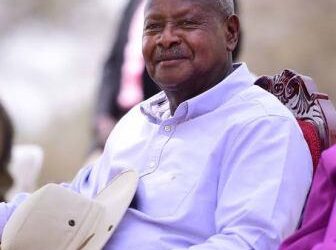










President Yoweri Kaguta Museveni has renewed his pledge to accelerate Mitooma District’s transformation through major road upgrades, expanded power connections, and intensified wealth-creation programs, positioning the area as a key growth corridor in western Uganda ahead of the 2026 general elections.

The commitments were made during the National Resistance Movement (NRM) Presidential campaign rally at Kirambi–Ruhinda Market Grounds, where the President outlined a comprehensive package of socioeconomic interventions aimed at strengthening the region’s agricultural productivity, connectivity, and human development indicators.

Observers note that this rally comes at a time when the western region remains one of the NRM’s most dependable political bases, and Museveni’s message in Mitooma aligns with his wider strategy of consolidating rural support through infrastructure and enterprise-development promises.
President Museveni began by announcing that his next term will prioritise the extension of the Ishaka–Kashenshero tarmac road through Mitooma District all the way to Rukungiri District.
He emphasized that the long-awaited Bwizibwera–Nyakambu–Rukungiri road will also be upgraded, arguing that modern road networks are essential for reducing transport costs, attracting private investment, and linking farmers to competitive markets.
The President said these roads form part of a larger national logistics plan to connect productive districts in Ankole and Kigezi, noting that improved rural road access has been one of the most consistent demands from local leaders across the region.
Museveni further confirmed ongoing efforts to complete last-mile electricity connections in Mitooma, stating that “the remaining three subcounties will be connected to power”, and assuring residents that his government has already delivered “significant development milestones” in the district.
He pointed out that reliable and affordable electricity remains central to rural industrialisation, small enterprise growth, and household productivity.

The President highlighted improvements in the social services sector, noting that Mitooma now has 109 government primary schools, 16 government secondary schools, several Health Centre IIIs and IVs, and a general hospital serving the wider population.
He said the government’s priority going forward will be to ensure that these facilities are well-equipped and adequately staffed to meet the growing demands of the district.
Turning to agriculture, Museveni reminded residents of the government’s Shs 360 billion fund established to revamp the tea sector.
He assured farmers that “the facility will be accessible to all tea growers,” calling on producers to organise themselves and take advantage of the funding to expand plantations, improve yields, and stabilise local incomes.
The President added that other cash-crop producers will also receive targeted support, including coffee, fruits, dairy, and fish farmers, urging residents to practise sustainable land use for long-term prosperity.
He emphasized that national development cannot be achieved without lifting all households out of subsistence, explaining that wealth-creation must involve every citizen regardless of age, gender, or education level.
Museveni advised residents to embrace commercial agriculture, citing the 4-acre model which includes dairy, poultry, fish farming, fruit growing, coffee, cocoa, and other viable enterprises.
He referenced several success stories across the country where families have adopted similar models and significantly increased their incomes.
The President stressed the importance of preserving peace and security, warning the public against political actors who promote sectarianism or **“identity politics and gender chauvinism.”**
He credited the NRM’s mass-line ideology—focused on unity and patriotism—for delivering decades of stability that have enabled economic and social progress.
He urged the people of Mitooma to “defend the gains of free universal education” in government schools and to reject divisive politics that derail national development.
First Lady Maama Janet Kataha Museveni called on young people to actively participate in grassroots mobilisation, saying they must champion NRM achievements and work for the re-election of President Museveni and all NRM candidates.
She emphasised the role of youth as ambassadors of continuity and progress in their communities.
Deputy Speaker of Parliament Thomas Tayebwa commended ongoing agricultural efforts in Mitooma, particularly in coffee farming and enterprise diversification.
He requested the President to support the completion of the Queen Elizabeth National Park fencing project to address persistent human-wildlife conflicts affecting farmers.
Tayebwa underscored the achievements of government poverty-alleviation programs such as the Parish Development Model, Emyooga, the Youth Livelihood Program, and the Women Empowerment Fund, arguing that these initiatives have strengthened household resilience and entrepreneurship across Mitooma.
The Internal Affairs Minister, who is the NRM flagbearer for Ruhinda County, called on residents to safeguard NRM achievements and to turn up in large numbers to vote for the President and all NRM flagbearers.
Mitooma District NRM Chairperson Moses Tumwekwase presented a detailed district status report, outlining progress made in infrastructure, agriculture, and social services, while highlighting challenges that still require government attention in the next development cycle.