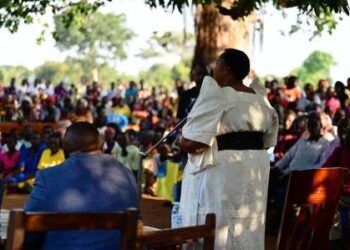











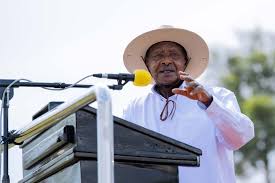
President Yoweri Kaguta Museveni returned to Kiryandongo District today with a message that blended history, development, and political continuity, addressing thousands of residents gathered at Karagalya grounds in a rally that underscored the National Resistance Movement’s (NRM) 40-year imprint on Uganda’s governance and socio-economic transformation.
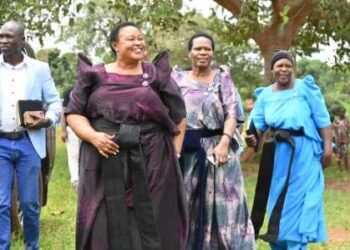
The President, accompanied by his daughter. Natasha Museveni Karugire and senior NRM leaders, remarked that his visit to Kiryandongo carried a sense of nostalgia, recalling the stark contrast between the area’s current development and its desolate state decades ago.
He narrated how parts of the district such as Katulikire and Bweyale were “once bushy with only three shops,” painting a portrait of northern Uganda’s internal displacement era when thousands were fleeing conflict zones.

He recounted how he met displaced families in Anaka during the Congo war and encouraged them to settle in Kiryandongo, a move that helped establish the foundation of today’s bustling and multicultural Bweyale Town.
His reflections formed the backdrop for a broader message: that the NRM’s longevity in power is tied to concrete achievements that have reshaped the country across security, development, and household prosperity.
President Museveni reaffirmed that the NRM’s foremost contribution is peace, emphasising that Uganda’s security is built on the government’s rejection of discrimination based on tribe, religion, or identity.
He stated that this approach has strengthened national institutions and allowed social stability to take root in formerly volatile regions.
He pointed to post-war northern Uganda, the Rwenzori, Karamoja, and Teso as areas that once endured conflict but today benefit from relative calm and functioning local governance.
On development, the President cited the extensive road network, new schools, and expanding physical infrastructure that now link once-isolated communities to national markets.
He acknowledged concerns raised by Kiryandongo residents regarding the state of health services, agreeing that Kigumba, Kiryandongo, and Panyadoli hospitals require urgent improvement to meet the health demands of a rapidly growing population.
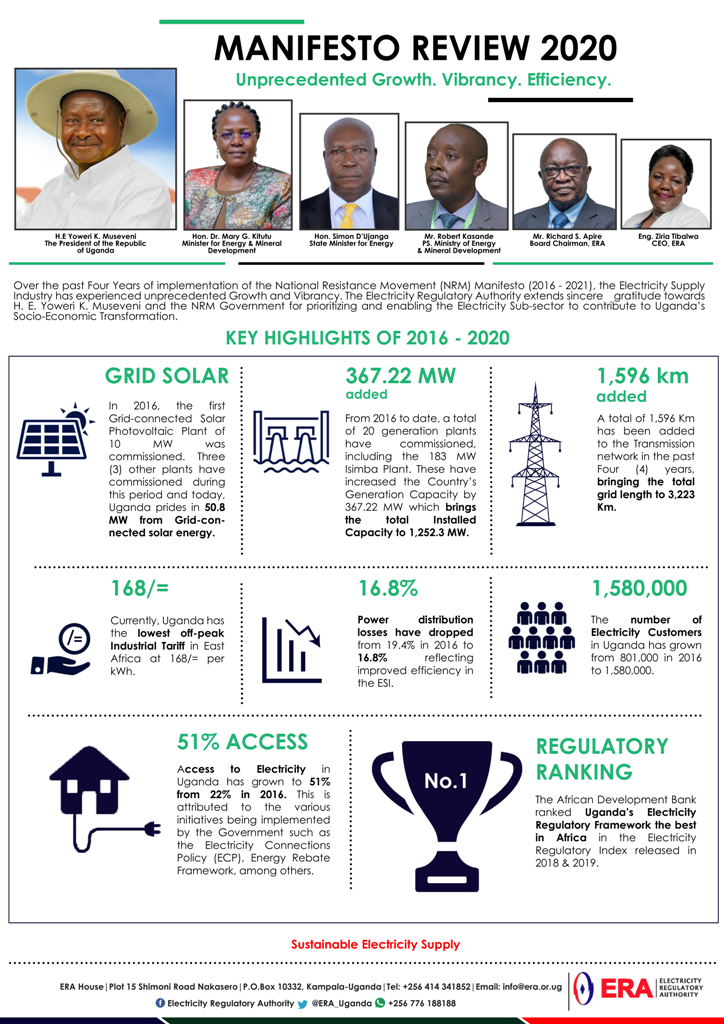
President Museveni also expressed concern that “some parts of Kiryandongo still lack electricity despite hosting major power installations,” pointing specifically to the presence of the Karuma Hydropower Project.
He directed the Prime Minister to ensure that communities surrounding these installations “fully benefit from electricity distribution” instead of watching power flow past them to distant destinations.
He transitioned to the topic of wealth creation, a theme he said has long been misunderstood as many Ugandans focus solely on development projects without improving household incomes.
He reminded residents that government introduced the four-acre model in the 1996 NRM Manifesto as a targeted plan to help small landowners generate sustainable income.
He urged farmers to adopt the model’s seven enterprises—typically including coffee, fruits, food crops, dairy, poultry, and pasture—while landowners with larger acreage engage in commercial tea, cotton, ranching, or timber production.
He reaffirmed that programmes such as the Parish Development Model (PDM) and Emyooga were designed specifically to help citizens escape subsistence farming.

He condemned the illegal practice of deducting money from PDM allocations, insisting that government would not tolerate corruption in poverty-alleviation initiatives.
He warned that, “We shall deal with anyone reducing PDM money. That money is for the poor.”
He further highlighted the role of the money economy and reiterated that no Ugandan should remain stuck in subsistence production.
On job creation, President Museveni emphasised that employment opportunities naturally arise from four major sectors—commercial agriculture, industry, services, and ICT.
He cited inspiring examples such as Mr. Johnson Basangwa of Kamuli, a poultry farmer who now employs 300 workers, demonstrating how individuals can transform local economies through enterprise.
He encouraged urban youth and school leavers to enroll in government skilling hubs, which he said provide training in practical fields including “hairdressing, bakery, welding, and more,” as part of a national effort to ensure every Ugandan acquires a marketable skill.
The rally also featured reflections from other national leaders who underscored the importance of Kiryandongo’s development trajectory.
The Speaker of Parliament and NRM Second National Vice Chairperson (Female), Rt. Hon. Anita Annet Among, thanked President Museveni for Uganda’s refugee policy, noting that hosting refugees in Kiryandongo demonstrates that the country is “a safe country” founded on peace and stability.
Prime Minister Rt. Hon. Robinah Nabbanja praised the President for bringing “lasting peace,” which she said has enabled development to flourish across the Bunyoro Sub-region.
She argued that without NRM-led stability, infrastructural progress such as roads, power projects, and schools would not have been possible.
Kiryandongo District NRM Chairperson, Hon. Linos Ngopek, described the district as cosmopolitan—home to multiple ethnic groups who coexist peacefully thanks to the security ushered in by the NRM government.
He pledged that Kiryandongo would continue to support the NRM in the upcoming elections.
He thanked the President for situating the Karuma Power Station within the district but expressed disappointment that local communities benefit little from the electricity.
He said the limited access to power poses economic challenges, particularly for the vibrant business community in Bweyale Town, which also hosts a large refugee population.
He appealed for the establishment of a modern market in Bweyale and requested that Kiryandongo Hospital be upgraded to a highway referral facility to serve the district’s rapidly expanding population and its strategic location along the Gulu–Kampala highway.
President Museveni’s rally in Kiryandongo thus became more than a political gathering—it evolved into a sweeping account of Uganda’s 40-year transformation under NRM rule, grounded in a narrative of continuity, security, and the promise of shared prosperity.