
















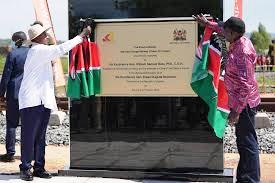
The lakeside city of Kisumu came alive as two East African leaders stood side by side to launch a project many believe could redefine regional trade.
Yoweri Kaguta Museveni arrived in Kenya to join William Ruto in officiating the construction of the Kisumu–Malaba Standard Gauge Railway extension.
The project forms a key phase of the wider Standard Gauge Railway vision aimed at linking the region through modern transport infrastructure.
A Ceremonial Welcome and Diplomatic Engagements
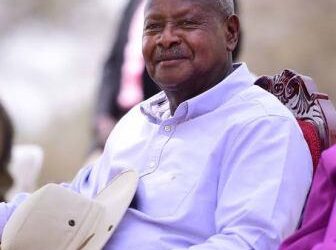
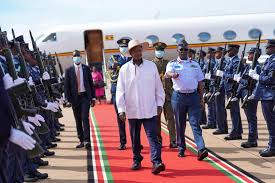
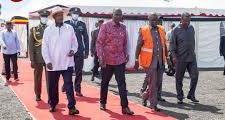
Upon landing at Kisumu International Airport, President Museveni was received with full honours by senior Kenyan officials.
Among them was Musalia Mudavadi, alongside James Opiyo Wandayi.
A guard of honour stood in formation as a mark of respect, underscoring the importance of the visit.
Members of Uganda’s diplomatic and security delegation, including Ambassador Unice Kigyenyi, accompanied the President.
Behind Closed Doors: Talks That Shape the Region
Before the public ceremony, the two presidents held a closed-door meeting to discuss matters critical to both nations.
Their discussions centered on strengthening bilateral ties, enhancing regional trade, and accelerating infrastructure development.

The meeting reflected a shared understanding that economic integration is essential for East Africa’s growth.
The Symbolic Launch
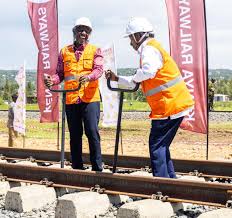
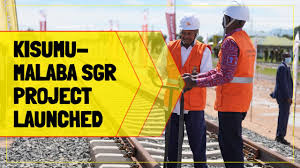
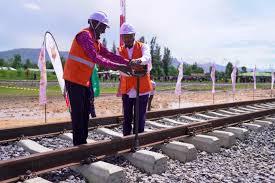
At the launch site, Presidents Museveni and Ruto jointly marked the beginning of construction.
They tightened a bolt on the railway line, a symbolic gesture signaling the start of a project expected to transform regional logistics.
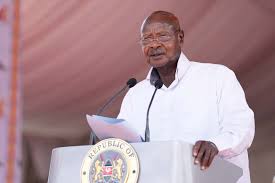
President Museveni described the occasion as a milestone.
“This is a very important function of launching the Naivasha–Kisumu to Malaba Standard Gauge Railway,” he said.
Museveni’s Vision: Fixing an “Irrational” System
President Museveni used the moment to restate his long-held concerns about Uganda’s transport structure.
“The railway is part of the rationalisation of our transport system, especially on the Ugandan side which is irrational and wasteful because passengers, light cargo, heavy cargo and petroleum products are all concentrated on the roads,” he explained.
He outlined a clear plan for Uganda’s future logistics.
Heavy cargo, he said, should be moved by rail.
Petroleum products should shift to pipelines and water transport.
Roads should mainly serve passengers and light goods.
The Cost of Inefficiency
Museveni emphasized that high transport costs are one of Africa’s biggest economic challenges.
“If Africa does not address these cost pushers, we shall be outpriced and our goods will not be competitive even within Africa,” he warned.
He linked expensive logistics to broader issues such as costly electricity and high financing rates.
According to him, reducing these costs is key to unlocking industrial growth.
Ruto’s Perspective: Speed, Efficiency, and Competitiveness
President Ruto echoed similar concerns about inefficiencies in the current system.
He pointed out that cargo movement from Port of Mombasa to inland destinations remains slow and costly.
“A slow transport corridor inevitably loses business and weakens our competitiveness as a nation,” he said.
He revealed that cargo volumes through the port reached 7.37 million tonnes in just six months of 2025.
Nearly 70 percent of that cargo, he noted, is destined for Uganda.
A Railway Years in the Making
The launch of the Kisumu–Malaba section is not an isolated event but part of a long journey.
President Museveni has for years championed the development of the Standard Gauge Railway as a backbone for regional integration.
Discussions between Uganda and Kenya on the railway date back to the early 2010s.
One key milestone was the 2014 agreement between Uganda, Kenya, and Rwanda to develop a joint SGR network.
In subsequent years, Museveni held multiple bilateral meetings with successive Kenyan leaders, including former President Uhuru Kenyatta, to coordinate timelines and financing.
These meetings often focused on ensuring that Uganda’s railway would connect seamlessly with Kenya’s line at Malaba.
Museveni repeatedly insisted that Uganda could not build its section unless Kenya extended the railway to the border.
Explaining the SGR to Ugandans
Back home, President Museveni has consistently explained the benefits of the railway to Ugandans in practical terms.
He has argued that transporting goods by rail is far cheaper than by road.
He has often illustrated how a single train can carry cargo equivalent to hundreds of trucks.
This, he says, will reduce road damage and lower maintenance costs.
He has also highlighted how faster and cheaper transport will reduce the price of imported goods.
At the same time, Ugandan exports such as coffee, fish, and manufactured products will reach international markets more competitively.
Museveni has further explained that the railway will attract investors by lowering the cost of doing business.
Industrial parks, he says, are more viable when connected to efficient transport systems.
Lessons from the Past
Museveni’s push for the SGR has also been shaped by lessons from Uganda’s colonial-era railway system.
The old metre-gauge railway, once a vital link, deteriorated over time due to underinvestment.
This forced a shift to road transport, which gradually became overburdened.
The President has frequently described this shift as both inefficient and unsustainable.
A Regional Lifeline in the Making
The Kisumu–Malaba extension is expected to strengthen the Northern Corridor, a key trade route linking East Africa.
It will connect inland countries such as Uganda, Rwanda, Burundi, South Sudan, and the Democratic Republic of Congo to the Kenyan coast.
The railway will also support economic activities around Lake Victoria, including agriculture and fisheries.
Ugandan Leaders in Attendance
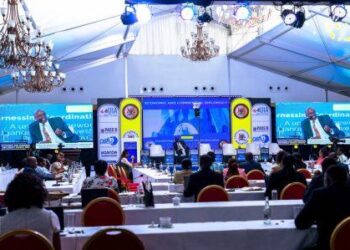
The event drew high-level representation from Uganda. Among those present was Rebecca Alitwala Kadaga. Also in attendance was Katumba Wamala.
A Shared Vision for the Future
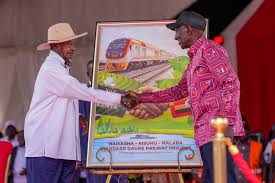
Both leaders expressed optimism that the railway will transform the region.
They highlighted its potential to reduce transport time, cut freight costs, and boost trade.
For many East Africans, the SGR represents more than infrastructure.
It is a symbol of cooperation, ambition, and a shared economic future.
And as the first bolts are tightened on the new railway line, hopes are rising that the long-awaited dream of seamless regional connectivity is finally moving from vision to reality.