















Shock and grief continue to ripple through communities in Gaba as the trial of a man accused of killing four young children formally opened under extraordinary circumstances that have captured national attention.
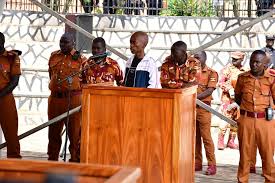
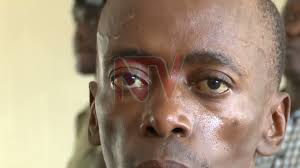
The accused, Christopher Okello Onyum, appeared under heavy security at a specially arranged court session held at the Gaba Community Centre, marking the beginning of what is expected to be a closely watched legal process.
The case stems from the brutal killing of four children from Gaba Early Childhood Day Care Centre, an incident that occurred on April 2, 2026, and sent shockwaves across Uganda.

The victims—Eteku Gideon, Keith Agenorwoth Otim, Sseruyange Ignatius, and Odeke Ryan—were described by residents as innocent lives whose loss has left families and the wider community devastated.
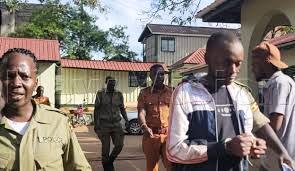
Okello was escorted to the venue by the Uganda Prisons Service with reinforcement from the Uganda Police Force and other security agencies, reflecting the sensitivity and gravity of the case.
He appeared before Lady Justice Komuhangi Khaukha in what has been described as a mobile court session, an arrangement that has since triggered widespread public and legal debate.
During the proceedings, Okello formally denied all charges, pleading not guilty to the four counts of murder brought against him.
The court confirmed that he is being represented by two lawyers, Kumbuga Richard and Stella Awello, who were assigned under state brief to ensure his constitutional right to legal representation is upheld.
Before the hearing commenced, three assessors—Musana John, Teopista Maria, and Ainomugisha Rachel—were sworn in to follow proceedings and later provide advisory opinions to the court.
These assessors, drawn from ordinary members of the public, are expected to contribute perspectives grounded in common understanding, although their views are not binding on the final judgment.
As prosecution began presenting its case, attention quickly shifted beyond the courtroom to broader questions about how justice is being administered in this high-profile matter.
The use of a mobile court and the speed at which the trial was organized have raised concerns among sections of the public and legal community.
Many residents in Gaba expressed mixed feelings, with some welcoming the swift response while others questioned whether due process was being fully observed.
Some community members argued that holding the trial near the scene of the crime could help restore confidence in justice, while others feared it might expose the process to emotional pressure.
Human rights defenders have been particularly vocal, cautioning against what they describe as a potentially rushed prosecution.
They argue that while the crime is deeply disturbing, the accused must still be afforded a fair, transparent, and unpressured trial in line with constitutional guarantees.
Several rights advocates noted that mobile courts, though not illegal, must be handled carefully to avoid the perception of “instant justice” driven by public outrage.
They warned that “justice must not only be done, but must be seen to be done without intimidation, haste, or influence from public anger.”
The Uganda Law Society has also weighed in, raising concerns about both the venue and the pace of the proceedings.
Legal experts within the society have emphasized that while the state has a duty to respond swiftly to serious crimes, this must not compromise procedural fairness.
They have cautioned that “hurried prosecutions risk undermining the integrity of the judicial process, even in cases where the evidence may appear strong.”
The society further stressed the importance of ensuring that the accused has adequate time and facilities to prepare a defense, especially in a case involving capital charges.
This unfolding situation has also drawn attention to the stance of Yoweri Kaguta Museveni, who has historically taken a firm position on violent crime, particularly cases involving children.
In previous incidents of a similar nature, Museveni has publicly condemned such acts as “barbaric” and called for swift but lawful accountability.
He has consistently emphasized the need for security agencies to act decisively while respecting the rule of law, often warning against both impunity and mob justice.
Museveni’s broader approach has been shaped by past cases that stirred public anger, where he urged institutions to deliver justice efficiently without bypassing legal safeguards.
In earlier statements following violent crimes, he has maintained that “criminals must face the full force of the law, but through a process that is disciplined and evidence-based.”
His administration has also supported reforms aimed at strengthening investigation capacity and speeding up case handling.
The current trial, therefore, sits at the intersection of public demand for justice, government commitment to law and order, and constitutional protections for the accused.
As witnesses begin to testify, the case is expected to test not only the evidence against Okello but also the resilience of Uganda’s justice system under intense public scrutiny.
For the grieving families, however, the legal debates offer little comfort as they await answers and accountability for the loss of their children.
For the nation, the proceedings may ultimately define how Uganda balances urgency with fairness in the face of tragedy.