











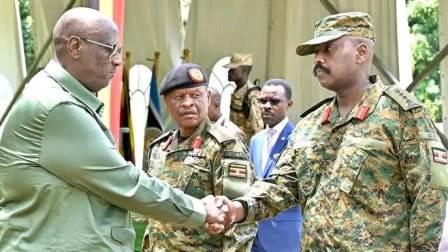
There is a strange symmetry to the fact that a piece of land once used as a military headquarters is now home to a school.
At Kirema Heritage Farm in Kapeeka, Nakaseke District, Gen. Caleb Akandwanaho, better known as Gen. Salim Saleh, has opened a new branch of the Gen. Caleb Akandwanaho School of Research, extending an institution that began as a policy think tank into a working farm where research is meant to be tested rather than merely written down.
The branch builds on groundwork President Yoweri Museveni laid earlier this year, and it pushes Uganda’s newest knowledge institution several steps closer to the soil it is meant to study.

From Teenage Fighter to National Development Architect
Understanding why a retired general now runs a research school starts with understanding who he is.
Gen. Caleb Akandwanaho was born on January 14, 1960, in Ntungamo District, the younger brother of President Museveni.
He joined Uganda’s liberation struggle at just 16 years old in 1976, adopting the nom de guerre Salim Saleh, a name that would follow him through frontline command in the 1981 to 1986 bush war and into decades of public service afterward.
His post-war career moved through Army Reserve Force Commander, Senior Presidential Advisor on Defence and Security, and Minister of State for Microfinance, before settling into the role he holds today as Chief Coordinator of Operation Wealth Creation.
That programme, launched in 2013 as the military-run successor to the National Agricultural Advisory Services, has become the institutional home for Saleh’s long-running push to move Ugandans out of subsistence farming and into what he often calls the money economy.
In April 2026, Museveni formally recognised that body of work, laying the foundation stone for the main Gen. Caleb Akandwanaho School of Research and its accompanying Walter Rodney Block at the National Leadership Institute in Kyankwanzi.
That flagship site was designed as a centre for policy research, ideological training, innovation, Pan-African studies, and leadership development.
The Kirema branch is where that vision is meant to leave the seminar room and meet the tractor.
A Farm That Already Looks Like a Laboratory
Kirema Heritage Farm did not need to be built from scratch to serve as a research site, because it had already spent years functioning like one.
Spread across thousands of acres in Kapeeka sub-county, the farm runs livestock production alongside certified coffee and cocoa nurseries, and it has drawn verification missions from the National Coffee Research Institute along with diplomatic visits centred on new technology.
Late last year, a joint United Kingdom, United Arab Emirates and India trade delegation, led by British High Commissioner Lisa Chesney, toured the neighbouring Kapeeka Industrial Park before meeting Saleh directly at the farm, a visit organised at Prime Minister Robinah Nabbanja’s invitation as a follow-up to investment talks held in London the previous year.
Ambassador Rosa Malango, Uganda’s Special Presidential Envoy for Tourism and Trade, said the visit was meant to show international investors the opportunities already available in the country.
The industrial park next door tells its own part of the story.
Kapeeka Industrial Park now employs more than 15,000 people across its various factories, built on ground Saleh has said carries deep historical weight.
“Where that industrial park is located was the headquarters of the Kabalega unit,” Saleh told New Vision in an interview late last year, adding that the site remains at roughly 40 percent of its eventual capacity.
He has framed the entire Kapeeka experiment in blunt economic terms.
“Ten years ago, we started with people who had never earned or handled cash,” Saleh said at an industrialisation forum, noting that the share of people in the area with no cash income has fallen from 68 percent to around 39 percent since the project began.
Machines, Mandates, and a Tractor Built for Uganda
The Kirema branch has wasted little time putting that research-to-action pipeline to use.
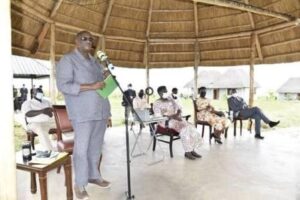
The site recently hosted the signing of a Memorandum of Recognition between Farasi Agricultural Company Limited, The Grain Council of Uganda, and Operation Wealth Creation, an agreement built around developing a tractor suited specifically to Ugandan farming conditions.
Officials say the deal is designed so that 85 percent of the tractor’s materials are sourced locally, and Saleh was careful to clarify that the arrangement was not meant to hand Farasi a monopoly, since OWC holds similar agreements with other tractor dealers.
Speaking at the same event, Saleh turned his attention to a very different piece of idle machinery sitting at Namanve Industrial Park.
“The President brought in a machine-making machine that can make any machine and spare parts at the request of the industrial sector many years ago, but it has been lying idle in Namanve Industrial Park,” Saleh said, challenging local and foreign investors to finally put the equipment to use.
His pitch was straightforward, that manufacturing machines and spare parts locally could create thousands of skilled jobs while cutting Uganda’s reliance on imports.
He has made a similar argument about land itself, warning that mismanagement and institutional hoarding of land have stalled industrial expansion in multiple regions.
“Agencies holding land in trust should release it for productive use,” he has said, arguing that “we need to replicate what happened in Kapeeka across Uganda.”
More Than Farming: Security, Ideology, and Pan-Africanism
The Kirema branch’s ambitions reach beyond agriculture and manufacturing.
Officials say the site will also support hands-on research into security studies, including contemporary concerns such as information warfare, alongside ideological orientation and Pan-African collaboration.
That combination mirrors the mandate of the flagship Kyankwanzi campus, effectively giving Nakaseke District its own working satellite of the same national project.
Land conflict resolution remains part of that mandate too, an area where Saleh’s hands-on approach through the Kapeeka Land Bank Committee has drawn praise from outside observers.
Prof. Ogenga Otunnu, an expert in post-conflict reconstruction, has credited Saleh’s mediation work in the district as setting a benchmark for resolving historical land grievances.
A Legacy Still Being Written
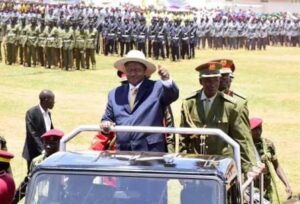
Nearly fifty years after a teenager from Ntungamo joined a guerrilla war in the bush, the same man is now overseeing a school built to document lessons for the next generation of Ugandan policymakers and farmers.
The Kirema branch does not close that story so much as give it a permanent address, one where investors, diplomats, and researchers can walk the same ground where machines are being reassembled and land disputes are being settled.
Whether the branch succeeds in turning decades of trial and error into replicable national policy, the way Saleh insists the “Kapeeka formula” can be, will likely take years to fully judge.
For now, Kirema Heritage Farm has added a new title to its gate, and a new chapter to a life that began in a liberation camp and has spent the decades since trying to build something more lasting than a war.