












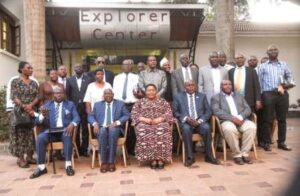
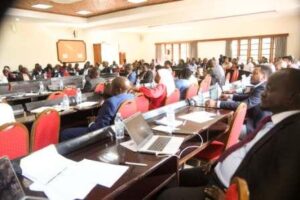
Jinja Nile Resort hosted an unusually weighty gathering yesterday.
Resident District and City Commissioners, their deputies, District Chairpersons, Mayors and Chief Administrative Officers filled the room.
Town Clerks, district technical officers and local government councillors sat alongside them.

They had come to prepare for the arrival of the Northern Uganda Social Action Fund Phase IV (NUSAF IV) in Busoga.
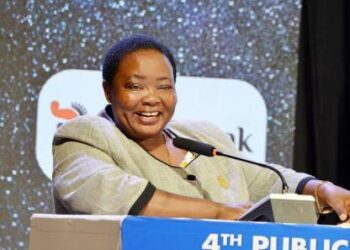
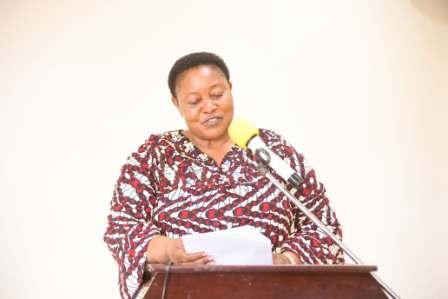
The Minister for the Presidency and Member of Parliament for Budiope West, Hon. Babirye Milly Babalanda, used the platform to deliver a stern message.
She warned political, administrative and technical leaders against corruption, political interference, favouritism and the mismanagement of public resources.
She thanked the Office of the Prime Minister and the World Bank for their partnership in advancing the programme.
She noted that similar engagements had already been held in the Acholi, Elgon, Lango, Karamoja and Bukedi sub-regions.
Her central argument was simple.
NUSAF IV, she said, should not be judged by the money released.
It should be judged by the number of households whose livelihoods are genuinely transformed.
“As a daughter of Busoga and Minister for the Presidency, I have a particular responsibility to ensure that this programme succeeds. I understand the aspirations of our people, the challenges facing our communities and the enormous potential that remains untapped,” she said.
A Rich Land with a Stubborn Poverty Problem
Busoga has fertile soils.
It has abundant water, a hardworking population and considerable agricultural potential.
Yet poverty, youth unemployment and food insecurity remain stubborn realities.
The Minister revealed that about 840,700 people in the sub-region account for roughly 12 per cent of Uganda’s poor population.
That figure, she said, underscores the need for interventions that turn government resources into tangible improvements in people’s lives.
NUSAF IV, she explained, offers one such opportunity.
It will provide enterprise grants for agriculture, fisheries and small businesses.
It will also fund labour-intensive public works that give people income while improving community infrastructure.
How a Northern Recovery Fund Reached the East
NUSAF is not a new idea.
It was created in 2002 by the Government of Uganda and the World Bank in response to the devastating effects of the Lord’s Resistance Army insurgency on Northern Uganda.
Over its earlier phases, it supported schools, health facilities and water sources, as well as agriculture and small-scale enterprises.
The programme reached more than 1.2 million households in total.
Busoga’s inclusion in the fourth phase was a deliberate policy choice.
Cabinet authorised the NUSAF IV project on 24 January 2022, covering West Nile, Acholi, Lango, Teso, Karamoja, Elgon, Bukedi, Busoga and Bunyoro.
Government planners argued that the expansion to Busoga was needed because poverty levels there remained persistently high.
The road from approval to rollout was long.
Implementation had been expected to start in 2023, but it was later scheduled for the 2025/2026 financial year.
The World Bank’s Executive Directors approved the US$250 million IDA credit on 1 April 2025.
On 29 October 2025, Parliament approved a wider borrowing package that included US$250 million for NUSAF IV.
Hon. Beatrice Akello Akori, the Minister of State for Northern Uganda, sent a separate message that Minister Babalanda delivered on her behalf.
It described Busoga’s arrival in the programme as a historic milestone.
According to the message, this is the first time the sub-region has benefited from NUSAF since its inception in 2003.
The Programme in Numbers
NUSAF IV is implemented through 104 beneficiary local governments.
The Office of the Prime Minister and other government institutions support the work.
The World Bank is financing it to the tune of US$276 million.
That figure includes a US$250 million credit.
The balance of US$26 million comes as grant funding.
The World Bank lists December 31, 2031 as the project’s closing date.
Its stated objective is to support sustainable livelihoods, strengthen household resilience to shocks and build adaptive social protection systems.
The programme focuses on three areas.
These are sustainable livelihoods, resilience and human capital development, and stronger social protection delivery systems.
Poor rural households will receive grants of up to about Shs1 million.
They will also get business skills training, mentorship and market linkages.
Young people and women in urban areas will benefit from entrepreneurship training and business grants.
Other interventions include climate-smart public works.
There is also nutrition support for mothers and young children.
Extremely poor households unable to take part in public works will receive direct assistance.
Busoga by the Numbers
Hon. Akello pointed to Busoga’s heavy development needs.
About 840,700 people live below the poverty line there.
That makes it the second-highest among the nine NUSAF IV beneficiary sub-regions.
With more than 4.3 million people across 15 local governments, Busoga is also the most populous sub-region in the programme.
About 6,200 mothers with young children in Buyende, Mayuge and Namutumba will receive nutrition support and counselling.
The aim is to tackle anaemia and stunting.
In Jinja City and the municipalities of Bugiri, Iganga and Kamuli, young people and women in the informal economy will get entrepreneurship training and business grants.
Eyes on the Ground: What the RDCs Must Do
Minister Babalanda supervises the Resident District Commissioners.
She gave them a clear brief.
They must visit project sites and beneficiary communities regularly.
They must ensure that beneficiaries are selected fairly and transparently.
They must follow up suspected cases of fraud and misuse of funds.
They must coordinate stakeholders and make sure complaints are documented and addressed.
She had no patience for ceremonial leadership.
RDCs, she said, should not become passive observers or occasional visitors.
A visible presence in the field is the only way to know whether government programmes are reaching the people they were meant for.
She also reminded them to respect institutional mandates.
Oversight, she said, should not turn into duplication or interference with the work of the Office of the Prime Minister, local governments and the programme’s implementation structures.
A Warning to Politicians: No Rewards, No Punishments
Elected leaders, including District Chairpersons and councillors, received a different message.
They should mobilise communities, explain the programme’s objectives and encourage public participation.
They must also shield the initiative from political manipulation.
NUSAF IV, she stressed, is a government programme for eligible Ugandans.
It must not become a reward for supporters or a punishment for opponents.
“No leader should demand that beneficiaries belong to a particular political group, pay a fee, offer a kickback or surrender part of their grant,” she cautioned.
The Technical Test: Procedure, Paperwork and Proof
Chief Administrative Officers, Town Clerks and district technical officers have the job of keeping implementation clean.
They must follow approved procedures, budgets, safeguards and reporting requirements.
That means proper verification of beneficiaries.
It means accurate records of grants and payments.
It means close supervision of expenditure and early identification of risks.
It also means supporting audits and independent verification.
Making Different Programmes Pull in the Same Direction
The Minister urged leaders to make sure NUSAF IV complements other poverty eradication efforts.
She named the Parish Development Model, Emyooga, the GROW project for women’s enterprises and the Uganda Women Entrepreneurship Programme.
Their approaches differ, she noted, but their goals reinforce one another.
All of them aim to raise household incomes, create jobs, strengthen production and reduce poverty.
She encouraged local governments to coordinate so that no household is financed twice for the same purpose.
She also wanted beneficiaries linked to extension services, savings groups and markets.
Elite Capture and the Fight for Fairness
Hon. Babalanda spoke bluntly about elite capture.
She described it as influential individuals manipulating programme processes to secure resources for themselves, their relatives, associates or political networks.
Vulnerable households, she said, pay the price.
She called for strict adherence to approved selection criteria.
She asked communities to verify beneficiary lists.
She also asked for the use of authorised payment channels only.
Public officials, she said, must declare and manage conflicts of interest.
No one should use public office to gain personal benefit from programme resources.
Giving Citizens a Voice
She also spoke about grievance redress.
Communities need safe and accessible ways to report concerns.
These include problems with beneficiary selection, delayed payments, suspected fraud, exclusion and official misconduct.
Complaints, she said, must be documented and acknowledged.
Where necessary they must be handled confidentially.
They must then be referred to the right authorities for resolution.
Hon. Akello’s message added more detail on the safeguards.
The Inspectorate of Government will monitor implementation through Community Monitoring Volunteers, community scorecards, interface meetings and investigations into complaints.
Beneficiaries will be able to report grievances by SMS, USSD, WhatsApp, toll-free telephone lines and a web portal.
Payments will go through verified bank accounts and mobile money platforms.
Her message also stressed that nobody should pay money to access NUSAF IV benefits.
She called on local leaders, RDCs, security officers and project desk officers to protect programme resources and ensure fair selection.
She pledged to monitor implementation personally.
She promised unannounced visits to project sites.
She also promised to hold officials accountable for results.
The National Social Registry and Your ID Card
Akello’s message also stressed the National Social Registry.
It is meant to provide reliable household data for choosing beneficiaries of government social protection programmes.
She urged communities to register for National Identity Cards.
She also asked them to give accurate information during household registration.
Fair and transparent targeting depends on it.
Four Questions to Measure Success
Hon. Babalanda wants monitoring that goes beyond financial reports.
She asked leaders to judge whether the programme is delivering its intended outcomes.
She set out four areas.
The first is inclusion, which asks whether vulnerable households are being identified and supported.
The second is integrity, which asks whether funds reach beneficiaries and are used as intended.
The third is delivery, which asks whether enterprises and public works meet the required standards.
The fourth is impact, which asks whether incomes, food security, employment and resilience are improving.
A Closing Appeal
In her concluding remarks, the Minister appealed to Busoga’s leaders for discipline and integrity.
She asked for real commitment to public service.
Community interests, she said, must come before personal and political ones.
She urged RDCs to stay vigilant, visible and impartial.
Political leaders, she said, should mobilise communities and protect fairness.
Technical and administrative leaders should uphold professional standards.
Citizens should take part actively, demand transparency and report wrongdoing through proper channels.
“Let us ensure that NUSAF IV becomes a programme remembered not for the money it spent, but for the families it lifted, the enterprises it strengthened, the jobs it created and the dignity it restored,” she said.
She reiterated the need for collective commitment to ending resource diversion, discrimination and corruption.
No eligible household, she said, should be left behind through negligence or abuse.
What Happens Next
The rollout in Busoga is expected to give the region a real chance to tackle household poverty.
It should widen economic opportunities.
It should also strengthen the resilience of vulnerable communities through coordinated government action.
Whether it succeeds will depend less on the US$276 million than on the integrity of the people who handle it.