
















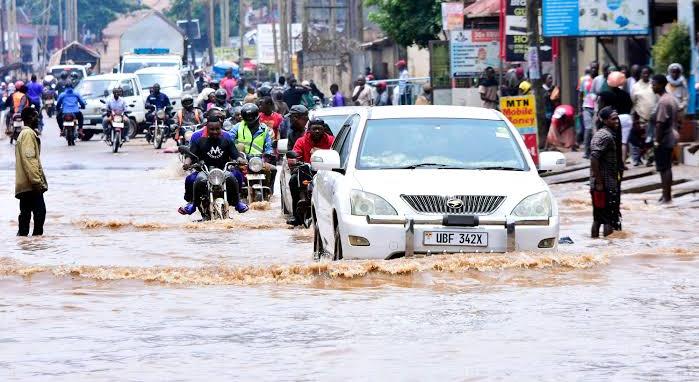
Every rainy season, Kampala tells the same story.
Water rises where it shouldn’t, shops close before midday, and somewhere in the city a family loses whatever it managed to save.
This time, Parliament wants answers, and it has given the Kampala Capital City Authority just seven days to provide them.

The Parliamentary Committee on Physical Infrastructure has demanded a full report from KCCA explaining how the Authority manages the city’s drainage system and why flooding keeps returning despite years of promised fixes.
Walking the Flood Line
The directive did not come from a desk in Kampala.
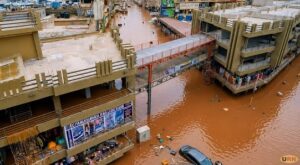
It came after committee members physically inspected three of the capital’s most notorious flood hotspots: Nalukolongo-Najjanankumbi, Lugogo, and Kyambogo.
Committee Chairperson Mwine Mpaka said the inquiry was driven by the growing human and economic toll of the flooding.
He cited United Nations Development Programme estimates showing that Uganda loses roughly 50 million US dollars, about 188 billion shillings, to flood damage every year.
“Our interest as a committee is to determine what practical interventions can be implemented to prevent these recurring disasters,” Mpaka said.
“With heavier rains expected in August, we started with three critical locations but intend to inspect all flood-prone areas across Kampala,” he added.
At Nalukolongo-Najjanankumbi specifically, Mpaka said the drainage channel is simply too small for the volume of storm water flowing from its catchment area, leaving surrounding communities exposed every time the rains intensify.
A City Built Where the Water Wants to Go
To understand why one undersized channel can paralyse an entire neighbourhood, it helps to understand what Kampala actually sits on.
The city was built across seven hills and the low-lying wetlands between them, land that historically absorbed and channelled storm water away from settlements before it ever reached Lake Victoria.
Key channels including the Nakivubo and Bwaise-Lubigi systems were designed to carry that runoff, but decades of unplanned construction have narrowed or blocked many of them, while the wetlands that once acted as natural stormwater sponges have steadily disappeared under buildings.
KCCA’s own engineering leadership has acknowledged the scale of the problem in blunt terms.
“As a city of seven hills, Kampala faces persistent flooding challenges that require sustainable, newly designed systems,” KCCA Director of Engineering Justus Akankwasa said during a recent infrastructure project visit, adding that the city needs support to re-engineer its systems to cope with worsening climate pressures.
Only about 30 percent of Kampala’s more than 2,100 kilometres of roads are paved, a gap that compounds flooding every time heavy rain meets unpaved surfaces and overwhelmed drains at once.
The Toll on Homes and Businesses
For residents in flood-prone areas, the disruption goes well beyond wet floors.
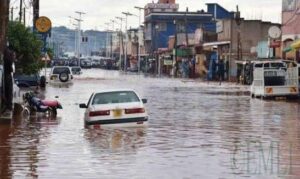
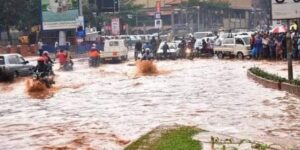
Repeated flooding has destroyed homes, roads, and other infrastructure in the very areas the committee inspected, displacing families and, in past flood events, claiming lives.
Businesses absorb their own share of the damage, with commercial activity in flood-hit zones repeatedly disrupted whenever water submerges roads and premises, cutting off customers and destroying stock in the process.
Hoima City Woman MP Asinasi Nyakato did not mince words about the cumulative cost, accusing KCCA’s leadership of failing to properly plan and regulate the city’s drainage infrastructure despite years of recurring floods that have claimed lives, displaced families, and disrupted businesses.
The financial burden has increasingly fallen on the public purse rather than on those responsible for blocking natural drainage.
Mpaka revealed that government has already spent close to 20 billion shillings compensating residents affected by flooding in the Nalukolongo-Najjanankumbi area alone, a figure that covers just one of the city’s many flood zones.
Where the Water Meets Politics
The committee’s inspections surfaced a more uncomfortable question than engineering capacity alone.
Mpaka said the committee had uncovered apparent inconsistencies in how developments were approved, raising concern that technical advice from KCCA’s own engineers may have been overridden.
Bukora County MP Emmanuel Ilokul went further, saying the committee had received evidence suggesting political influence may have overridden technical recommendations during the approval process.
He alleged that one private developer acquired roughly 46 acres and constructed buildings directly on a drainage channel, even as government continues spending public funds on compensation and flood control in the same areas.
A second case emerged at Lugogo, where a private investor identified as ICRD is alleged to have built on a designated drainage corridor.
Parliament has since asked the National Building Review Board to conduct an independent assessment, following an earlier report submitted by the Ministry of Works and Transport.
Mpaka argued that the financial logic of the current system is backwards.
He said developers whose projects obstruct natural drainage should bear part of the cost of maintaining the drainage system, rather than leaving taxpayers to shoulder the burden alone.
His warning to KCCA officials was direct.
“If KCCA tells us these plans were technically harmonised and approved, yet flooding continues and Parliament is repeatedly asked to appropriate money for compensation, then those responsible should either resign or face prosecution for failure to perform their duties,” Mpaka said.
Responding to the committee’s concerns, KCCA Deputy Executive Director Benon Kigenyi said the Authority has a comprehensive master plan guiding urban development, addressing climate change, and closing infrastructure gaps despite the pressures of rapid urbanisation.
Decades of Promised Fixes
Kigenyi’s reference to a master plan is not new, and its history explains some of Parliament’s frustration.
Kampala first adopted a formal Drainage Master Plan in 2003, developed through international consultancy studies aimed at prioritising the city’s most urgent drainage needs.
That plan was revisited in 2015 after the city inaugurated an updated Drainage Master Plan meant to more effectively manage recurrent urban flooding, yet independent research found that Kampala went on to experience some of its worst flood events between 2019 and 2020, just years after the update.
Academic researchers who studied the city’s flood governance concluded that drainage improvement initiatives had not significantly reduced flood risk, pointing instead to shifting institutional priorities, political interference, and poorly coordinated interventions among the agencies responsible.
Money has flowed into the problem before, largely from outside partners rather than KCCA’s own revenue.
The World Bank-funded Kampala Institutional and Infrastructure Development Project, known as KIIDP, ran through two phases, with its first phase supporting early drainage and road works and its second phase, budgeted at roughly 260 million US dollars, targeting the Lubigi, Nakamiro, and Nalukolongo channels specifically between 2014 and 2019.
More recently, the African Development Bank mobilised 275 million US dollars for a Kampala road rehabilitation project that includes five kilometres of new drainage structures, though implementation progress on that project stood at only about 28 percent as of last year, with completion pushed back to December 2027.
Each of these projects arrived with similar language about ending Kampala’s flooding for good, and each has been followed, within a few rainy seasons, by fresh headlines about the same neighbourhoods underwater again.
What Parliament Wants Now
The committee’s current inquiry is narrower than a full policy overhaul, but its implications are not.
Investigators want KCCA to explain specifically how the disputed developments at Nalukolongo-Najjanankumbi and Lugogo were approved, and whether professional recommendations from the Authority’s own engineers were ignored in the process.
Mpaka has made clear that the answer carries consequences, warning that officials found to have approved projects against technical advice could face disciplinary or criminal action.
The committee’s findings, once complete, are expected to determine whether Kampala’s worsening floods trace back to engineering failure, poor planning, weak enforcement, or straightforward unlawful construction inside the city’s drainage channels.
For residents of Nalukolongo, Lugogo, and Kyambogo, whose homes and shops keep absorbing the same damage year after year, the answer to that question will matter far more than which agency ultimately gets blamed for it.